 “Where are the papers?” I asked Sam Sifton on our first day in the new headquarters of The New York Times back in June 2007.
None of the customary bundles had been delivered. Sam, culture news editor at the time and therefore my boss, bellowed across the cavernous new newsroom: “Read it online like everybody else!”
It was the first sign of the brave new world that, within weeks, would radically reshape the newsroom culture and pecking order. So I read The Times online like everybody else – that day, and in the following months when I sat in my cubicle with bundles just a short walk away, then later at home. (I had given up home delivery several years before when I moved into a building with no doorman, where papers were left on the front stoop, to be stolen or turn soggy in wet weather.) And never more so than in the last year, large chunks of which I spent in locales stretching from Hunan province in China to the Turkish coast. The Times was not an option at local newsstands, never mind home delivery.
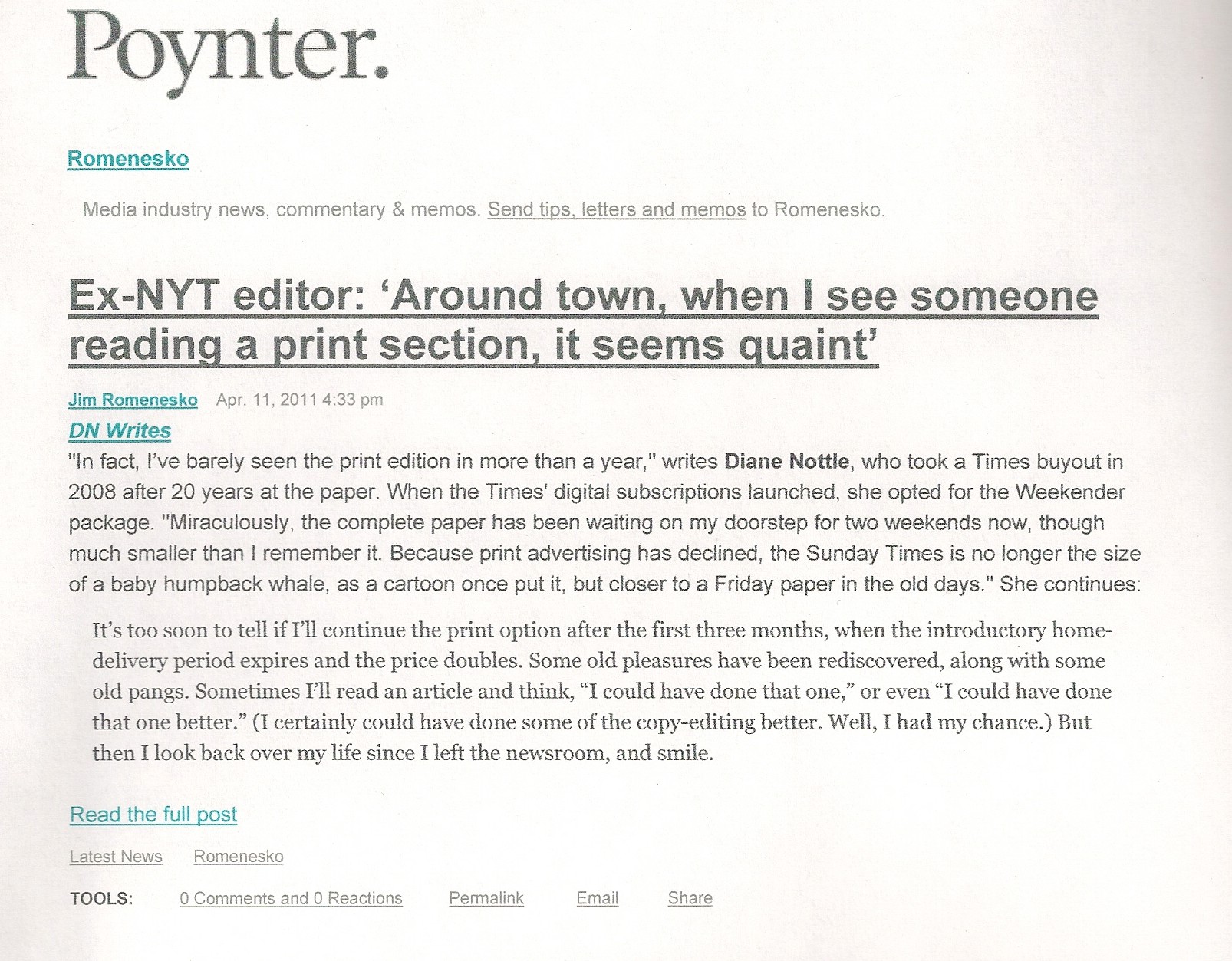
In fact, I’ve barely seen the print edition in more than a year. Even back in New York, I continued my foreign reading habits: logging on in the morning to read the paper online like everybody else. Around town, when I see someone reading a print section, it seems quaint.
Then, two weeks ago, The Times started charging for full access to its website.
After a Times fellowship at Duke University in 1995 introduced me to something called the World Wide Web, I returned to work — at a time when I was the only person in my department with a personal e-mail account — overflowing with visions of the future. “But how will newspapers make money on the Web?” I was asked repeatedly. “Same way they always have,” I answered. “Advertising and circulation.” Information may want to be free, and that was nice while it lasted. But professional journalism costs money, even if you’re not paying for paper, ink and delivery trucks.
Since I need full access to The Times for research, teaching and everyday life, there was no question I would sign on. A digital subscription costs $15 a month. But the Weekender home delivery package – which includes the features I’ve always called “the interesting sections,” long before I edited some of them — cost only 20 cents more for the first three months. So I decided to experiment with going back to print, figuring that any sections that actually made it into my apartment were gravy. Miraculously, the complete paper has been waiting on my doorstep for two weekends now, though much smaller than I remember it. Because print advertising has declined, the Sunday Times is no longer the size of a baby humpback whale, as a cartoon once put it, but closer to a Friday paper in the old days.
“I think you’ll rediscover old pleasures,” said one friend whose own pleasure in reading The Times may be tempered by her continuing employment there. I’ve certainly rediscovered old habits.
Newspapers, in whatever form, have traditionally served me as “second reading” – the second stage in my extended wake-up process. (“First reading” means a book in bed, after orange juice. “Second reading” is material that requires less focus, like a newspaper or magazine, and is done sitting up, with tea.) In the last year, “second reading” has meant booting up the laptop much sooner, going straight to a device that to my mind signals work, and reading The Times there, missing the relaxation factor.
With print, I still go to “the interesting sections” first. On Friday that means Weekend (which I could skip from 1999 to 2007, when I had edited much of the copy in it); on Saturday, Arts & Leisure. The news comes after that. On Sundays, since I’ve already digested A&L, I read the main news section first, then Week in Review. By that time, mental fatigue has generally set in, and it’s time to get up and move around. The rest of the Sunday sections are left on a pile for second readings throughout the week. Only then do I go to my laptop — and to nytimes.com for updates and breaking news, since what’s in print is already up to 12 hours old.
Reverting to print points up how differently I, and I suspect many others, read in the two media. Online, I start with the headlines “above the fold,” as we old-timers would say – the main news stories that are the equivalent of the front page — and click on a few that grab my attention. Then I go to the Arts section, but again, I tend to call up only one to three stories a day, not read the whole report with care, as I once did. Opinion is next, and then it’s back to the home page to catch up with the remaining sections. Since only three headlines are displayed on each (many repeated for stories with overlapping disciplines), and since I rarely go through a section page, I miss a good deal of what used be to called “the scanning effect” – happening on stories unexpectedly by scanning multi-story pages. I’ve also realized I’m somewhat out of touch with New York cultural life, in large part because I’ve been seeing mainly reviews after the fact, not the print ads well in advance of events.
Online, I find I read text with less concentration, distracted by ads, multimedia features, e-mail and whatnot, but that’s the nature of the Internet. On deadline, I used to talk about “editing with my fingers, not with my brain”; online, too often I read with my eyes, not with my mind. In print, I tend to follow stories pretty much to the end (although I don’t turn to jumps, but catch up with them later); online, I’m far less likely to “turn the page.” Even in print, concentration dims — for example, in the back of A&L, past the indispensible theater and film pages – and more often than I’d like, I simply turn the page. That section now takes me about an hour, compared to the three hours I’d happily spend with it each Saturday morning 20 years ago, getting a graduate education in the arts. For those who assume faster is better: that was a good thing.
The experience was more disorienting on the other side of the world. Reading The Times in different time zones makes it feel less like a newspaper, with well-defined daily editions, than a continuous 24-hour news report – which is, after all, the goal today. Last year in China, where I was conveniently 12 hours ahead of New York, I generally went online in the morning and just before bed, which were the times my friends were most likely to be online. They were also good times to read the paper, although deadlines for different sections divided one day’s editions into two. I could count on a fresh culture report in the morning, since that section closes at 5 p.m. in New York, but would have to wait until evening for the Opinion pages, which close hours later. Since the same headlines would often stay up on the home page for days, from the time they were “previews” until they were replaced by the following week’s sections, the report often seemed a bit stale.
It’s too soon to tell if I’ll continue the print option after the first three months, when the introductory home-delivery period expires and the price doubles. Some old pleasures have been rediscovered, along with some old pangs. Sometimes I’ll read an article and think, “I could have done that one,” or even “I could have done that one better.” (I certainly could have done some of the copy-editing better. Well, I had my chance.) But then I look back over my life since I left the newsroom, and smile.
A story was told about Beverly Sills – I believe it was at her New York City Opera memorial in 2007 – that in her later years her husband had given her a ring, engraved, “I already did that.” Same here.
UPDATE: This Sunday morning, the sixth day of home delivery, there was no paper on my doorstep. No great loss: I had already read the interesting sections in print and The Week in Review online late Saturday afternoon. I logged on to scan the headlines, read what I wanted of the Opinion pages and check the week’s Modern Love column.
 DIANE NOTTLE