Interlude

Opera House, exterior.

It was time to “throw myself out into the world,” as Middle Alison says in “Fun Home,” or at least into Guangzhou’s performing arts world. I had been here two months with only one theater night, a visiting Beijing opera troupe at the campus auditorium down the street. But last week, as so often in New York, everything seemed to be happening at the same time; here as there, the season has begun. The parallel feels slightly surreal (as does the fact that, as I write, I’m listening to the New York Gilbert & Sullivan Players, whom I’ve written about for City Center Playbill, promoting their new season on wqxr.org).

Last week, a cab driver serendipitously took me to the wrong art museum. (There are two with similar names, and despite my pointing to a map, he preferred the closer one.) It was serendipitous because the Guangdong Museum of Art had so much more to see than when I visited five years ago, but also because it’s next door to the Xinghai Concert Hall. I had been trying to find an online calendar in English for this sleek hall on the river ever since I spotted it on the night cruise. In the lobby I found not only the Guangzhou Symphony Orchestra’s season s schedule, but also flyers for the Guangzhou Jazz Festival, a night of movie music, a Menachem Pressler recital and two Vienna-style New Year’s concerts.

The first one that appealed to me was coming up that week, the symphony’s subscription concert of Mendelssohn and Rachmaninoff – each composer’s first piano concerto. Two on one program seemed odd, but they were performed by different pianists: Wang Yalun, a girl around Small Alison’s age, in a white dress with a sash tied in a big bow behind her that Alison would hate, and Sun Yingdi, a young man. He pounded the keys, at least in the first movement of the Rachmaninoff, but she had a delicate, trickling touch. Conducting was Long Yu, “China’s Herbert von Karajan . . . the most powerful figure in China’s classical music scene,” according to my old New York Times colleague Dave Barboza as quoted on the flyer.

The hall is configured much like the Berlin Phiharmonic’s home: the orchestra is in the middle, surrounded by listeners, and the cheap seats behind the musicians offer views of the conductor’s front instead of back, for a change. The acoustics are lovely, but Chinese audiences behave no better than New Yorkers. They check their smartphones throughout performances, talk with no regard for other listeners, and let their little emperors and empresses run wild. (During an encore, one father and son behind the orchestra tried to leave via the stage steps.) Two teenage girls in front of me kept talking during the concert, but at least they seemed to be discussing the pianists’ techniques. Ushers stand in the house and watch carefully, using red laser pointers to discourage bad behavior and, when necessary, entering the rows, which have enough legroom to let them.
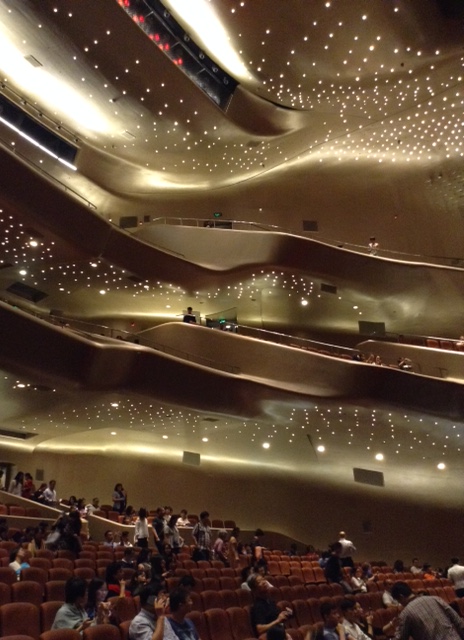
And interior.
And interior.

The next evening, I made my first trip to the architect Zaha Hadid’s spaceship of an Opera House to see “Glengarry Glen Ross” in the smaller, 300-some-seat theater. The conversation at the ticket counter was the usual: “But it’s in Chinese.” “Yes, I know. It’s an American play I know very well. I want to hear how it sounds in Chinese.” (I refrained from adding, “That’s my idea of fun.”) David Mamet’s 1984 play about real estate agents hustling a questionable new development seemed especially a propos in today’s Guangzhou, where massive new skyscrapers are going up on every vacant lot. When I taught in Hunan, billboards near campus advertised housing developments under construction with French and Venetian themes. Why not Glengarry Glen Ross?

“Let me know what the F word is in Chinese,” wrote Georgia, chief usher at Circle in the Square, when I mentioned I was going to “Glengarry.” I didn’t hear anything over and over again that sounded as if it could be Mamet’s signature word, though at once point I was hearing a lot of dui – “right?” or “yeah.” I had thought Mamet’s sharp, staccato language might transfer well to Chinese, which I often hear as loud, abrupt and harsh, but in fact it sounded softer in translation; the park workers I had heard talking that night while waiting for my dumplings at a food stand sounded more like Mamet. Shelly Levene was as desperate as ever, but the production didn’t really come to life until the scene where the real estate office is ransacked and the actors started walking on the oversized table representing their workspace. The musical choices made me laugh: an easy-listening version of “Try to Remember” (which I often sing to my permanent neighbor Jerry Ohrbach as I walk past his grave in Upper Manhattan on my way to the pool); “Love Theme From Romeo and Juliet,” the 1968 movie of my teenage years; and the Habanera from “Carmen.”

I was back the next night, this time in the Opera Hall for Mozart’s “Magic Flute” from the Komische Oper Berlin. I had wavered; the cheap seats were sold out, and the Komische Oper has an unfortunate tendency toward Regietheater, the European trend in which directors insist on putting their own often senseless stamps on productions. (The last opera I recall seeing at the company’s home just off Unter den Linden was a version of Rossini’s normally frothy “Italiana in Algerie” in which l’Italiana is shot dead at the end for shock value.) But I wanted to see something in the Opera Hall, and “The Magic Flute” was the most appealing thing scheduled for my time in Guangzhou. (Second choice: a second-tier Russian ballet company in “The Sleeping Beauty,” “Swan Lake” and “Coppelia,” none of which I need to see again anytime soon, perhaps in this lifetime.)

It turned out to be the right choice, especially for Halloween weekend. Papageno’s birds are white owls the look like Casper the Friendly Ghost; pumping human hearts explode with love; and there’s a delightful black cat that I mistakenly thought might transform into Papagena. This arachnophobe was not pleased to see the Queen of the Night depicted as a giant knife-throwing spider, but as always her aria was worth it.

The sets and props are almost entirely animations projected onto a white wall, with precarious little ledges high above the stage for singers, presumably in safety harnesses, to stand. Standing in one spot much of the time and interacting only with projections must feel something like singing a recital. (The company brought along the Arnold Schonberg Choir Wien but used a local orchestra, the Shenzhen Symphony.) The projections didn’t always hit their marks as precisely as, say, the Zapruder film of the JFK assassination hitting Neil Patrick Harris’s T-shirt in “Assassins,” but in general they worked. (One thing that doesn’t: the hall’s hard, bare wooden steps. With latecomers admitted anytime and audience members coming and going as they please, the clacking of their heels points up a serious design flaw.) So did the silent-movie conceit, with a Buster Keatonish Papageno in a yellow suit and flat-topped hat, and narrative titles in German, with supertitles in Chinese and English. Cartoonish? Yes, but fun.

Xinghai Concert Hall.

On Saturday night I returned to Xinghai for the week’s finale, a evening of film scores by Zhao Jiping. “That looks like ‘Raise the Red Lantern,’ ” I had thought when I had picked up the flyer, and I was right. Online research revealed it was a program by the Guangdong National Orchestra of scores by Zhao Jiping, including that film and “Farewell My Concubine.” Would it be more like the New York Philharmonic’s “2001: A Space Odyssey” and “Modern Times,” with the score played live, or Film Night at Tanglewood, with clips from movies scored largely by John Williams?

As it turned out, neither. No film was shown, so this was the kind of concert where, as an old boss of mine once said, “you just sit there with your feet hanging down.” That is, you actually had to listen to the music, and it was well worthwhile.

Taking the stage at Xinghai.

The orchestra of about 65 looked, and sounded, familiar yet different. To the conductor’s left, in place of the violins, were two dozen erhus (stringed instruments something like the Japanese shamisen); to his right, the violas were replaced by a dozen pipas (like big banjos), with cellos and basses in the usual spots. Another dozen flute and brass players sat upstage, in front of the much- and well-used percussion. Soloist Wang Shuang — dressed to the teeth first in a billowing red gown, then in a slinky gold-and-silver sequined dress – sang in that high nasal voice that Westerners may hear as a cat with its tail caught in a screen door. The audience adored her.

Without visuals or an English program, I couldn’t match the almost two hours of music to the movies I had seen, but never mind. Near the end, the composer was applauded in his fist-tier seat. The third and final encore was a clap-along march, apparently the Chinese equivalent of Strauss’s “Radetzky.”

After four nights out in a row, it is now time for an evening in front of the TV. I’m not sure when or how often I’ll be back in the concert halls; for one thing, it’s not easy getting a taxi home afterwards. But in December the Opera House has a “dance drama” called “Crested Ibises.” China’a “Firebird”? I may have to go find out.
Why I haven’t written

My life online has become a juggling act worthy of Cindy Marvell. As I write on my laptop, an iPod Touch and a Nook sit next to it, one trying to send out e-mail, the other to have handy just in case. At the moment each holds a tenuous connection to the outside world.

In 2012, I wrote about how dependent we’ve all become on electronic devices, and how many I packed for a semester in Vancouver: five. For this semester in China, I’m down to four, the three mentioned above plus a cellphone. (My iPad and Nook First Edition were stolen when my apartment was burglarized not long after Vancouver; they were jointly replaced by a second-generation Nook HD, already obsolete.)

In Vancouver all these devices worked, for a simple reason: the Internet did, on campus and at home. In China, nothing is simple.

When I taught in Hunan proivince in 2010, the wired connection at my apartment was laughable. The antique desktop computer sometime connected, sometimes didn’t. Five years further into the digital age, on a far more sophisticated campus in a major city, not much is different.

The day I moved into the Foreign Experts Residence, a staff member handed me a username and password, pointed out the Ethernet cord as a backup, watched me log on to the university wifi successfully and, satisfied, left. For two weeks, it worked. Oh, it was slow sometimes, what with 20,000 students, plus faculty and staff members, using it. But I could still teach Skype students in Poland for an hour at a time with only the occasional interruption in service.

At the same time, I was juggling devices to reach websites blocked by the government: Gmail, Google Chrome, The New York Times, Wikipedia, YouTube, Facebook, Twitter. What one device can’t reach, another sometimes can. Some sites, like my Chinese bank’s, are accessible only at the office, since I decline to download the “official” version of Chrome that would give me access at home — no more Chinese software on this laptop! But Gmail, The Times and other sites I’d like to plunder for teaching materials remain blocked without a VPN.

No problem, I thought: if I needed an article for class, I would print it at home and copy it at the office. Then, just as my bureaucratic troubles seemed to be over, my communication problems intensified.

One day the wifi not only stopped working but completely disappeared from my laptop. A message appeared onscreen: “This app can’t open. Your free trial period has ended. Go to the Windows store to purchase the full app.” Not long before leaving New York, I had taken advantage of the “free upgrade” to Windows 10. I thought of Windows 10 as Windows 10, a system I owned, not a collection of apps that could independently work or not at Microsoft’s whim. It’s not just the wifi; I can no longer search Windows for a filename or program; upload photos from my Nikon’s memory cards, which are filling up fast; or probably perform any number of other functions I haven’t thought about yet. The Windows 10 store is blocked – at least, in any language I can read. Windows customer service won’t even think about helping me unless I sign into my Microsoft account, which is “temporarily suspended” because I’m connecting from China, hacker heaven. It demands a verification code, which it sends to my phone number of record – in New York.

The wifi magically returned when I stayed in a hotel and worked, mostly, for my week in Sanya. Now, back in Guangzhou, it comes and goes. Every time someone else logs onto the system, I am pushed off. I was told I could get my own router, which it took a Chinese student in New York to provide. (Thank you, Yuxin.) It’s adorable – a petite aqua rectangle with two white rabbit ears sticking up and with four tiny blinking lights. Still, my connection apparently comes from that overtaxed university system.

The laptop rarely gets wifi, and the Ethernet backup works best between 6 and 9 a.m. (though today I couldn’t connect until 8:30). The rest of the time, I too often get the message Unable to get a connection: Still unable to dial tcp://doesnotexist.com:80 after 3 attempts. I have become a morning person to catch the connection before it dies for the day. The canary in my coal mine is WQXR.org, the New York classical music station. If the music streams at all on a given day, I know my time is up when it stops sometime around 9.

And those other devices? My smartphone works via the Internet, so that’s out; I’m back to my international dumbphone, its SIM card replaced by a local one for the duration. The iPod and the Nook connect, sometimes, to the wifi, when it’s working. The Nook’s browser is Chrome, which is sort of blocked, sort of not; it connects to banks, eBay and sometimes Playbill.com, but I have to log on again for almost every single page. To download e-mail, I need to log on to a web page, then read a book while I wait for syncing, and eventually another message flashes: 7 new messages, now 17, now 25 or more, mostly junk On the Nook I can read the daily “Today’s Headlines” e-mail from The Times, but clicking on the links is fruitless. To read a story, I have to go to the laptop.

The iPod barely connects at all. I carry it in my purse, mainly as an auxiliary camera, and sometimes try checking my e-mail around campus. A photo of a Beijing opera curtain call last Thursday night was still trapped inside until this morning instead of whooshing to the student who took me to the show. (Xie xie, Qing.)

So I juggle compulsively, wasting hours puzzling out how I could connect if only I could figure out the right thing to click on. Troubleshooting has become as addictive as the devices themselves.

In a couple of weeks, I’m going to Hong Kong – a special administrative region where blocking doesn’t apply and things still work – partly to tackle some of these issues, partly to honor a longstanding commitment as a guest speaker at New York University via Skype. I have yet to figure out how to Skype guest speakers in New York and Beijing into my own classrooms, since the computers there have no webcams or mics, and my laptop with both may or may not connect to the wifi. This week I wanted to show my class a Facebook post, which I couldn’t print at home and couldn’t call up at school. “Does anyone know how to get Facebook on this computer?” I asked the students – who can get anything. The answer was a resounding, unanimous “No!”

Recent news reports indicate China may unblock Google, but one step at a time, and not initially the ones that would solve my problems, like Gmail and Chrome. Mr. Xi, tear down this firewall.

For now, blog posts happen when they happen, like everything else. Skype lessons? What’s Polish for fuhgeddaboudit? If I seem slow in answering e-mail, I’m not ignoring you. If you get a message apologizing for not having answered when I already have, it means the first message was still sitting in whatever device when the second fought its way out. Please be patient, as I’ve had to learn to be. Maybe that’s the zen of the China Adventure of 2015. Or maybe it’s as Leslie Kandell (mother of Ms. Marvell, the eminent juggler) said this summer when she went offline to finish writing a Tanglewood review: “I want to be alone for while.” More and more, that’s OK, too.

Starting from scratch

newsmeeting

The sophomores were having trouble with the Monday morning news quiz. In the first three weeks, only two students had passed even once, and a passing grade here is only 60. It’s not as if the questions were obscure or they didn’t understand English. The stories had been all over the media: “Why did a 3-year-old Syrian boy make the news this week?” “How are Central European countries reacting to the refugee crisis?” “What big mistake did the Egyptian military make last week?”

It’s bad enough that they were flunking the quizzes, but they also weren’t learning anything. “Why are you majoring in international journalism if you don’t pay attention to the news?” I asked. Two dozen blank faces stared back. So I took another tack: “Next week, I’m making you responsible for the quiz. We’ll have a news meeting.”

The class would become a news organization, most likely a website, based in Guangzhou but aimed at an international audience. I would be the chief editor; the students would form teams representing six news departments. They would propose stories for home-page consideration; I would choose seven or eight and explain why.

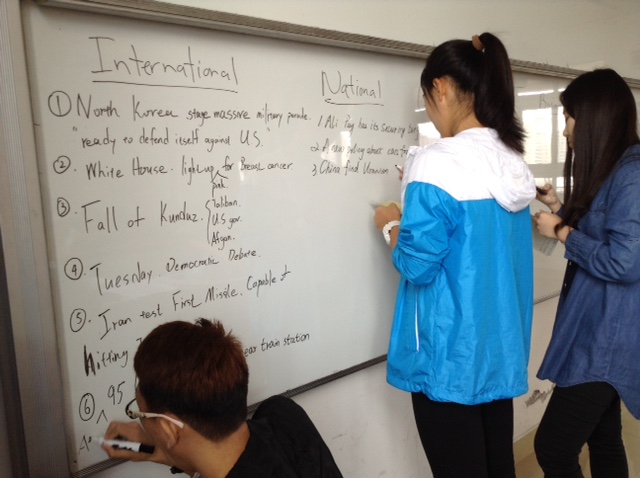
A week later, it wasn’t exactly the Page 1 meeting at The New York Times (from which this exercise is admittedly cribbed), but it was a start. Having budgeted half the class, 45 minutes, I pushed the meeting along much as a pressed-for-time masthead editor at The Times would have, by barking out questions: “What do you have on the two shootings after the Oregon shootings?” (More blank faces.) “What’s your next story?” “What else have you got?” The students wrote too much information on the whiteboard, talked to the board instead of the class, and humbly recited their stories instead of selling them. Well, they’re sophomores; they haven’t sat through those Page 1 meetings yet. But at least they were paying attention. At the end, I asked if they wanted to continue with news meetings or go back to the traditional quizzes. Silly question.

Here at Jinan University, I am literally starting from scratch. After three years of coaching graduate students at CUNY, many of whom arrived with significant professional experience, I’m back to undergraduates, teaching their first professional courses in the new international journalism program. One of the most important lessons I can teach them is that a journalist must be adaptable. I had to adapt a teaching method that wasn’t working. They have to adapt themselves to so much more: a new classroom style, professional expectations, a new way of looking at the world.

“How many lectures a week do you have?” other foreign experts here have asked. “Four,” I answer, but it’s hard to think of them as lectures. I teach three courses, each two hours a week, to roughly the same group of sophomores. (I also have one bubbly class of freshmen for oral English.) The courses make a nice balance in subject matter and work, for all of us.

“English News Gathering and Writing I” is what the title says: an introduction to who-what-when-where-why, inverted pyramid and basic reporting techniques, like asking questions and getting the facts straight. When I took the equivalent, called Journ 213 at Penn State circa 1973, we met in a lab room with typewriters nailed to the desks and had assignments like covering town council meetings. Here we meet in a lecture classroom, and I doubt if any Chinese government body would welcome 25 note-taking undergraduates to whatever public meetings it holds. Still, through classroom exercises and homework, they’re learning — some the hard way — about organizing information, meeting deadlines and not plagiarizing. (First lesson: a PBS documentary on Jayson Blair.) Like the news meetings, it’s a start. The final project will be a fully reported story, 1,000-word minimum, considered a long story in Craft I at CUNY.

“Survey of English-Speaking Countries” is my most lecture-like course, and much the same as I’ve taught in Hunan and Poland: social studies on the United States, the United Kingdom, Canada and Australia. Through lectures, readings and videos, I hope to give a taste of what it’s like to live in these countries and look at them from a journalist’s point of view. Grading is based on three written exams, two take-homes and a closed-book final.

Having spent little time editing foreign news since The Boston Globe in 1980,
I felt relatively unqualified to teach “International News Comparison and Analysis,” but I’m making it up as I go along. It now consists of half news meeting/quiz, half close reading and discussion of current news texts; with luck and a little tech support (ha!), I hope to Skype in two guest speakers with foreign reporting backgrounds. Class participation, i.e., the news meetings, makes up a big chunk of the grade; the final project will be an essay, five pages minimum, analyzing media coverage of an international issue during the semester.

While teaching journalism, I’m also teaching a little ESL and basic Western presentation skills, like projecting the voice and speaking confidently, rather than mumbling into a notebook, and not standing in front of the material on the board or slides. For that reason, the students spend a lot of time on their feet in front of the class. It’s a new experience, I think, for most of them.

On Pearl TV from Hong Kong the other night, I caught the finale of “The School That Turned Chinese,” a BBC series about a British secondary school that imported Chinese teachers for four weeks to test whether their far more demanding methods produced better results. In this case, they did, in the form of test scores – which, as American educators should know by now, are no definitive measure of learning. One of my “takeaways” — that’s teacher talk for the basic message students take away from a given lesson – was that Chinese education stresses conformity, becoming a good citizen to serve the country. That may help explain my students’ hesitation to speak up and stand out. But it’s the opposite of what it takes to be an international journalist.

That said, some are already showing promise. I pride myself on being able to spot early on who’s going to make it in journalism and who’s not. (I spotted AP’s Jerry Schwartz, recently celebrated on jimromenesko.com, the first night he dropped off his copy – on paper — at The Daily Collegian.) Among my sophomores, I can see at least two students with serious CUNY potential, in four or five years. They’re smart; they ask good questions; they speak and write English well; some are already engaged in entrepreneurialism.

And they’re digital natives. They may not carry laptops everywhere, but they use their phones as extensions of their brains: as dictionaries, research tools, references when they present to the class. Sometimes they take notes by photographing the whiteboard. They know every news app in existence, even The Times’s new bilingual digest on WeChat, which their government has theoretically blocked. They’ve already been there, read that.

Of course, their chief editor is still Old Lady Print Journalist. At the news meetings, I select seven or eight stories for a front page or home page, as if the news hole were still finite and mattered. Chinese students generally save their real, burning questions for after class, and on Saturday the ever-perceptive Bonnie came up to ask, “How important is that, when we have all these apps that know what we want to read, and our phones know us better than we know ourselves?” Good point, I said, and please raise that question on Monday. She had just given me another lesson plan. Thanks, Bonnie.

Saturday was a makeup for a class missed during the Golden Week holiday, to be followed by the regularly scheduled class – and news meeting — just two days later. “We have to do it again?” the sophomores groaned. Gently, I explained that when they’re out of school and working in the media, they’ll have to perform at news meetings (and produce a publication) every day. That’s another of the lessons I hope they’re learning.

Fourth of July in October

The new China celebrating.

Sometimes I’m not sure this is what Chairman Mao had in mind.

It’s Golden Week in China. Translation: a one-week national holiday celebrating the founding of the People’s Republic on Oct. 1, 1949.  In other words, last Thursday was China’s Fourth of July, and felt like it, at least in Guangzhou. The rainy season there is over, and the heat and humidity have tapered off to roughly New York City summer at its hottest.

On Tuesday night, returning from a swank pre-holiday reception at the White Swan Hotel (rendered white indeed, empty-feeling and cold after a recent renovation, though the atrium waterfall remains), I found my passport with residence permit waiting. By then, Thursday travel – my original plan — was prohibitively expensive. But I could get a cheap flight Friday evening to Sanya on Hainan Island and rebooked the hotel I had previously canceled, thus salvaging Golden Week.

The delayed departure left me in the city for National Day. I spent it much as I spend the Fourth in the States: at the pool, followed by lunch at the Happy Monk, an open-air Anglo-Irish pub (Magner’s hard cider on the menu!) at the Happy Valley Mall across from campus. I felt as if I should be eating hot dogs (ubiquitous here as “beef sausages” on breakfast buffets and in bakeries as glorified pig-in-a-blanket), and the Happy Monk does have them on the menu, loaded with cheese, pickles, sauerkraut, you name it. But even as a child at my cousins’ holiday “doggie roasts,” I was always a burger girl, so ordered the Happy Monk Burger – a real burger, meaty and juicy, covered with a slice of lean bacon and real sharp cheddar.

In New York I’ve skipped the Macy’s fireworks the last couple of years in favor of cheap tickets for Lincoln Center Theater. I kicked myself for not having wondered sooner if Guangzhou might have some – in America every city and town seems to have its own fireworks on the Fourth — but language and Internet barriers made it impossible to find out. Then, from Pearl TV in Hong Kong, I learned that the national fireworks take place over the harbor there, this year for the first time since a ferry hit a fireworks-viewing boat in 2012, killing 39. Had I known sooner (and had a residence permit), I might have gone to Hong Kong to watch and, not incidentally, straighten out my computer problems. Instead, I watched on TV like most of China.

Having learned of the fireworks on Pearl TV’s English channels, which had pre-show coverage on its 7:30 nightly news, I naturally assumed they would cover the fireworks live. But no. I started channel-surfing. CCTV 1 had a concert, perhaps from the National Performing Arts Center in Beijing, with singers who seemed to be celebrities giving emotional renditions of what I assume were patriotic songs to a cheering audience. Continuing to surf, I found the fireworks 24 channels later on Pearl’s Chinese channel. They were spectacular, as might be expected from the country that invented them. Especially intriguing were the opaque red clouds, solid as the color on the Chinese flag, that formed from time to time. I don’t know if they were designed or a result of the overcast sky, but they were stunning.

Twenty-four hours later, I was flying to Sanya — coincidentally, the setting of the Mao-era ballet “The Red Detachment of Women,” performed at Lincoln Center this summer by the National Ballet of China. I had long been curious about what a Chinese beach town might be like; I missed seeing one on my last trip five years ago. Would it be honky-tonkish like Revere Beach or the Jersey Shore? Would it be glitzy and loud, the way modern Chinese seem to like their architecture?  One thing it would certainly be, I had been warned, was very crowded as every family in China took advantage of Golden Week to go on vacation. In other words, just like Fourth of July.

Sanya Bay turns out to be elegantly restrained, and not at all crowded — a little like a newer Miami Beach, with the occasional convertible zipping along the Ocean Drive equivalent. Most hotels are as massive as the buildings in Guangzhou, with a few small ones like the one I chose, blindly but wisely, on Booking.com. Hotel shops (there are no others along the beachfront, just a few vans) sell the usual beach paraphernalia: rubber-ducky floats, emergency swimsuits and pareus, drinks and snacks (seafood jerky, anyone?), sunhats but no sunscreen under $25. Lavish buffets – a godsend for the only person in town who can’t read a Chinese menu – serve up breakfast, lunch and dinner. At the entrances, signs plead with diners to take only as much as they will eat; in a country that once suffered widespread famine, disposing of food waste has become in a major problem. (Four of my sophomores are currently finalists in the Enactus World Cup, a major international competition for student entrepreneurialism, tackling food waste as their project.)

The Mao suits I photographed 30 years ago are long gone; now the Chinese, or at least the women, love  to dress up. In Guangzhou I had been admiring the pretty summer dresses on women around town and working at the university (undergraduates dress like undergraduates), but I didn’t expect to that style to carry over to the beach. Here young women wear lacy cover-ups and high wedge sandals. One at my hotel pool seemed to be in a bridesmaid-style dress, turquoise and sleek, but minutes later she was next to me in the pool wearing only the top—her swimsuit – with the skirt tossed onto a chaise. Others sport bright red lipstick on the beach, matching their pedicures. Little girls wear what can only be described as tutus. Of course they all carry umbrellas; God forbid they should get a tan. (The women who peddle fruit and long strands of “pearls” on the beach are covered head to toe, some in native costume.)

Five years ago, I got the impression that the Chinese don’t learn to swim – “my mother says it’s dangerous,” a student from the Guangdong coast told me – but they do. They were in my hotel pool when I arrived at 10:30 p.m. and at breakfast time the next morning. At the beach they seem a little timid, and at the hotel where I had dinner last night, a signed warned against swimming off the beach, since conditions were “unstable.” On the day I arrived there were the gentlest of waves, yesterday a bit of surf that reminded me of the calmest day at Watch Hill on Fire Island. I took several dips, but pretty much alone.

Today it’s pouring rain; my skin can use a break after two days of hazy sun. Over the music playing from my laptop – Debussy’s “Mer,” John Luther Adams’s “Become Ocean” – I can hear the waves, one of my favorite sounds. The surf is stronger than yesterday. I’d still go in, but it would upset the Chinese, who already think l’m crazy for sitting in the sun. I can see them on the beach, huddled under the thatched umbrellas and the ones they carried there – umbrellas under umbrellas.

So hutongs have given way to holiday hotels, famine to food waste, uniformity to fashion. “The Depression is over,” I used to tell my mother, who was scarred by it for life, and so is the Long March. The workers’ paradise has become a beach resort, and the workers are solidly middle-class or better. It may not be what Chairman Mao envisioned, but maybe it’s what he had in mind after all: people enjoying their lives, like the happy family of four cavorting in the pool beneath my window in the rain. I may have to join them.