Christmas with Joey

Outside Shanghyai Culture Square.
Outside Shanghai Culture Square.

I thought Joey and I were finished. Almost three years had passed without a word. Oh, sure, I had mementos – his movie on a homemade DVD; the National Theatre’s 50th-anniversary special, two hours preserved on my DVR in case I ever need to see the transformation scene, which can’t take more than two minutes. But except for the memories, that was all.

Then, in late August, while waiting in the lobby of the Foreign Experts Residence, I picked up an issue of China Daily, well over a month old. And there he was, in the lead feature on the Life pages announcing news I never saw coming: Joey was in China.

What are the chances of that paper’s being on top of the pile in that lobby on that particular day? Of all the gin joints in all the towns in all the world, he walked into mine.

War Horse, the Tony Award-winning play adapted from Michael Morpurgo’s young-adult novel about a boy and his horse cruelly separated by World War I, was coming to Beijing, and from there traveling to Shanghai and Guangzhou. Joey, a life-size horse puppet, is the star. In 2011 I was so entranced by the Broadway production that within the week I had signed on as a substitute usher at the Vivian Beaumont Theater, where I worked much of show’s two-year run. After it closed, I saw the NT Live broadcast of the original London production — not just to see Joey again, but also to hear the French and German characters in the second act speaking those languages, in contrast with the all-English New York production. Now I’d have the chance to hear the whole play in Chinese.

Joey doesn’t arrive in Guangzhou until March, by which time I will be long gone, though his portrait already graces the box office lobby of the Opera House. I didn’t make it to Beijing, but by Christmastime the show would be in Shanghai. Shanghai is the New York of China, and though I’d still be missing the best party of the year on Christmas Eve, seeing a Broadway show would feel a little like being home. So, like young Albert, who runs away from the farm in Devon on Christmas Day to look for Joey on the battlefields of France, I set off for Shanghai.

In the weeks before, I could feel him drawing closer. In the exam on the United Kingdom in my English-Speaking Cultures course, one student surprised me by answering a bonus question – “Who is your favorite figure in British culture, and why?” – by choosing Morpurgo, though for a different book. And I had bought my ticket online through an agency whose e-mail address is, aptly, ponypiao, and whose office turned out to be right behind my hotel. When I went to pick up the ticket, I expected to hear the usual: “But . . . this play is in Chinese.” Who in the audience would understand it better than I? For once, no one asked.

The venue was Shanghai Culture Square, which since the 1920s has been a racetrack, a casino, a political re-education center, a temporary stock exchange and a flower market. In 2011, the year I met Joey, it reopened as a glass-walled performing arts center with an oval flying saucer of as roof and a 2,000-seat Broadway-style house – twice the size of the Beaumont – underground. (The balcony is at street level, much like the Stephen Sondheim Theater on 43rd Street.) Broadway-style entertainment is a booming business in China these days, though the house for War Horse was only about 500 on Christmas night — early curtain, 7:15, and no, I didn’t ask if the ushers were being paid holiday premium.

The theater has a slightly curved proscenium stage, less rounded than the Beaumont’s. The stage floor replicated the design with a circle (but no turntable; it’s a touring show) with extensions to the wings. Here the show does not use the aisles, robbing it of some drama, not to mention the puppeteers’ break outside the door.

Seeing War Horse in Chinese was a little like visiting an alternative universe, and sitting in the 10th row orchestra dead center instead of a little round jump seat or outside in the smoke rings was the least of it. Press reports had suggested there would be revisions for the Chinese production – changing the setting to the Rape of Nanking, perhaps? – but no, it was still World War I in Europe, with Chinese characters replacing “Devon” and dates in the strip of cloud/sketchbook hanging over the stage. Joey was still Joey, not Zhou Wei, and Albert was still Albert, though his name came out sounding more like Al-Bairt. I heard Chinese R’s in Rose and the translated lyrics to “Rolling,” with which I sang along sotto voce. (Why not? Everyone around me was talking, and texting, and waving lighted phones in my face.)

I caught the occasional word – dui (yes) and the ubiquitous mei you (literally “have not,” meaning “I don’t have it/any” or “there isn’t any”). But, much as when I saw Hamlet in Prague and recognized all the major speeches but one, I would have known these lines anywhere. As the play progressed, they jumped out at me in between thoughts and memories.

“30 guineas! The pair of youse should be locked up!”

“Well, I didn’t do it!”

Ted Narracott receives entrance applause (mild, like all applause here), so he must be somebody, but there was no playbill in any language. The training of young Joey resonated with me in ways it didn’t when I was living with a serene 15-year-old cat rather than the skittish 2-year-old I’ve domesticated since. The transformation scene seemed odd: instead of a foal galloping offstage to be replaced by a stallion, adult Joey appears to be giving birth to his younger self upstage center. Oddest of all was hearing the Germans speak Chinese.

“You sold him? You sold Joey to the Army? Joey’s MY horse!”

The scene in which Joey meets Topthorn for the first time has the same choreography as the New York production, but not its clean precision. I have my doubts that it’s rehearsed before every show, as I watched hundreds of times while stuffing Playbills. Even so, I was reminded of the puppeteers’ skill in movements large (horses rearing) and small (the flicking of one ear.)

“On and on about your bleedin’ horse. Your cousin Billy could be dead. Half the men in the village could be dead.” But this Rose is sweet, without the forceful practicality Alyssa Bresnahan brought to the role of Albert’s mother.

Captain Stewart’s death scene played the same, though I missed the turntable. But the first-act curtain, “jump the wire”? No barbed wire! Some did appear in the second act, when Joey becomes trapped in it. But the British and German soldiers who find common cause in rescuing him untangled it much too quickly, spending more time on the coin toss to see which side would win this spoil of war.

As always, the arrival of the red-caped nurse in the second-last scene signaled that it was almost time to go home. After so many performances, I could relax, knowing Joey would not be shot. “It’s ’is ’orse! It’s ‘is effin’ ‘orse!” sounds very different in Chinese.

And then the ending:

“Ted?”

“What is it?”

“It’s a man. And a horse.”

At the Beaumont, I would listen each night from the space between the house doors and the curtains, wondering which inflection Bresnhan would give the play’s last line: “It can’t BE!” or “It CAN’T be!”? I missed hearing the Chinese Rose as the final chorus of “Only Remembered” swelled behind her, but there was no missing the message. Once again Albert had gone to war a boy and come home a man, and once again both he and Joey had been mended.

Joey (right) and Topthorn take their bows.

Curtain calls followed exactly the same sequence as in New York, right down to that silly goose. Topthorn’s puppeteers took their bow, then Joey’s, before running offstage to pick up their puppets so the stars of the show could salute each other and the barely responsive audience. The cast’s upstage arc looked ragged, as if in need of a captain. But as the house lights came up, there was an unexpected second finale, presumably from the London recording: “Only Remembered,” played in English. This time I sang along in full voice.

Merry Christmas, Joey. Good seeing you again.
Endless summer

fall in GZ

Fall, Guangzhou-style

That August chill is in the air. Of course, it is December.

After last year’s cold and snow in the Northeast, this was meant to be my year without a winter, much as 1985 was my year without a spring. That year I went from China in March (winter) to Australia in April (late summer) to New Zealand in May (fall) to Tahiti (self-explanatory) and home to Boston just in time for summer there to begin. Thirty years later, I went from summer in New York to an extended summer in Guangzhou, and I must say, I could get used to it.

“What will the weather be like?” I was asked before leaving home. “Steamy is my guess,” I said, thinking back to 1985, when late March in subtropical Guangzhou, the last stop on my two-week China 101 tour, already felt like summer. And for the first month, steamy it was. All the time.

The day I arrived was gray. A few raindrops didn’t stop Angela, my administrator, from showing me some basic campus services like the supermarket before leaving me to settle in at my apartment. Nor did gray skies the next day stop Ellen, the journalism professor who had recruited me, from showing me around a little more. When we parted, I mentioned that I needed to go shopping for a few things for the apartment. “There’s a mall across the street from campus,” she said, giving what she thought were explicit directions. I set off in the lightest of summer clothes, carrying my little bright orange travel umbrella from Expo 2010 in Shanghai, but without a raincoat – unbearable in the heat.

I didn’t find the mall that day. I did find McDonald’s, by which time it had started to rain, so I took shelter and had lunch. The rain turned into a monsoon, or so it seemed to someone who had not grown up in South Asia. When it was time to go, the little Expo umbrella did not turn inside out, as so many seem to in New York, but it was thoroughly inadequate; I should have packed the bigger, sturdier Portland model. I fought my way home, normally a 10-minute walk, and arrived with clothes, sandals and skin thoroughly soaked.

The monsoon continued. The next morning I met my class for the time. I had hoped to dress like a grownup and make a good, professional impression, but the best I could do was my CUNY Journalism T-shirt, old black usher pants, the blue-and-green leopard-spotted rubbers that were never intended to go home again and the raincoat that was still stifling. My Expo umbrella joined two dozen others left outside the classroom to avoid trailing water inside. The class looked at me skeptically.

“It’s the rainy season,” people explained; when I asked, “When does it end?” they shrugged. Around early September, said the Internet, which does not shrug, and it was right. After that the weather was just steamy – all the time. For the first month, I traipsed from class to one bureaucratic appointment after another in temperatures around 100 degrees, doing next to nothing in between but going home to collapse in front of the air conditioner and think about when I could go swimming. When rain did come, it brought no relief from the humidity – just more steam.

The relief came during Golden Week on Sanya Bay in early October. When it was hot there, I could choose between the pool just below my balcony and the beach across the road. Midway through came a half-day or so of monsoon, but it did bring relief, and who doesn’t need a rainy day on a beach vacation to rest the skin and read a book?

My first few days back in Guangzhou were, oddly, chilly; oh, no, could this be fall? No, more like a cool stretch in July in the Berkshires, when you put on a cotton sweater and leggings. When those few days ended, glorious summer returned for two full months. Guangzhou seems mercifully free of the pollution that has brought northern cities like Beijing to a standstill in recent weeks; we’ve had days and days of not just blue sky, but air that felt like silk. I spent my October lunch breaks reading by the water-lily pond, just to feel the sun and that air on my skin. I continued swimming outdoors, but around late October I noticed that my first-choice pool at the Vanburgh Hotel down the street, shaded for all but an hour or so a day, was a less and less inviting place to submerge my body. I switched my allegiance to the Ramada Pearl pool, which gets full sun, paying my last visit there just a few days before Thanksgiving.

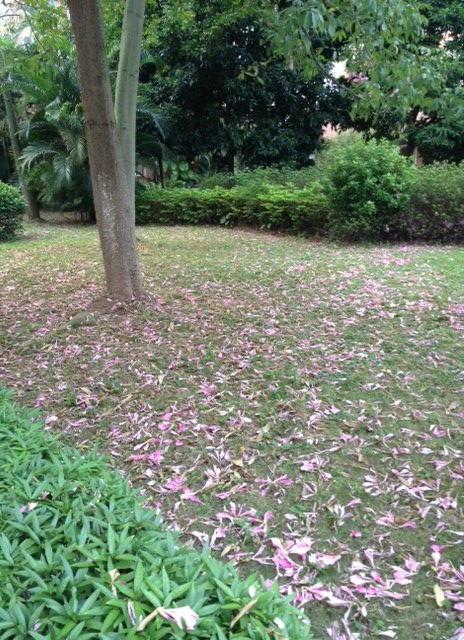
Meanwhile, I’ve enjoyed the fall foliage. Here that means trees covered with pink-purple blossoms that fall to the ground like autumn leaves, to be replaced by more blossoms. “I want all of you to look out the window and notice this!” I told the class one day, pointing to the entire row of trees outside the Main Teaching Building in full bloom. The kids smiled indulgently.

From a long weekend in once-scenic Hangzhou, now among China’s most polluted cities, I brought back a nasty cold. Right on cue, Guangzhou’s endless summer ended. From upper 80s the day I had left, the temperatures have dropped to the 50s and 60s, a good 10 to 15 degrees below normal, according to the Weather Channel. South of the Yangtze, universities have no heat in classrooms or dorms, and whatever there is in my apartment doesn’t seem to have kicked in yet. So I’ve spent much of the last month as I did my first here: collapsed on the bed, now under the heavy comforter to stay warm. My cold has lingered for three weeks and is just lifting; I coughed all through Thanksgiving dinner and a dozen classes. “Do you need to go to the hospital?” everyone asks. No, it’s a cold. “Do you want to drink some hot water?” No, I’m American. “You should wear warmer clothes.” They’re in New York.

With just about a month to go in China, I admit dreading the weather ahead, although it’s reassuring to know it hasn’t snowed in Guangzhou in 100 years. It’s been hard keeping track of time; given that summer has just ended, it feels strange to hear Bing Crosby singing “White Christmas” at the mall. I won’t escape winter completely, since I’m due home just in time for Groundhog Day. (Does the groundhog ever not see its shadow?) Between now and then, though, I’ll once again fly south to Australia, where my friend Beth has been known to describe Brisbane in January as “stinking hot.”

Bring it on.

I can cook, too

Dinner at a Hunan-style restaurant in Guangzhou.
“But what will you eat in China?”

The question startled me. It wasn’t the standard question asked by Chinese practicing their English: “Do you like Chinese food?” It came from a longtime resident of New York City, where Chinese food is not exactly an unknown quantity.

Having been back on the China Diet for three months and counting, I have to say it: Hunan food is better than Guangdong food. (Guangdong is the southeastern coastal province that includes Guangzhou.) “But Hunan food is very spicy!” the standard practice conversation continues, followed by, “Yes, I know. I love it.” Guangdong food is not so spicy, but it turns out to be mercifully free of what I dislike about Cantonese food in the United Sates, mainly that cloying sweet-and-sour sauce. And I can now identify most dim sum, which originated here.

At the risk of writing in sentence fragments, here’s a taste of what I’ve found:

Scallion pancakes.
Scallion pancakes.
Eggy scallion pancakes thin as crepes, with just a hint of sweetness.

In Hong Kong, fried rice with minced pork and preserved olive, so perfectly cooked that each grain of rice was distinct from all the others, and the pork so finely minced that it was indistinguishable from the grains of rice.

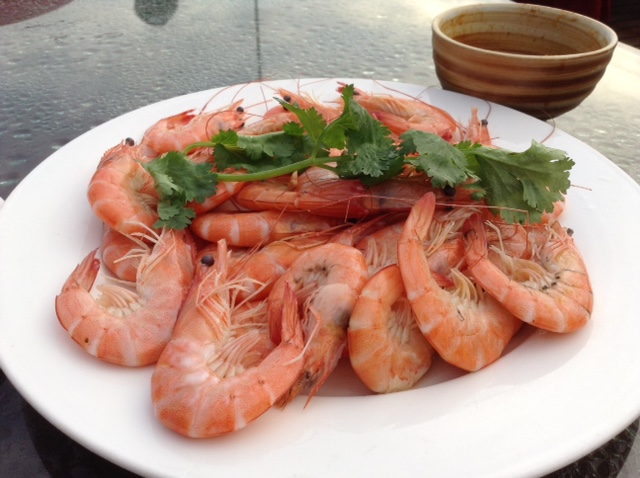
Shrimp at the beachside restaurant on Sanya Bay on Hainan Island, swimming in a tank one minute, boiled and on my plate the next. (Nearly every restaurant in Guangdong has a wall of tanks with live seafood at the entrance.) They turned into a peel-and-east feast for a mere $7; the Cantonese wouldn’t bother to peel. Only after I had eaten the shrimp did I discover the couple grilling next door and move on to the next course: more shrimp, skewered head to tail and flash-grilled in their shells on skewers, thinly sliced potatoes, a slender eggplant butterflied – all topped with lots of garlic, pungent yet sweet.

Shrimp by the beach.

Strawberry and peach nectars, a divine alternative to orange juice for starting the day. For some unknown reason, all orange juice here, even Dole from a cardboard carton, tastes as if it came out of a can. But who needs orange when the strawberry juice from Starbucks contains so much pulp it’s practically puree? Slightly weirder, there’s blueberry juice with actual blueberries floating in it. I’ve also found cherry juice (sweet memories of Poland) and pomegranate (Istanbul) and coconut palm. Instead of the Twining’s Blackcurrant I swill in New York on demand from my Mr. Coffee iced tea maker, each day I brew a liter or so of green tea, possibly from the plantations outside Hangzhou that I toured a couple of weeks ago.

I’ve always thought Chinese leftovers make a fine breakfast, especially fried rice or noodles, but here no one thinks I’m eccentric for it. Every hotel has a buffet, which usually runs about $10 to $15 if not included in the room rate. In addition to the rice and noodles, it often includes leftovers from the day before, like the stir-fried spicy cabbage or, one morning, watercress at my beach hotel in Sanya. At home, a schoolday breakfast usually consists of frozen baozi (pork-stuffed buns) from the supermarket, microwaved for a minute or two. While I’m sure the fresh-steamed ones I could get if I’d actually walk to the supermarket are better, these are surprisingly good, accompanied by a banana and a daily cup of strawberry yogurt for calcium in this non-dairy culture. On a weekend or Thursday, my free day, I might do a “brunch” of bacon and (hard-boiled) eggs. Chinese bacon is marvelous — long, meaty rectangles with very little fat. (Why is the United States seemingly the only country where bacon means mostly fat with skinny strips of actual meat?) Even better, a recent excursion to Metro, a warehouse-style supermarket chain with international foods, turned up black pepper bacon, as well as a few treats: prosciutto, bresaola (Italian dried beef) and two excellent crumbly cheddars.

Lunch or dinner may be home-cooked, or at least home-boiled. It took me two weeks to learn how the electric hotplate worked. (It will not turn on until it senses the weight of a pot on it.) But now I can hard-boil eggs (successfully), roast peanuts (less successfully), and fry rice and noodles (not as good as I can get outside). Granted, I’ve been lazy and use the hotplate mainly to boil the frozen jiaozi – dumplings stuffed with pork and corn, pork and greens, mushrooms and vegetable, and most recently little shrimp tortellini, meant for soup but just as good treated like dumplings. A dozen dipped into a simple mix of light soy and sesame oil, spiked with a little chili paste, make a fast, filling meal – especially with a garlic-heavy cucumber salad from the restaurant next door, with its leftover sauce mixed into the dipping sauce once the cucumbers are gone.

Dessert is mostly fruit, with an occasional wedge of strawberry mousse pie from the campus bakery. I gravitate toward the fruits I’d choose at home: breakfast bananas, crisp pink-and-yellow-striped apples, mandarin oranges. During melon season, I enjoyed small round watermelons, just the right size for someone who lives alone (though hard to open with a meat cleaver, the standard cutting device here), and a pale orange melon that looks like cantaloupe but has firmer, sweeter flesh. I’ve ventured outside my comfort zone, trying the infamous durian, which neither smells as horrible nor tastes as delectable as reputed, and persimmon, which I found fibrous and not nearly so flavorful as its flat-orange-tomato exterior might suggest. While pretty, starfruit and dragonfruit do little for me in terms of flavor, and pomelos I know from experience I can do without. Best dessert of all: candied walnuts. And though I try not to snack, I find it hard to pass by a bag of hot-pepper peanuts.

Dining out can be as simple as my Wednesday office-hours staple, beef fried rice with bright green soybeans at the Blue Bottle coffee shop on campus, or as elaborate as a dinner where one dish follows another, and then another, until the meal abruptly ends, as it normally does in China. But for that you need people. The very nature of Chinese dining – ordering lots of dishes to share, as opposed to one person, one plate – has always made it a group rather than a solo activity.

And it’s not so easy dining out as a single in a land of big, round tables for eight or more. My first night on campus, with no food in the apartment beyond the next day’s breakfast, I went to the restaurant next door for dinner. There I was eyed suspiciously, placed at a small, square table for two right by the door, and handed an “English” menu – no photos, just words like “maw,” which, whatever it is, I don’t eat. Unable to find anything that sounded safe except “fried rice with vegetables,” I ordered that and tea – a whopping $3 check. Since then, I’ve found myself much more welcomed when I do what I would in New York, if I still ate Chinese there: invest $20 in five or six dishes from the lavish picture menu that will last a week, and take the food to go, rather than taking up a table that will yield more revenue from someone else.

Fish heads.
Fish heads.
It’s been said that the people of Guangdong will eat anything, and any part of anything. I’m squeamish by nature about food, especially meat; I eat no dark poultry, no skin, no gristle, no fat I can possibly remove, no internal organs. (I don’t eat sushi, either, unless it’s vegetable or cooked.) All of which puts me at a disadvantage in Guangdong. When dining out, I always have a much higher discard pile – skin, bones, shrimp heads – than anyone else at the table. A student who invited me to a holiday lunch had pre-ordered “fish three ways”: deep-fried nuggets (spine and bones left in), chunks of flesh simmered in a hot pot with its skin, and the piece de resistance, fish heads Hunan style, served in broth and covered with red chili peppers. “Have some!” my student said, popping out an eye. Sorry, but no. The fried nuggets were delicious, bones and all.

For much of my time here, when temperatures were 90-plus, I couldn’t even think about malatang; now that the weather has turned and I’ve had a cold for two weeks, I most definitely can. Malatang is a ubiquitous hot pot where you choose what you want and a chef cooks it, item by item, in a communal pot of broth at full boil. Being squeamish, I avoid the skewers of meat and fish balls, whose texture I don’t like, and the pork and chicken kebabs with their fat, and the cocktail-size hot dogs. But all their flavors merge in the broth, creating a base of what for me becomes vegetable soup, full of greens, black mushrooms, thin slices of what seems to be bitter melon, water chestnut cake and the thin, crinkly tofu I like.

Chen at the hotpot spot.
That’s street malatang, but hotpot is also served in sleek modern restaurants with long lines outside the door, like the one where my new best friend Chen, a graduate student in journalism, took me a few weeks ago. Four of us sat around a pot with a mild seasoned chicken broth in the center, surrounded by a red chili pepper broth, blazing hot in every conceivable way. Chen ordered form the Chinese-only menu, and a cart of raw ingredients appeared by my left elbow, to be dipped, cooked and eaten piece by piece: paper-thin slices of beef and lamb, meatballs, tofu skin, vegetables. Even skipping the “cow voicebox” — oh, that’s maw! — I found the food and the heat more than satisfying.

Though I try to eat Chinese as much as possible, I do backslide, which is easer in a big city like Guangzhou than in Hunan. I allow myself one burger a week – if I’m in a hurry, at the local Burger King, where the (Chinese) bacon cheeseburger is actually good; if it’s a nice day and I have time, at the Happy Monk, an Anglo-American-style pub. Its bacon cheeseburger could compete anywhere: Chinese bacon, real cheddar, dripping with juice; I use the garlic dipping sauce for the fries in place of mustard. The Happy Monk also offers a creditable Caesar salad with finely shredded chicken breast and bacon, as well as a passable plate of nachos, with avocado slices rather than guacamole. It needs far more cheese, though, and when I tried asking if shredded chicken from the Caesar salad might be added to the nachos, it was more than the waitress’s brain could handle. I will miss sitting on the Happy Monk’s patio now that the time has come to move indoors. But there’s a good Thai restaurant in the Happy Valley Mall, where my favorite dish so far is the minced beef served in lettuce-leaf tacos, along with an even more garlicky cucumber salad.

I’ve tried one French restaurant, La Seine next door to the Xinghai Concert Hall on Ersha Island, a special-occasion place to the locals. The kir was far too heavy on the cassis, but the dark, creamy mushroom soup with truffle oil was superb. I’m not sure any Provencal would recognize the orange sauce and blood orange slices on the cod Provencal — in my experience, Provencal means in a tomato-based sauced with peppers, olives and capers – but as cod a l’orange it was sensational. And a crusty French roll with butter — my first in two months.

Home again: Hunan beef.
But the best meal to date, possibly my best in the five years since I left Hunan, was dinner at a new Hunan restaurant just off campus with Josephine Song of the university’s teaching affairs office and her husband, Harry. A Hunan girl herself, Josephine knows what to look for, scouted out the restaurant and approved. The beef with lemongrass was exactly the dish Pamela Britnell and I used to order every time we went to a certain restaurant, once prompting the laoban to tell us, “You know, we have many kinds of delicious foods . . .” There were the sliced raw lotus root that I love, fried rice, stir-fried cabbage, two kinds of tofu and shrimp, all but the lotus root spiked with, if not steeped in, red, hot chili peppers. The meal cleared my sinuses, and my mind.

Only one thing could top that. Josephine has invited me home for dinner.