An education

“Just to make sure we’re on the same page, what’s the biggest breaking news story in the arts this week?”

“WHITNEY HOUSTON!”

“Right! What makes it the biggest story of the week?”

It was the day after the Grammy Awards, and not quite 48 hours since Houston was found dead. Normally the Grammys would have been the story, but the demise of a bona fide pop superstar, even one past her prime, had upstaged Adele’s big win. The students in my arts journalism class thought for a moment.

“She was a big star.”

“It was unexpected.”

“She was going to perform at a party that night.”

“What else?” What I meant was, what makes this a great story? “She died the day before the Grammys! Now that’s a story!” To someone like me, steeped in literature full of fate and foreshadowing, it was all but Shakespearean, the exit of an arguably tragic figure on the eve of her art form/industry’s biggest night of the year.

The newsroom at UBC's Graduate School of Journalism, off deadline.

One of the perks of teaching, or practicing, arts journalism is that you can do things you would enjoy doing anyway, things that people are likely to be talking about at the water cooler the next day, and turn them into a plausible career. The Whitney Houston story was what I call “a gift from God” – an out-of-the-blue piece of teaching material from real life. This was a classic case study of breaking news coverage, and Multiplatform Journalism Professor decided to illustrate it with a timeline.

The starting point was Saturday just before 5:30 Pacific time, when I first heard the news in e-mail from my teaching partner, Steve Pratt of CBC Radio.  I immediately started monitoring the television networks and newspaper websites. ABC led its newscast at 5:30 Pacific time with the initial report, adding the few known details closer to 6. The CBS and NBC newscasts — clearly reruns of East Coast broadcasts – made no mention of Houston for 15 minutes before breaking in with brief live reports. The New York Times, whose early Sunday editions had closed hours earlier, had nothing at all for well over an hour, then an Associated Press report and finally, some hours later, its own story. I could just see the skeleton crew in the office on a Saturday night chasing down the pop music staff, some of whom were already out in Los Angeles for the Grammys.

“What can you add?” I asked the class.

“I heard it around 5 on Twitter,” Sam said. “Then Twitter just exploded.” Within 20 minutes, someone added, the inevitable sick jokes were already surfacing.

Multiplatform Journalism Professor instantly deflated into Old Lady Print Journalist. Of course. The water cooler is now electronic, and it is immediate.

Just past the midpoint of my semester at UBC, I’m still learning  – not least, just what an OLPJ I am. (None of my students would ever think of going to a network or a newspaper web site, let alone a printed paper, for breaking news.) Still, I’m trying.

Social media are (and yes, I still insist that the word “media” is plural) still not my fach, as we say in the classical music world. I’ve attended a social media workshop and started fresh on my Facebook page; I’ve amped up my LinkedIn profile by adding skills, requesting recommendations and joining a new group, the Adjunctpreneurs. During this week’s Oscar post-mortem, I even quoted a snarky tweet – something to the effect of “Who’s that guy with a face like a sponge?” (Billy Crystal). But I found it in The Times’s exhaustive Oscar night coverage, not on Twitter. OLPJs evolve slowly. We are all products of our time, and one day these students, too, will find themselves falling behind. Trust me on this.

It’s been, incredibly, five years since I ran Oscar night at The Times, and this year’s reminded me how much and how fast the media landscape has changed. Not so long ago – maybe 1995 – The Times staffed the Oscars with one reporter, two copy editors and the culture news editor to make the executive decisions, all sitting in the New York newsroom with a TV and a pizza. By 2007 we had a team of reporters and photographers in Hollywood, and at least a dozen people in New York; I turned around four print editions in four hours and coordinated with the digital people. This year’s coverage was overwhelming, and not only in The Times. (Canada’s Globe and Mail had dozens of treatments on various platforms.) Instead of one smooth narrative accompanied by a list of winners, the story is told in bits and pieces –Tweets, blogs, polls and infinite red-carpet photo galleries. How can anyone digest all this? “They don’t,” Steve said. Instead, audiences pick and choose.

We don’t talk about the Oscars and Grammys just for fun, like normal people. In less than five weeks comes the class’s final exam: live coverage of the Juno Awards, Canada’s Grammy-equivalent. Working  in the journalism school’s newsroom or outside, the class will produce the most complete coverage it  can, on as many platforms as possible. Most important, the students will plan that coverage themselves. “We’re not going to tell you how to do it,” I warned on Monday. “I can tell you how I used to do it, and Steve can tell you how he does it at the CBC. But we’re not going to do it for you.”

A word about these students: they strike me as extremely capable pre-professionals, more like junior colleagues than students. At least three have already published work produced for this class in local media, and most have posted on their own blogs. They are at various stages of training, and all have strengths and weaknesses, each one’s different. Six come from other cultures and thus may have arrived on campus less familiar with North American forms of journalism.  Some struggled with hard-news and feature assignments, not yet imbued with those formulas; the blog seems to be the natural form of their generation, although I was pleasantly surprised by their reviews. This being a multiplatform program, four chose audio for the first assignment; by the fourth, all had reverted to writing, which Steve tells me is less work. At least half had trouble meeting the first deadline, and some still do, indicating that they need to learn how to better manage schedules and workloads.

Above all, they are willing to learn. When Mohamed asked at the first class, “Will we be able to re-do these assignments?” for a higher grade, I was taken aback; did I look like some kind of pushover?  Wasn’t the idea to get it right the first time, on deadline? On reflection, I realized that, no, editors send stories back for rewrites all the time, and that what mattered here was learning. Since then a number of students have taken advantage of the rewrite process, transforming not only their grades but their stories as well.

Some have expressed uneasiness about Juno night. “I still can’t quite understand how it’s going to work,” one wrote on a midterm course evaluation. But after our Oscar discussion and my assurance that we would all work on the planning, together, in the weeks ahead, they seemed relieved, and energized. When Steve and I left that day, most of the class stayed behind, apparently to start forming strategy teams. There was a definite buzz in the air.

On April 1, Steve will be working the Junos for CBC in Ottawa; OLPJ will be in the newsroom at UBC, supervising. But right now, she’s going to cook dinner with the 6 o’clock news playing in the background.
Stacked

Another song has been running through my head since I’ve been on campus. It’s a bouncy little tune from “She Loves Me,” the Sheldon Harnick-Jerry Bock musical about two employees of a Budapest parfumerie who despise each other in daily life but fall in love via lonely-hearts mail. (See also “The Shop Around the Corner,” “In the Good Old Summertime” and “You’ve Got Mail.”) This song belongs to Ilona, their rather shallow co-worker who’s always getting involved with the wrong men.  Then, in the second act, she discovers a new love – a “clearly respectable thickly bespectacled man”  — in, of all places, the library:

A trip to the library

Has made a new girl of me.

For suddenly I can see

The magic of books!

I’ve always been under the spell of books, as anyone who’s seen the piles in my apartment can attest. But here at the University of British Columbia, I’ve rediscovered the magic of libraries.

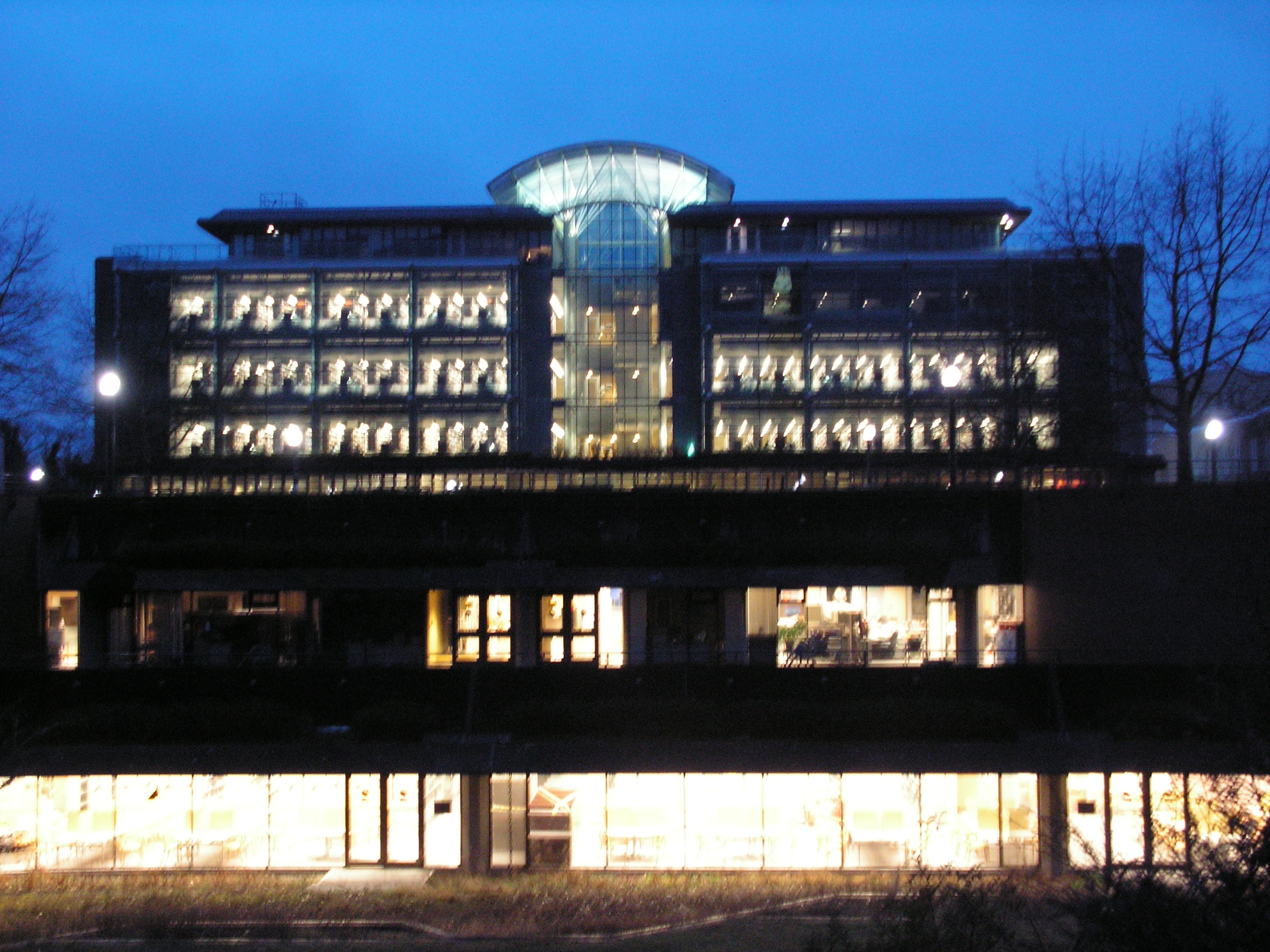
Koerner at twilight. My carrel is at bottom left.

“It was amazing!” I told a friend after my first trip to Koerner, the main library on campus. “All I had to do was show my faculty card, and they let me take out books!”

Well, yes. That is, after all, what libraries do. But in 40 years, I’ve barely checked out a book.

Having been a reader since age three and a half, according to my mother, I naturally gravitated toward the grade-appropriate mini-libraries in my elementary school classrooms. In junior high and high school, the libraries seemed immense: separate rooms with shelves stretching from wall to wall, floor to ceiling. I loved exploring the stacks, sometimes on a Dewey Decimal-guided quest (literature: the 800 section), sometimes just browsing. The distinctive smell of paper and ink — such a high concentration of it in one enclosed space – never left my sense memory.

Then, just when you’d think I’d have been in library heaven, I stopped going. Pattee, the main library at Penn State, was perhaps a case of too much information; for the first time in my life, there were too many books. Or perhaps the problem was the library itself: too big yet too cramped, too complicated and entirely inhospitable to browsing. Having gotten into the habit of buying textbooks, I now bought my leisure books as well. In any case, being a journalism major, I needed the library less and less, since journalists tend to get their information from interviews, not books.

A journalism career brought an unexpected bonus: free books. Almost every book published – often multiple copies, sometimes dozens — finds its way into the offices of newspapers, most of all The New York Times, courtesy of authors and publicists desperate for reviews.  When I first moved to New York, there were about 150 books on my unread pile; when my mother used to advise me, “You should be saving for your retirement,” I would gesture grandly toward the pile and say, “I am!” After 20 years at The Times, the unread probably number two or three thousand, some filling a walk-in closet, some in those piles on the floor, which occasionally collapse. Now that I’m in those gap years between end of career and actual retirement, paper books seem to be all but obsolete. I’ve been traveling with a Nook for two years, and now, with a laptop and an iPad as well, I can choose among three separate reading  options.

I did join the Boston Athenaeum for a few years when I lived nearby on Beacon Hill, but when I did go there, it was more to soak up the atmosphere than to do any real work – and, of course, to smell the books. When I arrived at The Times in 1988, I was delighted to find on the tenth floor a real, old-fashioned library, with stacks and card catalogues and bound editions and shelves of back-issue magazines and, yes, that smell. The destruction of that library was just one of many great losses when The Times moved in 2007; it was one of those things that made The Times The Times and could not be replicated in a glass tower. But at the last-night-in-the-old-building party, word seeped out that the library was giving away books, and I raced upstairs in time to grab a few — prizes to no one but me.

It took me more than 20 years to bother obtaining a New York Public Library card, and then only because I was passing through the performing arts branch at Lincoln Center and thought it might come in handy sometime, especially since I had moved into long-form projects. But that library, and another with an extensive dance collection, proved less than helpful in my research on a slice of ballet history. So, once at UBC, I found my way to Koerner.

On my first visit, I went to the research help desk to ask if the library had a dance collection. While far more modest than those two elusive ones in New York, it does exist, and the librarian gave me a slip with the call number of the section most likely to hold what I needed to know. As I turned away, I noticed two display towers. A book jumped out at me, thanks to its cover portrait of one of my heroines, Judi Dench, in the guise of another; it was “Elizabeth I in Film and Television,” by Bethany Latham. On another shelf I found an early P.D. James. I went back to the helpful librarian and pointed to the towers: “Do those books . . .  circulate?” They did. I grabbed my two and took them upstairs to the checkout desk. Evidence of the passage of time: instead of slips and rubber stamps, library books now come with bar-coded labels that are simply scanned. A printed receipt, suitable for use as a bookmark, states the due date, but you can always renew online.

So I put away the Nook for a few weeks. I’ve already gone back to the library for works by two favorite Canadian writers, Margaret Atwood and Douglas Coupland.  As for that dance collection: yes, it’s small, but it had what I needed. I checked out Lynn Garafola’s Diaghilev biography, read the relevant sections lying on a couch in front of the fireplace and called it work. Since then I’ve made two or three trips to the stacks, staking out a study carrel (remember those?) beside the dance section, then pulling half a dozen books off the shelves and settling in for the afternoon, with one sole purpose: to read and think. My apologies to the young man I nearly crushed when, in my eagerness to explore my section, I turned the handle on the movable shelves without looking first.

“How did you like the library, Ilona?” is the line in “She Loves Me” that leads into her song. “You’ve never seen such a place,” she answers.

So many books.
So much marble

So quiet

Dating from only the mid-1990s, Koerner is built not of marble, but of granite, stucco, glass and zinc.  Quiet? Definitely. Books? Capacity, 800,000. It could take a girl a while to get through them, with or without optometrist. A trip to the library hasn’t quite made a new girl of me, but it does remind me of the one I left behind.

Into the woods on a snowy evening

Mother said,

“Straight ahead,”

Not to delay or be misled. . . .

Mother said,

“Come what may,

Follow the path

And never stray.”

As I’ve often said, there’s a line in Sondheim to cover every situation in life. Following the path seemed like a very good idea indeed when I set out into the woods high up Hollyburn Mountain.

Like Little Red Riding Hood, who sings the lines above in Stephen Sondheim’s “Into the Woods,” I was protected by a hood, the one on the all-but-impermeable gray wool coat I brought to Vancouver.  Unlike Danielle Ferland in the original Broadway production, or probably any actress since, I was wearing snowshoes. 

The occasion was a gathering for newcomers to the University of British Columbia organized by Work-Life and Relocation Services, the people who found my wonderful apartment here andshepherded me through the work visa process. When I stopped by the office to say hello and thank-you, Debbie McLoughlin said, “You’ll have to come to our get-together,” and then added, as an afterthought, “Maybe we’ll go snowshoeing.”

I thought she was joking. But in Canada, snowshoeing is considered a normal thing to do.

Late Friday afternoon, five of us piled into Debbie’s car for the trip to Cypress Mountain on Hollyburn, one of the North Shore mountains I can see across Burrard Inlet from my neighborhood, Kitsilano, or the UBC campus. Cypress was the official freestyle ski and snowboarding venue for the 2010 Winter Olympics and is now a popular recreation area just 45 minutes from downtown. When we left, the weather was, as usual, gray and rainy, but about halfway up someone remarked, “The cars coming down have snow on them.” There was more and more as we climbed, and when we parked, big, round flakes were coming down, and piling up on my coat.

I was absurdly underdressed. The coat was fine, and the wool hat I keep rolled up in one pocket – also gray, with the logo of New York’s No. 1 subway line on the forehead – came in handy. (Here it is called a toque, pronounced tooke.) But underneath, having dressed for city temperatures in the upper 40s, I was wearing just my UBC sweatshirt over an L.L. Bean cotton turtleneck, and alpaca leggings over tights – not nearly enough layers, and none of them waterproof.  Most absurd of all were my boots, purple leather ones I bought in Mallorca, completely without tread. The polar-fleece socks, also purple, that I wore on the plane out here had mysteriously gone missing, so that was another layering opportunity lost. The Canadians in our party of 30 were properly dressed in parkas and waterproof pants and such, but I was limited to what I had packed back in New York. Who knew about snowshoeing?

The old-fashioned kind.

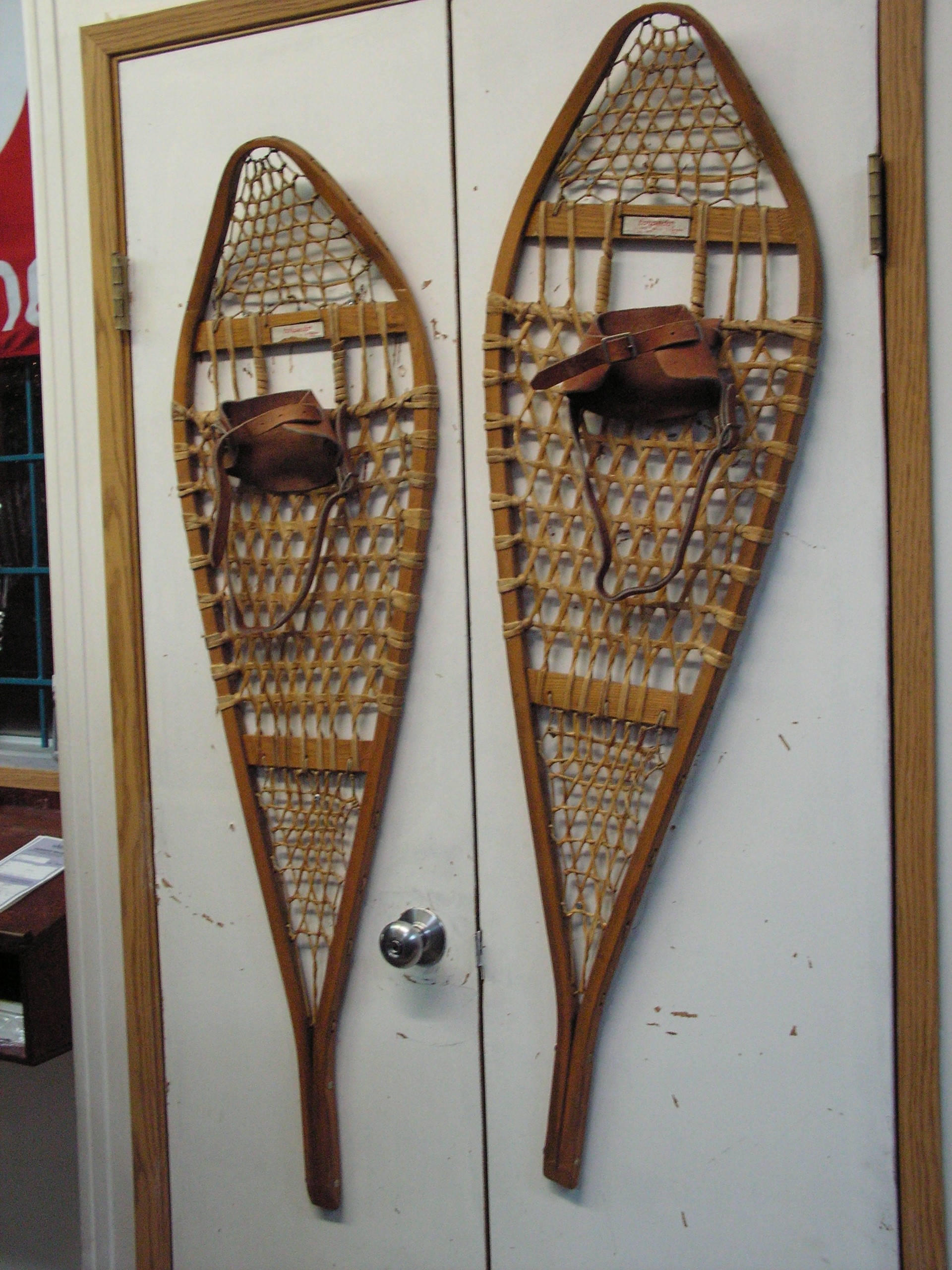
With assistance, I put on my shoes. A disappointment: snowshoes are now metal-and-plastic constructions, not the old-fashioned tennis rackets we outlanders expect (some of which decorate the walls of the rental office). On the other hand, they have the advantage of metal teeth that dig into the snow, a great advantage on an incline, or if balance and physical coordination are not your greatest strengths. They are not mine.

“If you can walk, you can snowshoe,” our guide, Rose,  explained in a five-minute introduction to the sport. I had attached myself to Rose’s group after she noticed my apparent nervousness. “Do you have any health problems you’re concerned about?” she asked. Oh, you mean like the herniated disc and two pinched nerves in my back? “I’ll get you some poles,” she said.

The poles were exactly what I needed. As it turns out, walking on snowshoes is not quite like walking. Snowshoes are several inches wider than your feet, and it’s necessary to remember that to avoid stepping on your own and pitching over. They’re also longer than regular shoes – like short, fat skis — which means you have to be careful not to step on the shoes of the person in front, with similar results.  It’s tricky, if not impossible, to back up, since your heels are loose and the backs flap downward. Walking forward in small circles to turn around takes some practice.

The group of 30 having split, about a dozen of us set off behind Rose across a well-lighted ski trail and, literally, into the woods. The path was narrow, just the width of a pair of snowshoes, bounded by a few (visible) inches of snow on each side. It was also anything but straight – those pesky trees getting in the way — and full of ups and downs, from several inches to several hard-packed snowy feet; they reminded me of the grooves in the sandstone of Ayers Rock in the Australian Outback, which I climbed in 1985. And the path was dark. While the ski trails have lights visible from Kits, the snowshoe trails have none, except in the occasional clearing. Along with our snowshoes, each of us was issued a headlamp of the kind worn by miners — or subway workers  on the No. 1 line, whose logo the lamp obscured.

As I became less self-conscious and more comfortable on the shoes, I grew more aware of my surroundings. In the words of Robert Frost, the woods were lovely, dark and deep. (Am I the only one who’s noticed that poem could easily be sung to the tune of “Into the Woods”?) They seemed to stretch on to infinity, shadowy cones outlined only by the snow resting on their branches. And yes, lovely in the quiet broken only by a dozen pairs of crunching feet.

“How far are we going?” I had asked Rose early on, for fear I might need to turn back. “About a kilometer to the lodge,” she said. “But it’s not a straight line. It’ll take about an hour.” As lovely as the woods were, it came to feel like a long hour, since we were constantly in motion with no lodge in sight; every time I saw the lights on a clearing, I hoped. The oldest and slowest in our group, I tended to fall behind. Still, with each step and swing of the poles, I felt more confident of my ability to stay upright. I began to realize what good exercise this was – how loose my back and hips felt, how my lungs were expanding – and how many calories I must be burning. I wasn’t even cold.

Eventually we reached the lodge, where we would have to remove our snowshoes to go inside. I declined: “These shoes are on, and they’re staying on.”

“But everyone else will have to put theirs on, too,” Debbie coaxed. “We might be here 15 or 20 minutes.”

“Just hand out a cup if you feel like it,” I said. “I’m staying here.”

She bought me not only hot chocolate but also a thick, chewy oatmeal-raisin cookie. I ate and drank clumsily with the poles still strapped to my wrists. But I managed, all the while enjoying the silence, the solitude, the vision of the red lodge outlined by a string of yellow lights, softly out of focus in the mist. When the others emerged and struggled to put on their snowshoes, I was dressed and ready.

As so often on ventures into the unknown, the trip back seemed far shorter and more direct. Rose noticed me falling behind and left the others in the care of her colleague Brad for one last turn through the woods. We waited for them near the entrance to the ski trail that would lead us back to base. As a finale, the more athletically inclined decided to race down the hill, breaking into a run with their snowshoes flapping and clattering behind them.

There remained only Frost’s “miles to go before I sleep.” When Debbie dropped me at my door an hour later, I rose from the back seat to discover that sitting had induced a certain rigor and I could barely walk. An ill-advised trek through Stanley Park the next day left me with a knee reluctant to bend and a hobble that canceled my Sunday morning lap swim. Still, I’m better off than Golnaz, my student who turned up in a leg brace after a snowboarding accident the other week and was still wearing it as she prepared for her spring-break flight home – to Iran. Thanks to those teeth on the bottom of my snowshoes, I’ve left my mark on Hollyburn Mountain – at least, until the next snowfall.

A morning at the opera

It felt strange going to the opera before having a good, solid meal, or even taking a shower. Still, last Saturday morning I hauled myself up, out and onto a bus just after 8, heading toward downtown Vancouver in search of the Scotiabank Theater.

The occasion was “The Enchanted Island,” the Baroque pastiche that was the latest in the Metropolitan Opera’s series of live high-definition broadcasts to movie theaters around the world.  These broadcasts have brought new audiences to the Met and other entrepreneurial performing arts organizations, from the National Theatre in London to the Bolshoi Ballet. (Two years ago, I saw a billboard for a screening of “Macbeth” in Chengdu, China.) My friends Leslie and Mike were also going to “The Enchanted Island,” but at the Walter Reade Theater in New York, where the show, and the opera across 65th Street, went on at a more civilized 1 p.m.

Being new in town, I allowed plenty of time to find my way and arrived with almost an hour to spare. The theater wasn’t open yet, and the few other earlybirds outside were looking around for breakfast.  A kindly jogger suggested an Italian café a couple of blocks away, where I ordered a bowl of stick-to-your-ribs oatmeal — and a good thing, too. Inside the theater, a welcome-and-etiquette announcement noted that the concession stands would be open by intermission but asked patrons to “please refrain from eating popcorn during the opera, as the sound can be distracting.” I remembered wondering at my first HD broadcast, “I Puritani,” if it was proper to eat popcorn at the opera. 

It also felt a little strange watching the onscreen crowd taking seats inside the Met, just a 20-minute subway ride from my New York home and practically next door to my second home in recent months, the Vivian Beaumont Theater (Travels With Joey, July 13, 2011).  The broadcast omitted my favorite moment at the Met, when the Austrian crystal chandeliers are raised to the gold-leaf ceiling, dimming the house lights and indicating the music is about to begin.

Confession: I know it’s heresy, but I’ve come almost to prefer seeing opera in movie theaters and later on PBS to attending live at the Met. It’s not just price. (Good seats at the Met tickets can run into hundreds of dollars, as opposed to $24.42 Canadian for this broadcast.) The Met’s acoustics are glorious, even up in the family circle, but the house is so cavernous that it dwarfs the singers even from parts of the orchestra. During Barbara Cook’s solo concert there in 2006, when I sat in the very last row, I could confirm by the blond mane that yes, that was Cook onstage, but I could make out nothing she was doing. On the broadcasts, performers are movie-star size, and multiple cameras provide close-ups and shots from many angles rather than a single point of view. Subtitles, even for English librettos, make not only the plot but every word clear, thus eliminating the need to study in advance, as I used to do before the Met installed its titling system in 1995. Intermission features, also shown on PBS, give the audience something to do beside go out for popcorn during half-hour breaks.

I had been curious to see who in Vancouver would turn out for an opera screening at 9:55 a.m., and no surprise: no one looked under 40 except members of the house staff. In fact, there were far more young faces in the onscreen Met audience than in the Vancouver theater. The Vancouver Symphony Orchestra’s concert of Mahler’s “Resurrection” Symphony  on Monday night drew a much higher proportion of younger people. As for the Wednesday matinee of the Tony Award-winning “Red” at the Vancouver Playhouse – well, anyone who ushers knows who goes to Wednesday matinees. This performance drew seniors and a school group, and few in between.

“The graying of the audience” is the nemesis of classical art forms like opera and ballet, which so many people find intimidating. How, presenters worry, will these forms, and thus their organizations, survive into the future if young people aren’t coming?

My arts journalism class at the University of British Columbia has been assigned to compile a Google Calendar for the semester. When I’ve checked it over the first two weeks, I’ve found listings for the PuSh International Performing Arts Festival, the Taboo Sex Show, Street Food City, the Stop the Presses! Journalism Film Festival, K-Pop/J-Pop Night and “The Vagina Monologues” (posted by Kate, who’s in it). But, with the exception of  “Red” and a local production of “Waiting for Godot,” there are few for institutions like the Vancouver Symphony, the Vancouver Opera and Ballet British Columbia. Is the problem the ticket prices? Lack of education in the arts? Or is it that the students just can’t relate?

Yet there is reason for hope, even though no one but me admits to having watched the Met’s “Anna Bolena” on PBS from Seattle over the weekend. Mohamed, who grew up in Bahrain, enthusiastically looks forward to learning about opera and ballet, Western forms to which he has had no exposure. Jennifer arrived for class on Monday with a stack of library books. “Puccini,” she explained. “I’m sort of obsessed with ‘La Boheme.’  It could be my final project.” Gudrun rushed up to me after I mentioned the Met HD broadcasts during our first class. “Are you going to ‘Goetterdaemerung’?” she asked. I am, and she was deeply envious. “I couldn’t get a ticket,”  she said. “My mother was so disappointed.” They had seen the other three operas in Wagner’s “Ring” cycle. Of course, Gudrun is from Iceland, a country that has nearly 90 music schools and still takes classical music seriously.

So I’ve suggested that the opera-shy consider attending an encore of “The Enchanted Island.” There’s nothing to be scared of. It is no more than a mashup – a modern word for pastiche, defined by Wikipedia (and really, where else would you go for the definition of a word like mashup?) as a “song or composition created by blending two or more pre-recorded songs.” (Think “Glee.”) “The Enchanted Island” is a mashup of hits from three or four centuries ago, but that doesn’t mean it’s not fun.

In this case, the mashup is a matter of not only the music (by various Baroque composers) but also the new English libretto by Jeremy Sams, which inserts characters from  “A Midsummer Night’s Dream” into “The Tempest.”  “It certainly helps to know your Shakespeare,” the British-accented woman next to me remarked at intermission, but even if my students don’t, they’d have little trouble following the story, especially with subtitles spelling it out. The over-the-top visuals alone are worth the trip. And as a mashup, what is “The Enchanted Island” but a part of the “Remix” culture we’re studying, in which elements of existing art are sampled and recombined to create something new? (For a fuller explanation, see Lawrence Lessig’s book of that name. It’s on our recommended reading list.)

At the conclusion of “Apollo’s Angels,” an exhaustive history of ballet, Jennifer Homans regretfully declared it a dying art. Is opera another? There’s no reason it needs to be in an era when Rufus Wainwright — Canadian! And best known as a pop artist — is about to have his first opera performed at the Brooklyn Academy of Music. (The Met originally commissioned it but pulled out because Wainwright insisted that the libretto be in French.)

For the record, the Feb. 11 live broadcast of “Goetterdaemerung” at the Scotiabank Theater was already 90 percent sold when I bought my tickets, the day after they went on sale in late August. It starts at an even less civilized 9 a.m., and it won’t be easy to make the curtain, or sit through six hours of Wagner in an undercaffeinated state.  But I’ll be there.

Postscript: After the opera, I spent the afternoon at the Vancouver Art Gallery looking at “Shore, Forest and Beyond: Art From the Audain Collection,” which, sadly, closes this Sunday. The exhibition’s two floors cover centuries of art in British Columbia, from First Nations artists of centuries past to contemporary ones of many ethnicities, with an especially fine display of my own collecting passion, masks. But that’s a different form of enchantment.

Baggage

If I needed any reminders that the world has changed, I could have found them in my luggage for Vancouver.

For my early travels, I used to pack exactly two electrical devices: a hair dryer and a travel iron, along with a boxed set of adapters. First the iron fell by the wayside as I learned to pack wrinkle-resistant clothes and realized that few people would care, or even notice, if I looked a bit rumpled. The hair dryer followed when hotels started supplying them. On my 10-week trip in 1985 to China, Hong Kong, Australia, New Zealand and Tahiti, I brought back 17 articles for The Boston Globe – all from a few reporter’s notebooks.

Then I started carrying a Grundig mini-radio in my purse for long bus rides (it came in handy on 9/11), later supplanted by an iPod Nano that let me carry my own music. When I started teaching abroad, I needed my laptop. On a three-month trip to Eastern Europe in 2008,  it served first as a teaching tool and later as a traveling companion; at an open-air wifi café in Split, Croatia, I would answer e-mail over early-morning tea and, at the end of the day, edit my photos over a glass of wine. In China the laptop became my workspace, entertainment center and lifeline to the world. “My whole life is on that laptop,” I told friends, and two years later, that hasn’t changed.

To Vancouver, I brought no fewer than five electronic communications devices: the laptop; a  Nook for bedtime reading; a brand new iPad, a Christmas/birthday present from my friend Heidi; her hand-me-down iPod Touch (code-named Alvin for our late friend whose picture she used as its wallpaper), which has replaced the Nano in my purse; and the international cellphone I carry but rarely remember to turn on. Make that six: at the last minute, I popped my little digital recorder into the bag, in case I need to do interviews. There are at least four separate chargers, carried in the “electricals” box (a souvenir from China, decorated with a frog or lizard motif) along with three flash drives, two extra sets of  earbuds and a spare USB cord. The electricals box can go into checked luggage, but everything else is carry-on, for which I now have a small wheeled office bag.

So much for traveling light.

The keyword here is “communications.” As a visiting professor in the University of British Columbia’s Graduate School of Journalism, I am back in the business in earnest, and these days, communication means mobile. When I first walked into my classroom, I found several long rows of work tables, empty except for pop-up electrical outlets. The notebooks students bring to class are mostly electronic, not paper. When I was their age (oh, to think of those words coming out of my mouth!), a journalism classroom was equipped with clackety manual typewriters, bolted to the desks. Here there’s a desktop Apple for the teacher, wired to projector and sound. My iPad is still too precious to carry around, but whenever I feel the need to look cool, I can whip Alvin out of my purse and peer intently at the little screen. Sometimes it even connects.

UBC’s program is entirely multiplatform, which means that no one majors in print or broadcast or online journalism; everyone learns to do everything. If that sounds a little scary to an old-lady print journalist, she need only read one course description for reassurance: 

Integrated Journalism (iJournalism) is our core journalism course, designed to familiarize students with the grammar and syntax of media across platforms, including text, audio and video. It provides hands-on experience in a simulated multimedia environment. Emphasis is placed on accuracy, meeting deadlines, and learning the elements of journalistic style.

Grammar and syntax. Accuracy, deadlines, the elements of style. Even if the school’s “newspaper,” TheThunderbird.ca, is a website billed as a “news service,” it sure sounds like journalism to me.

It occurred to me that in my first two visits to the school’s state-of-the art Sing Tao Building, I hadn’t seen any newspapers. “Does this journalism school get any actual newspapers?” I asked Barry Warne, who runs the front desk. (Every organization has one person who can answer any question, solve any problem, supply any need. In this school, it is Barry.) “No,” he admitted, “we used to subscribe, but I was the only one reading them. So we canceled. Everybody reads it online.”

A platform is just a platform; what counts is what goes on it. So, like everybody else, I’m reading The Vancouver Sun and The Globe and Mail online. (The Georgia Straight, the local equivalent of The Village Voice or The Boston Phoenix, does arrive at the school in print.) Once again I’m also reading my hometown paper, The New York Times, online after nearly a year of rediscovering the print edition (Scrolling back, April 9, 2011). I’ve had to revert to one old habit: appointment television. For seven Sunday nights, I’ll be home by 9 to watch “Downton Abbey”; the wonderful apartment I’ve rented has no DVR cable box, and PBS won’t let me watch online in Canada. No matter. I’ve enjoyed that Sunday-night date for more than 40 years.

Steps away from all the modernity are UBC’s Museum of Anthropology and its spectacular grounds. There, in the cold, fresh midday air, I strolled through a totem-pole gate to gaze across a pond north toward Burrard Inlet and the mountains beyond. In this oasis of peace and timelessness, out of wifi’s reach and without a newspaper in sight, I began to understand what British Columbia is all about.

The gap years

“You certainly seem to be enjoying your retirement.” I often hear these words from former colleagues, many retired themselves, and heard them again the other day from my longtime gynecologist. Then there was the morning  I read it on the Internet, my author credit for a magazine article published last year: “As reported by retired New York Times writer Diane Nottle.” Sometimes I correct people, sometimes I just smile faintly: do they really think I’m old enough and/or rich enough to be retired?

Let me be clear: I didn’t retire; I wasn’t laid off. I just left. The difference between leaving and retiring is a pension that lands in your account every month. And thus I entered the gap years.

In the Great Newspaper Meltdown of ’08, The Times, where I had been an editor for 20 years, was reducing its newsroom staff by 100 and had a buyout offer on the table. I wasn’t planning to take it, but then one of the managing editors called me into his office to give me a friendly heads-up:  in the shuffle that would follow the buyouts and any possible layoffs, some assigning editors would be returning to the copy desk, and I was likely to be one of them.  What he probably meant to say was: “We’ll need people with specialized skills to fill some holes, and you have those skills.” (Never mind that those skills had atrophied considerably after more than a decade in a different role.) What I heard was: “We think you’re only good enough do the same job you did the first day you walked in the door.” In any case, it would have been a demotion, and yet, as a savvy friend pointed out, with my experience I would be expected to fill in at the higher level whenever needed, without extra compensation or any likelihood of being promoted back up there. So I left.

I already envied my three brothers and the friend I met on the first day of sixth grade, all educators who had retired with full benefits after 30 years’ service, around age 52. At 53, with 20 years at The Times, neither was I old enough nor had I worked there long enough to qualify for even a partial early pension, only the buyout payment, 15 months’ salary. But that was 15 months more than I’d had the last time I left a job without another one waiting. Besides, I remembered being asked when I was about to start my job, “Where do you go from The New York Times?” and answering, “Anywhere  you want.” I was confident that was still true.

One of the first places I went was Eastern Europe, on a three-month rail odyssey. A funny thing happened when I wasn’t paying attention: the American economy crashed. I heard the news upon checking  into a hotel in Graz, Austria, after two media-free weeks in Croatia and Italy. By the time I reached Budapest a week later, I was starting to think, “Maybe this isn’t the best time in history for a woman my age to be unemployed.” But most of the buyout money was still there, not to mention a 401(K) that Vanguard identified as  “significant assets,” so I did the only sensible thing: invested in beaded evening bags.

Three years later, the view is slightly different. The IRS got the last of the buyout money some time ago, despite 46 percent withholding; the “significant assets” aren’t what they used to be. The pensions don’t kick in for three more years, Social Security for five, Medicare for eight – assuming any of those still exist by then. And it’s amazing how many people think I can work for free.

On  the job market, experience seems undesirable if it makes you look expensive, and especially if your resume dates back to 1975. In “The Company Men,” last year’s film about laid-off executives, Chris Cooper’s character is advised to delete anything before 1990 from his resume and to dye his hair – “You look like hell.” Frankly, I’m proud of everything on my resume, dates and all,  and it’s not so many years since I stopped coloring my hair precisely because I had come to admire the lush silver manes I was seeing on so many attractive women of a certain age, namely mine. But my contemporaries and I are living in a world where high-level positions — the ones we were told we might attain someday, if we were  patient and worked very hard — have turned into entry-level jobs for 27-year-olds, who expect their careers to be leaps from peak to peak rather than long uphill climbs.

A new generation has taken over; we are to get out of the way, as fast and graciously and we possibly can. (And really, who wants to work for the brash, arrogant, deeply insecure people we used to be?) But then there’s the matter of the income gap. In the book “Groping Toward Whatever, or, How I Learned to Retire (Sort Of),” Susan Trausch catches up with old friends from The Boston Globe who, like her, took a buyout. The money didn’t last as long as they’d expected, but they’re adapting – some by training in new fields, for the money — and surviving. As we all reinvent ourselves, we are still working, not to keep busy  but, like everyone else, to earn a living.

Yes, I probably should have saved more for my over-50 years, but who saw this recession coming, or the toll it would take on people who thought their jobs were secure until they were at least 65? (In all the government’s halfhearted attempts at economic stimulus, no one seems to have thought of lifting the 10 percent penalty for those forced to dip into their 401(K)’s prematurely.) But then I think of friends who died at 48, or 41 — I’m attending her memorial today — or 37,  and wonder if they wish they’d saved more for retirement. 

Like Edith Piaf, I think, “Non, je ne regrette rien,” least of all these last three years. In that time I have taught in Poland and China; traveled to almost a dozen other countries; published articles about my city in one halfway around the world that I’ve never seen; written hundreds of thousands of words for book projects I couldn’t have conceived back in the newsroom. I have dinner with a friend who did not take the last buyout and was promptly demoted, just as I would have been; now, as she considers applying for the current buyout offer, I give her the same advice I did then: “Jump!” Have I cut back? Do I worry about  where I’ll be a year from now, and how I’ll pay the bills and keep the Manhattan apartment where I’ve been so happy? Of course. But that’s no reason to stop living now.

A while back, in an indulgence not unlike those Hungarian evening bags, I ordered a pair of my favorite French walking shoes. Expensive? Oh, yes. But sturdy and good-looking, too. These shoes will wear for years, and I with them.

For the glory

My present-day self is very glad she’s not the editor of The Daily Collegian these days. My 19-year-old self would probably be having a field day.

The Collegian is, as my first resume put it, “circulation 16,500, Penn State’s independent student newspaper.” The circulation figure may have changed, but I suspect the paper is still an enterprise run by hard-working, idealistic young people who spend as much time as they can in the Collegian office getting their first taste of what it means to be journalists. In my three years at the university, I majored in Collegian and earned a couple of degrees on the side. So have many fine journalists before me and since.

My relationship with Penn State is complicated. It wasn’t my first choice of college; it wasn’t even on my list. But that’s where I ended up, for a variety of reasons. My parents, who had never had a mortgage, saw no reason to borrow to send a girl to school when my two of my three brothers had done fine at state teachers’ colleges. They would not allow me to take out student loans, explaining that my husband would become responsible for repaying them. (Would that mythical man please identify himself? And maybe send a check?)  One brother had wanted to study journalism at Penn State but didn’t get his wish; our cousin had gone there  and loved it, as have his two children after him. Most important,  Penn State had a powerhouse football team. To my father, whose formal education ended in the eighth grade, that made it a good school. In 1972 he was prouder that Woody Petchel —  star tailback of the Pen Argyl Green Knights,  the team of the hometown high school my father  never attended – was going to Penn State on a football scholarship than he was of a daughter who walked away from high school graduation with a record number of awards.

So I was sent off to Penn State, and made the best of it. After the first year I paid minimal attention to academics;  it’s hard to feel engaged in lecture courses with 400 students. But two Penn State experiences shaped my life: the journalism school’s study-abroad program in Manchester, England, and The Collegian, where I was editor-in-chief for 1974-75. Years later, for a Collegian alumni endorsement, I said: “The Collegian didn’t make me a better journalist. It made me a journalist, period.” I stand by that statement.  

Football? I barely gave it a thought — no mean feat in State College, Pa. In my freshman year, my father bought me a season ticket to home games; I attended one and a half. As editor, I put sports on the front page only under duress, arguing that it didn’t belong there at a time in history when the Vietnam War was ending and Watergate was rocking the very foundations of the country. I must have been a terrible misfit in that culture.

Then why do I find myself so feeling terribly sad about the way Joe Paterno’s career has ended?

Reading about what Paterno’s former assistant, Jerry Sandusky, is accused of doing to children makes me sick to my stomach. The fact that adults in positions of power knew and did next to nothing is almost as bad. I try to imagine how it may have happened. I think of a graduate assistant, an ambitious young man on the lowest rung of the football hierarchy, happening upon a horrific scene and perhaps being too stunned to think straight.  I see him reporting what he saw to Paterno,  the head coach and a campus idol, trusting that the chain of command will do the right thing. I imagine Paterno reporting to university officials and then, thinking he had done his duty, returning to his high-profile, high-pressure world, not giving it another thought. But nothing I imagine can begin to excuse the negligence.

About 10 years ago, I was asked to write a chapter for “The Collegian Chronicles,” a history of Penn State as seen through the lens of The Collegian. As I paged through the volumes of bound editions sent to refresh my memory of my year as editor, what jumped out were two running scandals: the fall of  President Richard Nixon and the impeachment of the United Student Government president, who was acquitted and remained in office. “Oh,” I concluded my chapter, “and I understand there was some football played that year.” (Memo to sports staff: My apologies. I’ve grown up. I now understand that what’s important to people  is news, even if it seems frivolous to me. Maybe you feel the same way about Broadway musicals.)

Last week, in The New York Times, the veteran sports columnist  George Vecsey wrote: “Fact is, we have not seen much evidence of the Joe Paterno we thought we knew: the Ivy Leaguer, the benefactor, the scholar, the man who took on President Richard M. Nixon back in 1973. Nixon, a football fan, stated in 1969 that the winner of the Texas-Arkansas game deserved to be voted national champion, which is how it happened, even though Penn State went undefeated, including a victory in the Orange Bowl. ‘I don’t understand how Richard Nixon could know so much about college football in 1969 and so little about Watergate in 1973,’ Paterno, a Republican, said in June 1973.”

The same might now be said of Paterno. How could he know so much about football and so little about what was going on in his locker rooms? He and Nixon appear to have a few things in common: willful blindness, cover-ups and now status as tragic figures, at least in the eyes of their supporters.

When it comes to the definition of  “tragedy,” I’m a strict constructionist; it’s not a word to throw around, the way it so often is on television newscasts. Tragedy in the classical sense refers not to something bad that happens to people, like a natural disaster or a fatal car crash, but to a drama in which the protagonist, generally someone of nobility or high rank, is brought down by a flaw in his own character. Macbeth’s flaw is ambition; Hamlet’s, indecisiveness. King Lear’s are legion, among them pride, arrogance and an inability to face the fact that his time has passed. Lear’s mistake was in giving up his kingdom too soon; Paterno’s was giving up his too late.

What happened to those children was not a tragedy; it was a crime. The tragedy lay in how it was handled, or not.

Diane’s further adventures: Eh?

How’s this for a sitcom pitch? Old-Lady Print Journalist in a Multiplatform New-Media World!

That’s likely to become the theme of this blog when I travel to Vancouver this winter as a Canwest Global Visiting Professor in the University of British Columbia’s Graduate School of Journalism. (For the official announcement, click here.)

During my 35-year newspaper career, I assumed that when I came to the end of the line,  I could always teach journalism, as I had on the side in the 1980s. But by the time I left The New York Times in 2008, the media landscape had so changed that nobody seemed to want to learn the print-based skills I could teach. (Good thing I had trained in teaching English to speakers of other languages, which has served me well.) Besides, I was moving away from the daily news cycle toward long-form writing, a career shift that has tempted more than one journalist. Meanwhile, the world around me was charging  ahead into Facebook and Twitter and clouds.

I’ve never been much of an early adopter. I was the last kid on my block to own a CD player, then a DVD player, and I intend to be the last to be tethered to any form of cellphone, let alone one that takes pictures, surfs the web and knows what my “friends” ate for breakfast. I prefer to wait until the technology shakes down, along with the prices. The big exceptions have been e-mail, the Internet and my beloved DVR cable box.

Thus I froze when Steve Pratt of CBC Radio, my partner in this Vancouver adventure, sent me his feedback on my first stab at a syllabus. Mine was based on writing assignments that would gradually give way to multimedia projects; Steve was talking about plunging immediately into digital storytelling and metrics. In short, my syllabus would have been fine for a course in journalism as I had been taught it, circa 1975, not as pre-professionals need to learn it today.

Then I started reading one of the books on Steve’s recommended list: “Remix: Making Art and Commerce Thrive in the Hybrid Economy,” by Lawrence Lessig. “Remix” addresses the transition from what Lessig calls “read only” culture, in which consumers pay their money and experience their media passively,  to “read/write” culture, in which they sample and participate, advancing the dialogue. (Old-timers may be reminded of Marshall McLuhan on “hot” and “cold” media.)   “Remix”  showed me the future – my immediate future – but it also propelled me back into my past.

In January 1995, I was a New York Times Visiting Media Fellow at Duke University’s De Witt Wallace Center for Communications and Journalism. The program was an overworked journalist’s dream come true: four weeks on a university campus where we fellows could sit in on any classes we wanted, or none at all if we just wanted to use the time to read, write and think. The only requirement was that we attend a luncheon once a week, and even that was waived for my birthday. But it was strongly suggested that we take advantage of a computer lab that had been set up for our use. You see, there was this new thing called the World Wide Web that seemed likely to be important in the years ahead, and we were encouraged to become familiar with it.

In my free time, I sat down and experimented. I learned how a mouse click could take me on a ride from one page and topic to another, and another, and another. I explored innovations like Hypertext novels, which seemed to be the coming thing: they let the reader determine the order in which the story was told and took her on interesting tangents. It was predicted that reporters would one day file their copy by e-mail, but that sounded farfetched. I returned to The Times an evangelist for this new technology – which sparked little interest among my print-focused colleagues. I was the only one in my department who had a private e-mail account (on CompuServe!) outside The Times’ in-house messaging system, and only a few computers in the newsroom had Windows and Internet access. If I wanted to practice, I had to wait until someone went to lunch.

Fast-forward 17 years. Just think how much the world has changed in that very short time. Not necessarily as I might have expected back then — when was the last time anyone even thought about using Hypertext for a novel? Now we have Google and iTunes and and Flickr and Netflix and Skype, and those are just the icons and bookmarks on my own desktop. CompuServe and countless other forms of technology have come and gone, superseded by newer, sexier ones; AOL, which was just starting out then, is pretty much old hat. Reporters have been filing their stories by e-mail for years (including me; I’ve freelanced for a newspaper in Abu Dhabi for two years without ever having set foot there or even so much as spoken to an editor by phone). Not just their stories, but their video as well. And the readers talk back!

So how about that? I’ve been part of digital culture all along. Hello, everyone, my name is Carlotta Campion, and maybe one of these days Stephen Sondheim will update his lyrics to “I’m Still Here.”  (If you don’t know what I’m talking about, Google it.) Now here I go again, into yet another growth spurt.

As Sondheim’s mentor Oscar Hammerstein II put it in “The King and I”: “If you become a teacher, by your pupils you’ll be taught.” I intend to give my students in Vancouver (and, apparently, one who’ll be joining us via Skype) the benefit of my four decades’ experience: a grounding in the arts; tools and thought patterns that will equip them to produce informed, intelligent coverage; an appreciation for the history of their craft, and its principles that still matter in the present and future. With luck, I may open their worlds and influence some of their lives in the way Philip Radcliffe at the University of Manchester (later a visiting professor at UBC himself) did for me.

In exchange, maybe they can educate me about Facebook and Twitter – for example, why it’s OK for a “friend” (actually a relative) to post on my wall, without my knowledge, a poll inviting people to speculate on my sex life and charitable contributions. Or maybe they’ll teach me something more useful, like how to use these digital tools for self-promotion. And that’s what it’s all about  — isn’t it? – in the Multiplatform New-Media World.

I fly to Vancouver on Jan. 3. Stay tuned.

Cut off from the world

Saturday

Around 7:30 last Monday morning, in the midst my daily wake-up ritual of reading in bed, my Nook let out a little “Ping!” That’s when I knew I was back in the 21st century.

For nearly two weeks, I’ve been in residence at the Akademia Sztuk Pięknych, or Academy of Fine Arts, in Wroclaw, Poland. It’s the third time I’ve lived here while teaching a three-week intensive at the University of Lower Silesia. Living at the art school is always a bit funky. There are no kitchen facilities, not even a refrigerator, requiring strategic meal planning. I apparently share a bathroom with a phantom who appears only to take late-night showers. The halls are populated by ghostly life-size sculptures, most of them nudes. While my garret (La vie boheme, w Polsce, Oct. 8, 2010)  is comfortable, it’s a bit like “high-end camping,”  as my China colleague Pamela Britnell once described foreign teachers’ housing in Xiangtan (Ever so humble, March 3, 2010). Actually, it’s much higher-end.

One reason I requested my same garret this year was the fact that the wifi – or VEE-fee, as it’s pronounced in Europe — works in my room, even though it’s supposed to work only in selected public areas. I suspect the thing outside my dormer window that looks a bit like an old-time TV antenna may be the wireless router. (If it’s a TV antenna, it’s not doing much good.) My laptop remembered the password and connected immediately upon my return. Imagine my surprise, then, when I returned from class last Friday night to find I couldn’t connect – not on my laptop, not on my web-equipped Nook, not on the old iPod Touch that my friend Heidi recently gave me, code-named Alvin in honor of our late mutual friend whose picture she used as its wallpaper. He always wanted to visit his ancestral Poland.

An evening without the Internet is hardly a hardship, considering that I lived without it for 40 years.  I settled in to watch “The Tudors,” long since downloaded on iTunes and held in reserve for just such an occasion. True, it was a little frustrating that I couldn’t do one last e-mail check or rush to IMDB.com to check whether Simon Ward, Henry VIII’s Bishop Gardiner,  was the Simon who played James Bellamy in “Upstairs, Downstairs.” (In fact that was Simon Williams.) But overall it felt like a quiet evening at home in my country childhood, when all there was to do was watch TV until you were ready for bed.

The next morning, I was still disconnected – no WQXR.org to bring me gently back to life. “Nie veefee,” I told Piotr at the front desk on my way out the door. Piotr, whom I know to be a very nice man despite the fact that he speaks no English and I understand little Polish, launched into a long explanation and gestured to indicate “around the corner.” My guess was that the school had turned off the wifi for the weekend, when few people would be there, but he was suggesting that I could connect at a nearby café or, for a fee, at the Radisson Hotel that shares our courtyard. I smiled, nodded and went on my way, still confident that I could live disconnected.

Then why did I pull Alvin out of my bag almost the moment I arrived at school? No matter. Nobody knew the wifi password, and the half-point type on the screen was too small to read anyway. After class I checked e-mail at the library and, in a blow to my ego, found that nobody urgently required my attention. Next I went to the movies and checked Alvin to see if there might be a connection at the cinema cafe; again, nie veefee. I went to dinner at Le Bistrot Parisien, connected there and, again, found nothing of importance. The restaurant where I had lunch on Sunday had no wifi, so afterwards I went to Coffee Planet on the Rynek for a pot of tea I didn’t really need, just to check the connection there. Once again, no urgent messages.

This is an addiction, and we all have it — even I, who don’t even carry a cellphone except when pressed or traveling. Maybe I’ll start when everyone else learns some manners – say, on the day I no longer have to walk down the street with someone six inches behind me screaming into my ear,  wrapped up in a “private” conversation but oblivious to being in public, or when the first notes of a Tanglewood season come from the orchestra, not a ringtone. Text messaging is far less intrusive, unless you happen to be sitting behind a lit screen in a dark theater. Little wonder I chose the most anachronistic ringtone my international phone offered: ”Greensleeves.”

Again I ask: What is so important that we cannot stand to be out of touch for even a moment? Yet I reach for Alvin at every opportunity. It’s become a reflex, much like the way my father used to reach to his shirt pocket for his cigarettes long after he had finally kicked his own addiction, which would nevertheless kill him a few years later. These devices have become  a habit, a pacifier, a shield. Yes, they connect us to the world, but they also they cut us off. Technology has made it too easy, even when we’re on the other side of the world, to read our own newspapers, watch our own TV, play our own music and communicate with our own friends instead of engaging with our surroundings — being present.

This Friday, the wifi had again been turned off by the time I returned from class. Never mind; I was holding a Saturday class at the office and could use the computer there. (I scored: “Venus in Fur” on TDF!) Mere hours after leaving the office, I went by Coffee Planet. This time I didn’t even go inside but sat on a bench just outside to see if the signal traveled that far. It did. What urgent business  awaited me? Just a continuing dialogue about naming a friend’s new cat.

I plan to spend Sunday as unplugged as possible . I’ll go swimming, maybe visit the art museum next door, have dinner with colleagues whom I now, after four years, regard as friends. Maybe I’ll spend some quiet time writing, maybe finish this very piece even though I can’t post it until Monday. In short, I will try to live like a civilized human being, the way people did in the days before a couple  couldn’t even enjoy a leisurely Saturday breakfast together without simultaneously checking their separate e-mails. But surely, somewhere along the way, I’ll reach for Alvin, just in case someone, somewhere, is trying to reach me with a message more important than seeing the charm of the city around me in the golden light of a northern European autumn, and being part of it. When Monday morning brings that “Ping!” I’ll be ready.

Update: I couldn’t connect from the bench outside Coffee Planet on Sunday, but Ula graciously let me check e-mail at her flat. Mea culpa.

Chased and confused

I found out I was worthless when my lunch check came back with the message “card declined.”

It was supposed to be a pleasant Sunday afternoon, New York style.  I had a ticket for “Atys,” a four-hour French Baroque opera at the Brooklyn Academy of Music, which is some people’s idea of fun. En route I would, as usual on BAM excursions, eat at Junior’s, the temple of New York cheesecake a few blocks away. A bloody mary, shrimp salad on toast, a slice of raspberry swirl to go for intermission – what more could I possibly need to hold me through four hours of French Baroque?

As it turned out, $17 plus tip. The bill came to $28; I had $11 cash on me, and no other card but the debit card linked to my checking account at JP Morgan Chase, which has made thousands of dollars on me in my account’s 23-year history.  

I gave up credit cards almost a decade ago, having learned the hard way just how the credit economy was bleeding me and millions of others. What I paid in interest and fees over the years probably could have bought me the apartment on West 57th Street that I rented for 10 years, or supported me through almost five years of my current vie de boheme. So I stopped handing the banks any more profit than absolutely necessary. Even so, they hold the purse strings and the power. In America, money is power, and when your money is cut off, you are indeed worthless.

The manager at Junior’s kindly let me go to the Chase branch next door, which looks something like the Supreme Court building, and check my account on the ATM; as collateral, I left behind my slice of raspberry swirl, the only evidence of good faith I could think of. The ATM indicated a negative balance of $192, which made no sense, since my account has a $6,000 credit line. A call to customer service revealed that my account had been blocked, but because it was Sunday, the office that could tell me why was closed. I had never in my life walked out of a restaurant without paying, but now I bolted to BAM, where curtain was 20 minutes away. In the lobby I ran into a friend who handed over $40 in cash, no questions asked. At the first intermission, I ran it back over to Junior’s, paid my bill and ransomed my cheesecake.  Cash in hand: now $17 with the change from my friend’s loan.

On Monday morning, I told my story to one Chase representative after another, most of whom talked down to me as if I were a retarded 5-year-old. It took nearly three hours for the explanation to become clear: while I see my checking/line of credit as one account, Chase sees it as two. (“Don’t they have different account numbers?” a friend asked. In fact they do, but I had to click through several screens to find out, since the accounts share their last six digits.) At some point in the preceding 30 days, I had dipped into my line of credit, and in exchange Chase expected a “monthly payment” of $275 – a figure that showed up nowhere online. In those 30 days I had deposited more than $1,000 in checks, but since I owed Chase nothing when I deposited $800 of those checks, only $200 counted as a payment, leaving me technically delinquent  by $75. All I would have to do, Chase told me, was deposit that $75, and we would be friends again. By that time I had already transferred $1,000  from a money market account elsewhere, but that would take two days to land electronically. Adding insult to injury, when I called a direct number to thank an agent named Anthony who had actually been of help, someone called Corey answered – and simply laughed. I was later told that no one at Chase has direct numbers. Perhaps they do not have direct names, either.

So I had $17 to carry me through 48 hours in New York City. I made a large batch of my mother’s macaroni salad and settled in at my computer to wait it out, as cheaply as possible. 

On Wednesday, Day 4, the $1,000 landed. I took out $100  cash and tested the card on a restaurant check, which added up to just about the amount of a check I had deposited. So far, so good. I told my friend it was now safe to deposit the postdated check I had given her on Sunday to pay back the $40 loan.

Day 5: I woke up to discover a negative balance in my checking account and the credit line still blocked. An e-mail alert – the first I had received, since Chase had apparently been sending alerts to a defunct address, though it knows my current one when it wants me to answer surveys – told me I had incurred more  insufficient funds fees. I called and was told that my account would still be delinquent until a transfer from checking to line of credit posted at 11 p.m. In short, about $800 was in limbo somewhere in Chase’s computer. I could neither use the money nor get it to count for anything, and once again I had a negative balance.  By this time my friend  had deposited the check in her own Chase account, leaving each of us liable to a bounced-check fee of $35. I told her I would pay any charge to her account, but she said, “I’d rather bomb them.” (Another friend with better connections at Chase than mine pulled some strings in the Private Banking division, which was willing to report to her but would not talk to me. At least some fees were reversed.)

On Day 6, the $800 still had not posted to the credit line. By Day 7 it had, but – surprise! — the credit line was still blocked, leaving me with a negative balance of $182 and change. All I had to do, a  “customer service” agent explained, was deposit that much in my account, and all would be right with the world. By chance I was going to deposit two checks that day, adding up to precisely $183.

And that is how a $75 misunderstanding cost me a week of my life.

The most infuriating part was, I had done nothing wrong, except fail to understand Chase’s byzantine system. My anger and powerlessness left me too shaken to think of anything else, let alone do any productive work  – and a freelancer who can’t work doesn’t get paid.  I might have been less worried if I hadn’t been about to leave, on what could easily have been Day 10, for a month’s business trip in Europe when I would be relying on my debit card, which has seen me through years of international travel.

Everyone who has heard my story countered with a similar one — “Wait’ll you hear what they did to me!” — about a bank, a government office, an insurance company. The banks are squeezing consumers already squeezed by a recession caused largely by the banks themselves, which resumed making profits in no time thanks to a government bailout.  Chase now charges me $12 a month for not making at least $500 a month in direct deposits – which I’d be happy do to, except that none of my current employers offer direct deposit. (When I asked a local branch banker about that charge, he began, “Well, you see, in order to maximize profits . . .” before he read my face and realized that was the wrong thing to say.) Much of my income now comes from abroad, and direct deposits from sources like the Abu Dhabi newspaper for which I write and the university where I will teach this winter are classed as foreign transfers — $15 each. And then there are the fees for foreign transactions whenever I travel. (Not to mention that I can no longer earn airline points for debit card purchases, but  that’s the government’s fault.)

When did corporate profits become the driving factor in American life? When did they become more important than the services that businesses were founded to provide? Why do corporations feel  entitled to every penny they can possibly gouge out of consumers? No wonder the Occupy Wall Street protests are spreading across the United States. If I didn’t happen to be in Poland at the moment, paying cash for just about everything, I’d join them.

That lunch at Junior’s has taught me a few lessons. I’ve begun shopping around for a new bank, though the ones I’ve found so far seem no better, and some worse. I now realize I’ve been foolish to put all my eggs in one basket, and at the very least I intend to set up a small account at another bank for emergencies. I’ve developed a phobia about going out to lunch on a Sunday afternoon, and I will never again walk into a restaurant without more than enough cash in hand to cover the bill.