Ten years, two concerts

The New York Philharmonic was scheduled to open its 2001-02 season on Sept. 20 with its annual gala, featuring a program that probably no one remembers now.  After 9/11, when the entire city was struggling to find its footing in a changed world, the Philharmonic announced that the evening would instead be a benefit built around a single work, Brahms’s “German Requiem.” I have often turned to this piece in times of grief and sent it to friends going through their own dark times. It’s been called a requiem for the living, and its words, from various books of the Bible, bear out the description. “Blessed are they that mourn,” it begins, in English translation, “for they shall be comforted.” And later: “How lovely is Thy dwelling place.” Overall, I find it, despite the many stirring passages, an extraordinarily calming work.

When that concert was announced, I simply had to be there. Betty Buckley was opening Lincoln Center’s American Songbook season that week, which was tempting, but as I told my Betty Buckley connection, who had lost his own wife just days before 9/11, “I don’t think I want to hear any music until the Brahms Requiem.” And so I took my seat in a third-tier box after passing through the first security check I can remember at Avery Fisher Hall.

As it turned out, the Requiem was not the only piece on the program, which began with “The Star-Spangled Banner.” The audience rose and, one by one, started singing. Ordinarily I’m not one for patriotic displays, especially  in the Bush era, but how is one invited to sing with the New York Philharmonic? So I stood and sang.  Almost everyone takes “The Star-Spangled Banner” too slowly, awed by its status as the national anthem;  since the melody was originally a drinking song, it should bounce along, not leave you panting for breath in the middle of a line that’s gone on too long.  But that, of course, would have been inappropriate to the occasion. The anthem over, we sat again, listening to speeches and a request that there be no applause at the end, that the audience and musicians simply file out in silence. And so, after 70 minutes of meditation to Brahms’s music, we did.

These may be among my most vivid 9/11 memories because I videotaped the broadcast of the concert (copying it to DVD as time marched on) and have watched it on 9/11 most years since. It’s half  of my small private commemoration; the other is my tradition of wearing the dress I wore to work that day, and the day after, and the day after that while camping out with friends downtown until the subways started running again and I could go home. Each year on the DVD, Beverly Sills, alive again for the 90 minutes of the program, gives the television a somber welcome. Members of the New York Choral Artists shown in closeup have become old friends. Look! There’s the soprano with the wavy red hair! The strawberry-blonde with curly hair and gold wire-rims! The slim, clear-eyed  brunette with the chic short wedge cut. I don’t know any of their names, but of course I recognize Glenn Dicterow, the concertmaster, who also has a closeup. No face speaks more eloquently than that of the conductor, Kurt Masur. Except in the rare concert hall like the Berlin Philharmonic’s, which has seating behind the orchestra, all concertgoers generally see of a conductor in action is his back. For the broadcast, cameras were placed upstage directly opposite Masur, and his face registers just about every emotion New Yorkers were feeling in those days: shock, incomprehension,  sadness, weariness, regret. Masur’s, though, has one more layer: joy in his artistry (he’s often seen singing along, or at least lip-synching) and the gift it gave New Yorkers, who needed one right about then. As the music softly ends, Masur closes his eyes for a long moment; when they open, the concert is over.

I spent some days thinking about what to wear the Philharmonic’s 10th-anniversary concert on Sept. 10, for broadcast on the 11th. The 9/11 dress was first choice, but its abstract swirl of greens, blues and oranges seemed of questionable taste. Another possibility was the dressy two-piece I had worn to a party the night of Sept. 10, 2001, on a 57th Street roof deck from which I saw the World Trade Center standing for the last time, but its vermilion silk also seemed a little too vibrant. Perhaps usher black, if I was unexpectedly called to work the matinee of “War Horse” next door to Avery Fisher? In the end I settled on  the 9/11 dress, and was neither sorry nor much outclassed.

“A Concert for New York” followed the format of the 2001 concert: “The Star-Spangled Banner” and a single classical work, Mahler’s Symphony No. 2 (“Resurrection”).  A new music director stood in Masur’s place at the podium: Alan Gilbert, beginning his third season. (Lorin Maazel’s seven-year tenure had come and gone in between. The program also served as a reminder that Mahler himself had also been the Philarmonic’s music director, from 1909 to 1911.) Gilbert took the national anthem a bit faster than Masur, but not much; once again the audience sang along. Mercifully, he made the only speech of the evening, and a brief one.

Most  apparent was the shift in mood. Gone was the heaviness of spirit at the 2001 concert. This was an occasion for joy, nowhere more evident than in the smile of soprano Michelle De Young as she sat patiently waiting for her solos.

Time has brought other changes, too. I couldn’t help noticing how many women were now playing in the orchestra, many of them young and Asian. Principal bassoonist Judith LeClair, visible in the 2001 concert video, is still in place, her short hair gone stylishly white; Glenn Dicterow seems barely aged.  Lives and voices change in a decade, so I was not surprised that two of my old friends seemed to be missing from the chorus, the redhead and the one with the wire rims. I did spot the slim brunette, though; her face looks thinner, her wedge is starting to gray at the temples and she now wears glasses over those clear eyes. In other signs of the times, the five-minute pause Mahler specified after the first movement clocked in at 33 seconds, just long enough to bring the soloists onstage; in this era of electronic distractions and reduced attention spans, it’s now a pause for checking e-mail rather than, as the composer put it, “for recollection.” (Not that I’m immune: on Sunday night, listening to the DVD of the 2001 concert in the background while waiting for the 2011 broadcast to begin, I was online reading the New York Times review of the night before, not yet in print.)

In sharp contrast with the silent clearing of the hall 10 years ago, this concert concluded to an immediate standing ovation and rapturous applause that lasted 10 minutes, far longer than New York standards – so long, in fact, that the musicians didn’t seem to know whether it was time to go. The ovation seemed a fitting coda to a musical recovery that had begun 10 years before, in a concert dedicated to the 9/11 victims and “to the indomitable spirit of all who survive, mourn and rebuild.” Some might be tempted to interpret Saturday’s concert, with its message of “remembrance and renewal,” of resurrection and resilience, as a sign that New York is back. In truth, we never left.
‘Porgy’ by the pair

Phillip liked the second act; I preferred the first. Ian felt the show moved along briskly; Lois found it slower than she expected. Maureen, Josh and Ed liked it just fine. Carol stayed home in Memphis to avoid flying through one of the libretto’s “September storms” – in this case, Hurricane Irene at the end of August.  References to “Mr. Hurricane” resonated on a rainy Saturday night when the next day’s matinee had already been canceled.

The event in question was “Porgy and Bess,” or rather, “The Gershwins’ ‘Porgy and Bess,’ “ the new production at American Repertory Theater in Cambridge, Mass., directed by Diane Paulus (the revival of “Hair”) and adapted by Suzan-Lori Parks (“Top Dog/Underdog,” among her more printable titles) and, musically, Diedre L. Murray. I had assembled this theater party before we knew the show was coming to Broadway in December; in any case, I was overdue for a visit to Boston. The production had taken on the label “controversial” when the reigning master of musical theater, Stephen Sondheim himself, wrote a letter to The New York Times a few weeks ago excoriating this revisionist “Porgy” even before previews had begun. Our performance was roughly the tenth.

I came a bit better prepared than the rest of our party – or maybe not. Two days before, I had attended the runthrough of the Boston Symphony Orchestra’s concert presentation of “Porgy” at Tanglewood on Friday night, by which time I would have already left for Boston. Since the B.S.O. was following the original 1935 version, the runthrough struck me as a good way to refresh my memory of a score I had not heard in full for years, and with the characters as their authors, DuBose and Dorothy Heyward, intended them.

As might be expected, Tanglewood took the classical approach.  Speaking at a “Talks and Walks” brown-bag lunch just hours before the runthrough,  the conductor, Bramwell Tovey of the Vancouver Symphony, stated flat out: “This is not a musical. This is a full-blown opera. . . . It has everything: arias, recitatives, leitmotifs,” he added, citing the shimmering “happy dust” motif. In contrast with the Paulus/Parks version’s perceived need to flesh out the characters,  Tovey regards them as archetypes. “It’s not just white people and black people. Porgy is a cripple; Crown is a murderer. There are unwed mothers.” In the microcosm of Catfish Row, he said, “we have a whole society.”

That society began taking shape when the musical forces reported to the Koussevitsky Music Shed. As hinted at lunchtime, Tovey left the podium partway through the overture and dashed over to a honkytonk-style upright piano. The  piano didn’t sound its best, whether for reasons of tuning or the acoustics in the open-air Shed on a day when the air was heavy with moisture that later rained down in sheets. Still, it produced the appropriate lowdown sound. Acoustics may have accounted for the fact the lyrics, and hence the story, were indistinct — or was the problem  the soloists’ high-opera style?

But the choruses! At A.R.T. they are performed, in various scenes, by a dozen or so members of the ensemble. At the B.S.O., they were sung with power and color by the roughly 100-voice Tanglewood Festival Chorus, an institution in itself. When the singers stood for the first time in “A Woman Is a Sometime Thing,”  the sound popped out from the stage like images in a 3D movie; “Overflow” brought another wow. They broke out of their customary choral dignity to become individuals, acting and dancing in place on the risers. During a break, one chorister was heard to remark, “We’ve been singing for decades and acting for minutes,” yet they were entirely convincing. (Exception: “It Ain’t Necessarily So,” in which Jermaine Smith’s otherwise attractive Sporting Life hammed it up and the chorus followed suit.) I was struck by how many great “songs” the score introduced, one after another after another.

At A.R.T., the voices come off as not at all operatic (despite the classical training of some cast members, notably Phillip Boykin as Crown), but every word is clear, from the very first “Summertime . . . and the livin’ is easy.”  The story is similarly clear, though I can’t say I’m entirely comfortable with the parts I didn’t recognize: the scene in which Bess is “divorced” from Crown, the “we’re not friends” number “I Hates Your Strutting Style” and much of the second act. (Not that I’m a “Porgy” expert – it’s not exactly “A Little Night Music” —  and having had to leave the B.S.O.’s long runthrough before the end didn’t help.) Some numbers seem to have been shifted to Bess; I don’t recall ever hearing her sing “Leaving for the Promised Land.” Whether in reaction to Sondheim or anticipation of audience outrage, the program notes include a two-page production history  headlined “Reinvention and Restagings.”

Ben Brantley has already rhapsodized in The New York Times over Audra McDonald’s Bess, who, frankly, at times reminded me of her Lizzie Curry in “110 in the Shade” on Broadway a few seasons ago. Norm Lewis as Porgy exuded authority. His Porgy may never have had a woman before, but when he gets one, he knows what to do with her, and I don’t mean sexually (or not just). Quietly and patiently, he explains to her, “Bess, you is my woman now,” and just what he expects of her.

“It’s really Porgy’s journey that we’re on,” Tovey had said at Tanglewood, and that’s certainly the tack A.R.T.’s version now takes at the end. (Originally, the creative team, according to The Times, “in their most radical move, added a more hopeful ending that may roil purists who cherish the ambiguous final moments of the original.”) I assume the B.S.O.’s ending was traditionally choral and uplifting.  A.R.T.’s, at least at this writing, is essentially a solo for Porgy, slow, soft and prayerful. He is last seen not being pulled out of Catfish Row on a goat cart – this Porgy walks with a stick — but alone on the stage, setting out to find Bess in New York.  He has enough grit to make you think he just might find her.

Grit of another kind was what Phillip, a Southerner by birth and breeding, found lacking, at least in the first act. “It’s so cleaned up, so politically correct,” he said at intermission, noting the excision of a “Mammy” in the dialogue. As an experienced director of musical theater, he complained that Gershwin’s music had been reduced to “easy swing.” But in the second act, when Bess encounters Crown after the picnic and finds she can’t resist his temptation, he turned to me and whispered, “Now there’s grit!” There was more when Bess returned to Catfish Row days later, the stupefied survivor of apparently brutal and repeated rape.

The productions are based on two very different views of “Porgy,” for two different audiences. Tanglewood’s was for people who know the opera and its music. A.R.T.’s is for those who may not know their Gershwin – among them young and, presumably, African-American audiences.   It’s for the ones who might be scared away from the music and the story by the label of opera,  an art form that  too many Americans find elitist and intimidating.

The adjective that came to mind, at A.R.T. and since, is “accessible.” This production isn’t perfect or classic. But if Paulus, Parks and company bring this glorious music to the attention of new audiences without scaring them away, is that such a bad thing? Though I don’t need to see this “Porgy” again, I’m trying not to think of it as dumbed-down, but as a starting point, a way in. It reminds me how much junk culture I consumed  as a teen-ager – soaps and sitcoms, paperback genre fiction, second-rate ’70s  poster art — from which I moved on and grew up. If audiences connect with this “Porgy” at first meeting, maybe they, too, will someday move on, to the real thing.

Class night on Broadway

The work was done: the memos had been written, the meeting held, the speakers questioned, the presentations made.  “From here on in,” I told the class, “it’s all fun.” And what could be more fun – or a better way to blow off steam after a three-week intensive course – than a Broadway musical about  the very field you’ve been studying?

It was the second-last day of “English for Professional Purposes: Business,” which I taught this summer  in Columbia University’s American Language Program. To friends, I admitted, “What I know about business could be engraved on the head of a pin, and you’d still have room for ‘War and Peace.’ “ ALP offered me this course because, I was told, “you have all that outside experience” – meaning, I came to realize, that I had in fact spent more of my adult life in a corporate setting, in my case newsrooms,  than in a classroom. Even so, this arts-journalist-turned English-teacher felt like an imposter.

I needn’t have worried.  As I told the students the first day: “This is an English course, not a business course. And I’m pretty good at English.” They bought it. Among the group of 14 – three Brazilians, three Italians, two Chinese, two Koreans, one Japanese, one Ecuadorean, one Pole, one Swiss —  were several headed directly to Columbia Business School and one to New York University’s. Some of the younger ones (the average age was 30) were thinking about business school, but most were already working professionals in fields like banking, finance and real estate. They didn’t need me to teach them about business, but while all were already quite fluent in English, they did need a little polishing and a lot of vocabulary.

The work of the course – the first 14 days – included a case study by a B-school professor just as he would teach it there; a screening and dissection of “Inside Job”; an introduction to the American nonprofit sector; field trips to Wall Street and NASDAQ; and a talk by a colleague from The New York Times on the Great Newspaper Meltdown of ’08, the business crisis that had indirectly propelled me into this classroom. Students wrote memos on an executive compensation issue, then simulated a meeting on the subject. Each week they made team presentations — one on a venture capital project, one on a business in crisis — and then joined me to watch the videos and evaluate their performance. Interspersed were exercises on grammar points like the proper uses of who, which and that.

The fun began after the final presentations last  Thursday. That evening we would make one last  field trip, to the Al Hirschfeld Theater on West 45th Street. No way was this course going to end without  a Broadway show, and none could have been more perfect than the Hirschfeld’s current occupant , the revival of “How to Succeed in Business Without Really Trying,” starring Daniel Radcliffe  as J. Pierrepont Finch and John Larroquette as Mr. Biggley.

I became acquainted with “How to Succeed” in its original form, Shepherd Mead’s satirical 1952 book on climbing the corporate ladder in the form of advice to a young window-washer. An older brother had left the paperback behind when he moved out of our house, and I first read it when I was about 8. I thought it was funny then, and now, having been through the career mill myself, I find it even funnier, mainly  because it’s so true. You can do your damnedest, work your hardest, make yourself available for every extra hour and extra task that’s asked of you, but it will never move your career along as far or as fast as riding in on connections or sucking up. 

Even though tickets weren’t covered by student activity fees, everyone in the class responded enthusiastically when polled by e-mail weeks before the course. Sergio from Brazil expressed one reservation:  “I’m only worried about my having a hard time to understand Radcliffe’s accent. Other than that it seems an outstanding idea.” I reassured him: “I’ve already seen the show, and he does quite a good American accent. If you’ve qualified for this class, I don’t think you’ll have a problem.” Well, duh!  “I was just kidding about the British accent,” Sergio wrote back. “I know I’ll be just fine.”

My friend Heidi had ushered “How to Succeed” the night before and reported it was an exceptional performance; we hoped the theatrical magic would last at least another night. We were not disappointed. Throughout the show, I could hear my students behind me  laughing in recognition; even the visitor from Dubai sitting beside me, who normally follows a strict no-musicals policy, was enthralled. At intermission, I asked Sergio how he was doing with the accent; as predicted, he was doing just fine. Dong Geun from Korea admitted he wasn’t getting every word of dialogue but had no trouble following the story. At the end, we all joined in the standing, screaming ovation.

Since it’s always important to follow up on a lesson, the next day I asked the students what they thought of the show. “It’s the best show I’ve ever seen in my life!” Sergio said. “Well, I don’t know what shows you’ve seen . . .” someone countered, but he pretty much agreed. They expressed special admiration for Radcliffe, whom they knew as the non-singing, non-dancing Harry Potter, and I shared my indignation over the dismissive attitude toward his performance among critics and the Tony Award nominators.  Then I asked if the show had reminded them of anything in their work experience, and the answer was unanimous: “Absolutely!”

“It reminded me of situations I’ve seen in my company,” said Seok Keun, a portfolio manager from Korea — for example, the advice to work for a company big enough that no one exactly knows what anybody else does, or the way any idea of Ponty’s was opposed by his colleagues until the boss said he liked it and they all chimed in, “I like it!” Seok Keun also cited “a lot of politics” and how crucial they become as you move up the ladder. “I think good luck is important, too ,” he added, noting how useful it was to Ponty literally bumping into Mr. Biggley at the beginning of his ascent.  Then there was the matter of timing. “Notice,” I said, “that every time Ponty is in the spotlight, it’s a matter of being in the right place at the right time.”

We talked about the status of women in the workplace of the early 1960s. “Who’s the most powerful woman in that company?” I asked. No question: “the boss’s secretary,” whom Marcello from Brazil said reminded him of his own boss’s secretary. Here I shared a business rule of my own: “Always make friends with the secretaries. They’re the ones who really run the place.”

But back to English. The show gave me business idioms to introduce – phrases like “the corporate ladder,” “dead-end job” (the kind where you may end up if, like the head of the mailroom at World Wide Wickets, you “play it the company way”) and  “kiss up, kick down.” Sometimes there’s even a teachable grammar point in a Broadway show. When the students assembled for Friday’s class, the sentence “It is I whom am late” awaited them on the whiteboard. “Who said this?” I demanded. Although they couldn’t remember her name, they knew it was the dumb but sexy hat-check girl Mr. Biggley brought into the steno pool. What was wrong with the sentence, and why? The class split on whether it was the “I” or the “whom.” I reminded them of what I had said the first week about “who” and “whom” — that people who don’t know the difference often choose  “whom” when they shouldn’t because they think it sounds more proper or educated. Here was the perfect illustration, and Tammy Blanchard’s performance as Hedy La Rue should make it stick in their minds.

Then, too, there were American cultural concepts to explain, like the “Old Ivy” number. The students understood the wisdom of sucking up to a boss by any means necessary, including college football. Drawing on my own experience, I speculated that my career might have gone further if only I’d  pretended to be fonder of my alma mater to a boss who was a rah-rah alum. Since the Groundhogs-versus-Chipmunks rivalry eluded them, I introduced the concepts of mascots and fight songs. The Geico commercial I use in teaching tongue-twisters could have shown what groundhogs looked like, but since it calls them woodchucks, it would only have been confusing.

Points taken, the course concluded with a brief survey of the differences between American and British English, followed by a practice session on business socializing over veal parmesan, rigatoni and sangria by the pitcher at Carmine’s. Not that these people needed lessons in socializing. Having bonded by lunchtime the first day of school, they were trekking to Yankee Stadium together at the end of the week. At Carmine’s they were planning a night of bar-hopping and clubbing; the next day, photos of them piled one on top of another in a stretch limo dropped into my inbox. Two days later, I was still getting e-mail every 10 minutes about that night’s dinner plans.

Nor do they need a book like Ponty’s to tell them how to succeed in business. These people are definitely trying. May their careers not be ruined by their hard work and integrity.

Travels with Joey

The first time I saw “War Horse,” it was as a civilian; the second time, as a theater professional. The two experiences are about as different as a horse chestnut and a chestnut horse.

“Do you really want someone working for you who cried through most of the show?” I wrote to Mim Pollock, chief usher of Lincoln Center Theater, in negotiating my debut at the Vivian Beaumont Theater in late April. My friend Heidi had been ushering on Broadway for a couple of years, often at LCT, and kept urging me to try it. “I’m not ready,” I kept telling her, but after seeing “War Horse” from B501, the front-row seat right on Aisle 4, I was ready.

 “War Horse” is, of course, this year’s winner of the Tony Award for best new play, and several others. Adapted from Michael Morpurgo’s novel about a horse sold to the British Army for service in World War I, it stars Joey, a life-size puppet, and a chestnut-colored one at that. (The supporting role of Topthorn is ably played by a corresponding black puppet.) A sturdy horse constructed of slender strips and mesh, Joey is brought to life eight times a week by teams of three puppeteers known as Head, Heart and Hind. Among the Tony haul was a special award to Joey’s creators, the Handspring Puppet  Company of South Africa. The highly cinematic score (long since added to my iTunes) is at least as good as any for a new musical last season, but it wasn’t nominated, even though the Tony Awards Administration Committee declared it eligible. Nor was the show’s human cast, which surely deserves recognition for its ensemble work.

I passed up a chance to see “War Horse” in London last September. If I’d had one more theater slot on my schedule, it would have been my choice. But it faced stiff competition: the opening night of Stephen Sondheim’s “Passion “ at the Donmar Warehouse, a new Alan Bennett play at the National, Michael Gambon’s opening in “Krapp’s Last Tape,”  my maiden voyage to the Menier Chocolate Factory. In any case, it was coming to Broadway, so what was the rush?

What a miscalculation. I could have met Joey seven months sooner. Now I’m as smitten with him as I was with one of his predecessors on the Beaumont’s stage, Paulo Szot in “South Pacific.”

To me, ushering “War Horse” a few times a week as a sub isn’t so much a job as a way to spend even more time at the theater. Having worked in arts journalism for so long, I never had a chance to work in theater; it would have been a conflict of interest. (And besides, I have no talent.) Ushering has given me an opportunity to learn, from the inside, a bit about how a professional theater operates. It’s also introduced me to the subculture of Broadway ushers, and how interesting these often-overlooked people can be. Among those I’ve met are an actress who once understudied Barbra Streisand; a younger actor who carries a thick volume of Alan Ayckbourn plays; a National Park ranger at the Statue of Liberty; a screenwriter, and more than one person who’s lived abroad for extended periods.

As a ticket-buyer, I was free to sit in my seat sniffling, clapping, covering my eyes at the difficult moments, possibly even exclaiming, at a moment of high melodrama, “Oh, no, don’t shoot Joey!” As an usher – I’ve now worked 20 performances of “War Horse” – I spend most of the show in the curved passageways between the lobby and the house known as “the smoke rings” and have actual responsibilities. Even so, every show has its moments of magic: Sitting on the steps, stuffing inserts into Playbills, while the horses rehearse onstage.  Watching the seats fill up like the squares of a crossword puzzle, and feeling an irrational satisfaction when everyone in my section is in place before the house lights go down. (My late-seating skills still need improvement.) Running up the stairs to close the doors quickly when they do.

The best assignment is house right, the side of the theater where Joey takes his break. About 40 minutes into Act I, he marches up aisle 4 into the smoke ring, where, minutes before, someone from the backstage crew has set up a pair of tripods and a young woman wearing a headset has carried a plastic bucket containing three water bottles, for Head, Heart and Hind. The doors open and out comes Joey, to be set on the tripods while the puppeteers sip from the bottles and do stretches on the floor, as do Seth Numrich (who plays Joey’s master, 15-year-old Albert Narracott) and Alyssa Bresnahan (Albert’s mother, Rose); Boris McGiver (Albert’s sad-sack father) has his hair spritzed. A couple of minutes later, the puppeteers are back in harness to take Joey back down the aisle, to be sent off to war. The tripods go back into the closet; the water bottles are carried off. I decline all offers to take my break until Joey has had his.

As a member of the audience, I was free to run out at intermission and sob on the phone to Heidi, “Why would anybody bother to produce ‘Spiderman’ when this exists?” Now at intermission, I’m on duty. That consists of opening my assigned doors and curtains, then either standing at the lobby doors, to answer questions like “Where’s the ladies’ room?” and watch for drinks being carried back in, or “working the stage” – standing guard at the bottom of aisles that have access to the thrust stage to make sure no one tries to climb on, or use it as a shelf or a footrest. Fifteen minutes of guard duty may sound boring, but in fact it’s an opportunity to interact with audience members, who can be almost as much fun as Joey.

There are the children who ask when I hand them their Playbills, “Are there real horses in this show?” (My answer: “You tell me after the show. I certainly believe they’re real horses.”) There are the people who’ve already seen the London production and couldn’t wait to see the show again, and bring their friends. There are the ones who ask how many times I’ve seen the show (just twice all the way through; occasional snippets during late seating) and want to know everything about it, and to tell me how wonderful it is. There are the people who run up the aisle, hoping to beat the crowd; it’s their loss, since they miss seeing  Joey and Topthorn rear up for their curtain calls. There are the people in wheelchairs and scooters for whom a trip to the theater is no easy matter, but worth it, judging from the tears they wipe away.

“Does it have a happy ending?” a woman about my age rushed up to ask me at intermission a few weeks ago. I didn’t want to spoil it for her, but she seemed in genuine distress, so I said a quiet “Yes” and nothing more. Minutes later another woman followed: “Does it have a happy ending? I mean, do Albert and Joey make it through the war?”  By that time I had figured out a better answer: “Yes, but you’re going to cry anyway.” After the curtain call, she passed me at the top of the aisle on her way out. “You were right,” she said, still sniffing.

“War Horse” is far from the only LCT production that‘s made me cry, for all the right reasons; “Pride’s Crossing,” in particular, comes to mind. It’s not just the beauty of the puppetry, but the resonance in the writing. The line I never tire of hearing  is Rose Narracott’s, “I know we done it all wrong, Albert”; who among us wouldn’t give anything to hear that from our own parents? I still tear up a little when, outside the doors, I hear the deceptively brief, economical final scene, then slip inside the house to join the cheering audience in applause. By then, it’s been an emotional three-hour journey since Mim’s call rang out in the empty house: “Ladies and gentlemen, may I have you in your places, please. The house is open.” Hearing that is almost as good as being in the show.

A visit with my mother

                “Nellie? You’ve been both a daughter and a mother,” the teenage Allison MacKenzie asks the housekeeper.  “Which one is worse?”

                “Being a mother,” Nellie answers without a moment of hesitation. Why? “You find yourself doing the same things you hated your own mother and father doing.”

                And there they stand, right in the middle of Constance MacKenzie’s kitchen: my mother’s chairs. The ones for which she spent years saving S&H Green Stamps – 40 books.

                I should know; I’m the one who pasted them in the books every Friday afternoon after our weekly trip to the Acme Market with Aunt Lillie. Sometime in the early 1960s, Mom had picked the wooden side chairs out of the Green Stamp catalogue. We all laughed, my father and brothers and I (none of us known for our tact), and told her she’d never save enough stamps to get them. But she was determined, and one day they arrived at our house from the Green Stamp redemption center, in big boxes tied to the roof of a friend’s car. They took their places, one on each side of the square kitchen table where we ate our meals, and there they stayed until the house and its contents were sold at auction after Mom died in December 1994.

                The dialogue between Allison and Nellie takes place about a half-hour into “Peyton Place,” the 1957 film version of Grace Metalious’s novel about the seamy, steamy underbelly of a picture-perfect New England town not so different from ours in Pennsylvania. And what more appropriate place to find my mother’s chairs?

                “Peyton Place” was something we shared. Not the movie, which came out when I was 2, or the novel. In my childhood, “Peyton Place” was still considered somewhat scandalous – the kind of thing Mom and her friends would talk about in whispers, much the way she’d hide borrowed copies of The National Enquirer under a stack of papers atop a tall bookcase. But when “Peyton Place” appeared in its third incarnation, as television’s first prime-time continuing story – i.e., soap opera – in 1964,  there was no question that she would watch it, and I with her, in our long evenings at home together while my father was out on police patrol.

                Whatever my parents’ flaws in bringing up a child too precocious for her environment, they never once tried to censor my reading or television, though more out of benign neglect than broadmindedness. (I was home alone at 16 when the first episode of “All in the Family” was broadcast, with a warning that some material might not be suitable for all audiences. I actually thought about phoning my parents at work to ask permission, then decided to just go ahead and watch it. Since it turned out that Archie Bunker was my father, there was nothing I hadn’t already heard.) Besides, where soap operas were concerned, I was third-generation. My grandmother had followed her “stories” on the radio, my mother on black-and-white television, often listening from the kitchen as she did housework like her mother before her. Having grown up fully conversant with “Love of Life” and “Search for Tomorrow” and the earliest days of “General Hospital,” I naturally joined my mother for “Peyton Place.” Our inevitable fights – what my friend Brina (Readers and writers, Sept. 27, 2010) would one day term “the mother-daughter warps,” after a phrase coined by her own daughter — came later. But is it any wonder I later spent several years writing the daytime TV column for The Boston Globe?

                When the nearly three-hour movie turned up on HBO this spring, I couldn’t help recording it on my cable box DVR to save for a long, quiet evening at home. I watched it a few weeks later, as winter was turning to spring just the way it does in the movie’s opening credits.  As the familiar music played, the memories started flooding back – and not just the names and the characters, the MacKenzies and the Harringtons and Dr. Rossi (Principal Rossi in the film).

                Suddenly I remembered the scale model of the town I made out of cardboard during a summer vacation. My confusion one night when my mother speculated that Elliot Carson might be Allison’s father. (What I had been told was that you had to be married to have a baby, and when you were ready, God would send one. Constance and Elliot were not married.) My first exposure to the actress Ruth Warrick, who played a Mrs. Danvers sort of housekeeper not to be confused with Nellie Cross; later I would come to know her – and yes, in this order — as Phoebe Tyler on “All My Children” and the long-suffering wife of “Citizen Kane.” I remembered Allison’s exit from the series, when she cut off her trademark waist-length blond hair and walked away from a hospital, never to be seen again, right around the time Mia Farrow, who played her, married some old guy, a singer named Frank Sinatra. Maybe she was frightened off by the stern Nurse Choate, played by Erin O’Brien-Moore, whose younger self had played, in the movie, a controlling mother who chased Allison away from her son.

                If this all seems rather circular, maybe that’s the nature of life, even one that moves from a small town to a big city, as Allison’s did – and mine. Thanks to the soaps, I came to New York already familiar with countless actors who had started out there (among them Christopher Reeve) or found steady work that subsidized theater careers (most notably Larry Bryggman of “As the World Turns”). The knowledge served me well on the culture desk of The New York Times. One night my boss called out, “Hey, some soap opera actress died. Do I have to get the obit in tonight?” “What’s her name?” I asked. “Ruth Warrick.” “Yes, you do.” The demise of one soap after another, from “Search for Tomorrow” in the 1980s (which I reported on page 1 of The Globe) to, most recently, ABC’s “All My Children” and “One Life to Live,” is an incalculable loss to American pop culture.

                The movie’s Allison eventually comes full circle, home to Peyton Place; the TV Allison never did,  and it’s unlikely that I ever shall. (I did see Mia Farrow once in my favorite burger joint on the Upper West Side). “Somewhere along the line,” Allison asks Nellie, “doesn’t  somebody get intelligent and realize the children have to grow up their own way?” Nellie answers: “The mind’s nothing to do with it. It’s your feelings. Kids get born, and you just worry about them, and you hope for them.” Whatever my mother hoped for me, I’m pretty sure it wasn’t  the life I’m living today (though I’m still using the dishes she got at the bank and the flatware for which she saved boxtops). Even so, she’s the one who supplied the matching set of Hartmann luggage I took off to college, acquired with – what else? – S&H Green Stamps. The heavy leather bags were fine for car travel, the only kind she knew, but not so practical for air travel, which has largely shaped my adult life. S&H Green Stamps have evolved into S&H Greenpoints – something like the frequent-flyer miles I save up obsessively, to redeem for travel instead of chairs. Anytime I feel like a visit home, both versions of “Peyton Place,” movie and TV, are available on Netflix.

Scrolling back

“Where are the papers?” I asked Sam Sifton on our first day in the new headquarters of The New York Times back in June 2007.

None of the customary bundles had been delivered. Sam, culture news editor at the time and therefore my boss, bellowed across the cavernous new newsroom: “Read it online like everybody else!”

It was the first sign of the brave new world that, within weeks, would radically reshape the newsroom culture and pecking order. So I read The Times online like everybody else – that day, and in the following months when I sat in my cubicle with bundles just a short walk away, then later at home. (I had given up home delivery several years before when I moved into a building with no doorman, where papers were left on the front stoop, to be stolen or turn soggy in wet weather.) And never more so than in the last year, large chunks of which I spent in locales stretching from Hunan province in China to the Turkish coast. The Times was not an option at local newsstands, never mind home delivery.

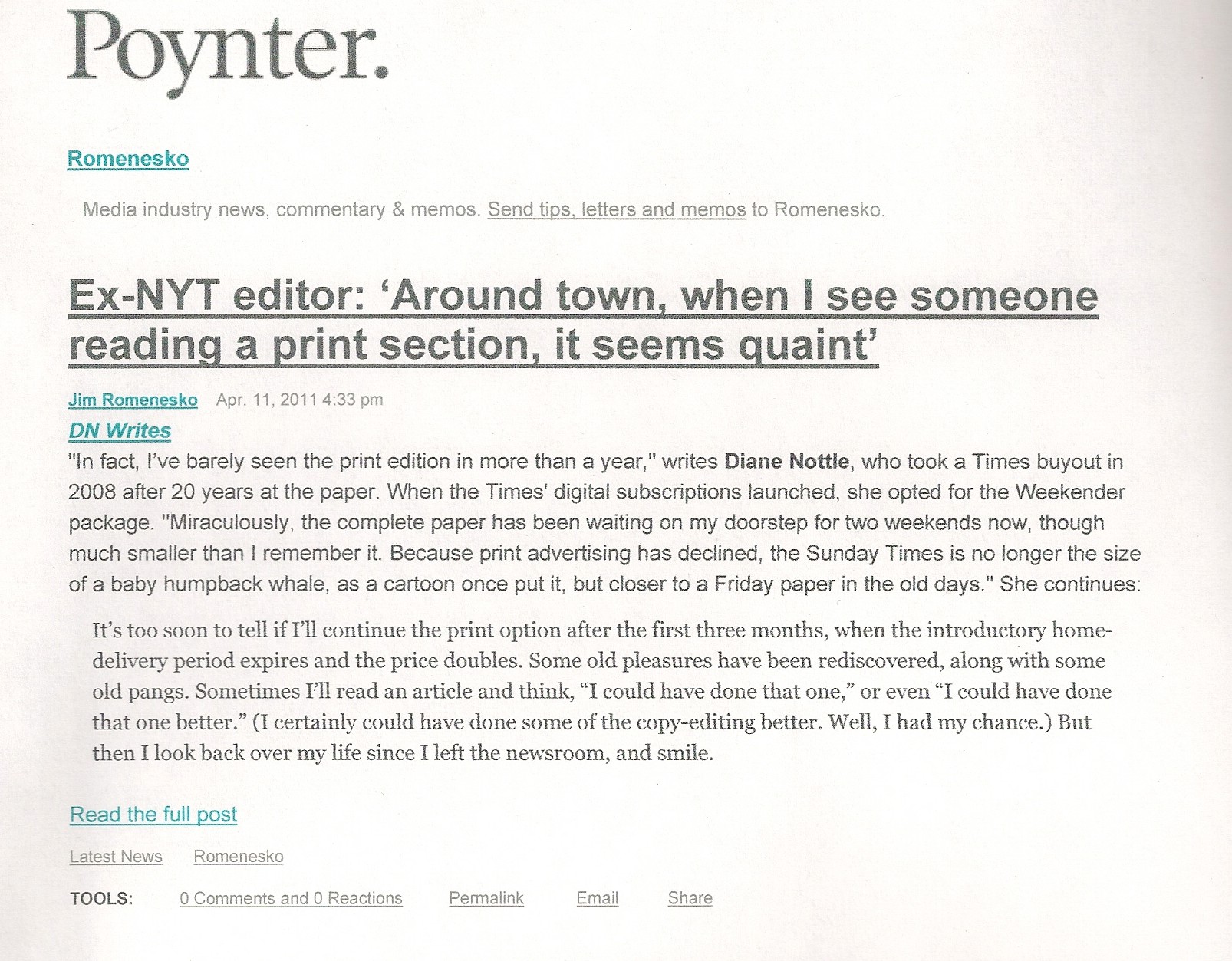
In fact, I’ve barely seen the print edition in more than a year. Even back in New York, I continued my foreign reading habits: logging on in the morning  to read the paper online like everybody else. Around town, when I see someone reading a print section, it seems quaint.

Then, two weeks ago, The Times started charging for full access to its website.

After a Times fellowship at Duke University in 1995 introduced me to something called the World Wide Web, I returned to work — at a time when I was the only person in my department with a personal e-mail account — overflowing with visions of the future. “But how will newspapers make money on the Web?” I was asked repeatedly. “Same way they always have,” I answered. “Advertising and circulation.”  Information may want to be free, and that was nice while it lasted. But professional journalism costs money, even if you’re not paying for paper, ink and delivery trucks.

Since I need full access to The Times for research, teaching and everyday life, there was no question I would sign on. A digital subscription costs $15 a month. But the Weekender home delivery package – which includes the features I’ve always called “the interesting sections,” long before I edited some of them  — cost only 20 cents more for the first three months. So I decided to experiment with going back to print, figuring that any sections that actually made it into my apartment were gravy. Miraculously, the complete paper has been waiting on my doorstep for two weekends now, though much smaller than I remember it. Because print advertising has declined, the Sunday Times is no longer the size of a baby humpback whale, as a cartoon once put it, but closer to a Friday paper in the old days.

“I think you’ll rediscover old pleasures,” said one friend whose own pleasure in reading The Times may be tempered by her continuing employment there.  I’ve certainly rediscovered old habits.

Newspapers, in whatever form, have traditionally served me as “second reading” – the second stage in my extended wake-up process. (“First reading” means a book in bed, after orange juice. “Second reading” is material that requires less focus, like a newspaper or magazine, and is done sitting up, with tea.) In the last year, “second reading” has meant booting up the laptop much sooner, going straight to a device that to my mind signals work, and reading The Times there, missing the relaxation factor.

With print, I still go to “the interesting sections” first. On Friday that means Weekend (which I could skip from 1999 to 2007, when I had edited much of the copy in it); on Saturday, Arts & Leisure. The news comes after that. On Sundays, since I’ve already digested A&L, I read the main news section first, then Week in Review. By that time, mental fatigue has generally set in, and it’s time to get up and move around. The rest of the Sunday sections are left on a pile for second readings throughout the week. Only then do I go to my laptop — and to nytimes.com for updates and breaking news, since what’s in print is already up to 12 hours old.

Reverting to print points up how differently I, and I suspect many others, read in the two media. Online, I start with the headlines “above the fold,” as we old-timers would say – the main news stories that are the equivalent of the front page —  and click on a few that grab my attention. Then I go to the Arts section, but again, I tend to call up only one to three stories a day, not read the whole report with care, as I once did. Opinion is next, and then it’s back to the home page to catch up with the remaining sections. Since only three headlines are displayed on each (many repeated for stories with overlapping disciplines), and since I rarely go through a section page, I miss a good deal of what used be to called “the scanning effect” – happening on stories unexpectedly by scanning multi-story pages. I’ve also realized I’m somewhat out of touch with New York cultural life, in large part because I’ve been seeing mainly reviews after the fact, not the print ads well in advance of events.

Online, I find I read text with less concentration, distracted by ads, multimedia features, e-mail and whatnot, but that’s the nature of the Internet. On deadline, I used to talk about “editing with my fingers, not with my brain”; online, too often I read with my eyes, not with my mind. In print, I tend to follow stories pretty much to the end (although I don’t turn to jumps, but catch up with them later); online, I’m far less likely to “turn the page.” Even in print, concentration dims  — for example, in the back of A&L, past the indispensible theater and film pages – and more often than I’d like, I simply turn the page. That section now takes me about an hour, compared to the three hours I’d happily spend with it each Saturday morning 20 years ago, getting a graduate education in the arts. For those who assume faster is better: that was a good thing.

The experience was more disorienting on the other side of the world. Reading The Times in different time zones makes it feel less like a newspaper, with well-defined daily editions, than a continuous 24-hour news report – which is, after all, the goal today. Last year in China, where I was conveniently 12 hours ahead of New York, I generally went online in the morning and just before bed, which were the times my friends were most likely to be online. They were also good times to read the paper, although deadlines for different sections divided one day’s editions into two. I could count on a fresh culture report in the morning, since that section closes at 5 p.m. in New York, but would have to wait until evening for the Opinion pages, which close hours later. Since the same headlines would often stay up on the home page for days, from the time they were “previews” until they were replaced by the following week’s sections, the report often seemed a bit stale.

It’s too soon to tell if I’ll continue the print option after the first three months, when the introductory home-delivery period expires and the price doubles. Some old pleasures have been rediscovered, along with some old pangs. Sometimes I’ll read an article and think, “I could have done that one,” or even “I could have done that one better.” (I certainly could have done some of the copy-editing better. Well, I had my chance.) But then I look back over my life since I left the newsroom,  and smile.

A story was told about Beverly Sills – I believe it was at her New York City Opera memorial in 2007 – that in her later years her husband had given her a ring, engraved, “I already did that.” Same  here.

UPDATE: This Sunday morning, the sixth day of home delivery, there was no paper on my doorstep. No great loss: I had already read the interesting sections in print and The Week in Review online late Saturday afternoon. I logged on to scan the headlines, read what I wanted of the Opinion pages and check the week’s Modern Love column.

Good night, sweet Jewish prince

This blog did not exist two years ago when my friend Alvin Klein, the longtime regional theater critic for The New York Times, died unexpectedly. I wrote this essay partly as therapy, partly as eulogy in the event that no one else at his memorial specifically addressed his years with The Times. That role was cast elsewhere, and in any case I would not have made it through. But this yahrzeit weekend seems a fitting time.

Heidi once introduced me to someone – I think it was Bonnie J. Monte of New Jersey Shakespeare – as Alvin’s boss. I nearly fell on the floor laughing. As if Alvin ever had a boss.

Everyone starting a career in journalism is given certain pieces of advice – for example, “Never agree to write a regular column” and “Never show your story to a source before it’s published.” Today I’m adding a new one: Never give the freelancers your home phone number.

Because if you do, they’ll use it. First they’ll call on Saturdays with questions about assignments. Soon they’ll start inviting you to use their second ticket, and then you’ll find yourself having long late-night talks about, say, how “The Iceman Cometh” exposed you personally as the world’s biggest fraud. And then you’ll find yourself attending their birthday parties, and their children’s weddings in far-off places, and their wives’ memorials. And before you know it, it’s today.

In 1995, I was leading a perfectly normal life when Chuck Strum stopped by my desk at The Times and asked, “Did you get my message?” I had not. Chuck had recently taken over the Sunday New Jersey section and wondered if I might be interested in becoming its arts editor. I didn’t know it then, but this was one of those moments that can change a life.

By summer I had started the job. It’s not unusual for editors to work with writers, especially freelancers, for years without ever meeting them face to face. (In this e-mail era, I freelance for a newspaper in Abu Dhabi where I’ve never even spoken to any editor.) In the first few weeks I introduced myself to Alvin and edited several reviews with him, all by phone. Somewhere along the line, he said, “What’s your home number?” I hesitated; I had been burned before. But for some reason, I gave it to him.

One day that summer, Chuck invited another editor and me to lunch in Jersey City with our bureau reporters there. I still knew next to nothing about New Jersey. I sat at the table listening to nonstop insider talk about Union County politics, wondering, “What on earth am I doing here?” Back at the office, I had no sooner sat down at my desk than a tall, long-limbed, shortwaisted man came up to me and said, “Hello! I’m Alvin Klein” – making a rare daytime appearance in the office to pick up his mail. (He much preferred late-night visits, after the theater.) We moved to a quieter area and talked, and talked, and talked. I know we talked about musicals; I think we talked about “A Little Night Music,” my all-time favorite, and that conversation was still going on in January [when Natasha Richardson and Vanessa Redgrave starred in a one-night benefit for the Roundabout]. Somewhere in the middle of it all, I thought: “Oh, I get it – those people talk about Jersey politics the way we talk about musicals.” Suddenly there was a we. Having Alvin to talk to was one of the things that kept me going on that job for nearly five years, and the conversation didn’t end when I left.

Soon I needed to assign a feature on the New Jersey State Opera. Our classical music writer was at Tanglewood for the summer, so I took a chance and called Alvin: “Do you happen to know anything about opera?” I soon learned there wasn’t much about opera he didn’t know.

Over the years, I came to realize what an incredible resource he was. I could call him to ask the most arcane question from the history of theater in America, and he could tell me the answer off the top of his head. When I moved back to the daily culture desk, he became my mole in the theater world. Alvin knew and cared more about theater than anyone else I’ve ever known — and I’ve edited four chief theater critics of The New York Times.

He could be absurdly prolific. One week he wrote seven pieces for the four regional sections; that’s more than some Times staff writers have been known to produce in a year. I remember one Thursday, our deadline day, when the page designer complained that he hadn’t filed at 4:30 for a 6 o’clock close, and I explained that he hadn’t been given the assignment until 1:30. Then, when I needed him to answer questions, he would disappear. It was years before I learned he was usually taking a nap.

Some of his pieces were incredibly beautiful – for example, his advance on “Rags” at Paper Mill Playhouse, a musical about Jewish immigrants to New York at the turn of the century that so moved him that he lent his father’s eyeglasses to the costumers for the run of the show. I tore up the arts pages on deadline to make it that week’s lede. Around the same time, he wrote an advance on “Do I Hear a Waltz?” at George Street that brilliantly summarized that rarely produced show from the mid-1960s, the only collaboration between Richard Rodgers and Stephen Sondheim, as the nexus between musical theater’s past and its future. One of our most heated arguments – and I was no more immune to those than anyone else – came when Athol Fugard had a world premiere at the McCarter, and the eminent Vincent Canby, then the chief theater critic, asked us not to review it so he could have the first word. Alvin fought me for a week on that one. Then he switched gears and went to Princeton anyway, attended a class Fugard was giving and brought all his expertise as a teacher to bear in writing one of the finest features of his career.

I’ve said more than once that when Alvin’s time came, I wanted to have the contents of his brain downloaded directly into mine – not the personal things, but everything he knew about theater and opera and New York. In the event, I missed my chance. And I would have liked to have memories of the original “Death of a Salesman,” and Alfred Drake in “Kiss Me Kate,” and Gertrude Lawrence in “The King and I,” and, of course, all the Sondheim – especially “Anyone Can Whistle,” the original production.

But I’m lucky enough to have my own memories of sitting next to Alvin in the theater, and that was always an education – sometimes sublime, sometimes ridiculous. He took me to the musical “Footloose” on Broadway – mainly because Janet was smart enough not to go  — and I never let him live it down. Once we went to the Public Theater to see Cherry Jones in a play so awful I can’t even remember the title, but we marveled at how such a fine actress could make us believe that she believed in every word. A couple of years ago, I took him to see the National Theater of Greece in “Electra” at City Center. At first he didn’t want to go. “Come on!” I said. “What could be more fun on a Friday night than watching a bunch of Greeks kill each other?” He went along. When I asked him if he was enjoying it, he answered, “I stayed awake, didn’t I?” Yes, we had a good time.

I don’t think I ever saw him look better, or happier, than the night I sat next to him and Janet at the New York Philharmonic’s concert version of “Sweeney Todd.” And I remember how we made peace after another major argument, just about a year after Janet died, by going to see “Falsettos” at Barrington Stage. We both cried through most of the second act, so you know it was good.

For a long time I’ve thought that, when today came, I would want to tell that story of my first meeting with Alvin. The trouble was, there’s a passage from Shakespeare that I happen to think is the most beautiful speech in the English language. I wouldn’t mind if it were the last words I heard on earth. For some time now, I’ve realized that the voice I’d like to hear reading it was Alvin’s, and I couldn’t figure out how we would manage both. Maybe when my turn comes, I’ll hear his voice in my head:

Our revels now are ended. These our actors,
As I foretold you, were all spirits, and
Are melted into air, into thin air;
And, like the baseless fabric of this vision,
The cloud-capped towers, the gorgeous palaces,
The solemn temples, the great globe itself,
Yea, all which it inherit, shall dissolve,
And, like this insubstantial pageant faded,
Leave not a rack behind. We are such stuff
As dreams are made on; and our little life
Is rounded with a sleep.

Back to school, via the scenic route

This essay is the product of an “assignment” given to me by Susan Shapiro in her recent workshop on how to sell a first book. As a way into a project that was just starting to take shape in my mind — a memoir of my experiences as both student and teacher of language — Sue assigned me a 900-to-1,500-word essay on how I became an ESL teacher. The essay is below; the book, “Traveling in Tongues,” is now well under way.

It’s finally happened. I’ve turned into the old-lady English teacher I was always meant to be.

Like the man who had that appointment in Samarra, running away from Death only to find it waiting at the end of his journey, I have long had an appointment  — not with Death (though eventually that, too, or so I hear), but with teaching. A 35-year career in journalism? That was just a detour.

I was the youngest of four children born over a 20-year span to a mother with a high-school education and a father pulled out of school after eighth grade to work in a shoe factory. Married at the height of the Depression, they spent their early lives scrounging for a living in rural Pennsylvania. But our  family was upwardly mobile in its own modest way. My three brothers all went to college and all became high school teachers. It was good, solid, steady employment when they graduated in the 1950s and ‘60s, and it paid well, compared to anything my parents ever made. As a child who did well in school, I knew early on that I wanted to go to college someday. And what we knew was this: you go to college, you come out a teacher.

Besides, playing school was always my favorite “let’s pretend.” (Producing my own one-sheet newspaper on a toy typewriter came in second.) In the basement of the neighbor kids down the road, somehow it was always the first day of school, and I was always the teacher. We had a decades-old green-and-red textbook titled “Human Use Geography.” I would start with the first chapter, about the Kirghiz and the Kazakhs, nomadic peoples who swept across the steppes of Central Asia on horseback. I had no idea what steppes might be, or even how the word was pronounced — one syllable? Two? But I was the one with the book in my hand, and thus I learned the first principle in methods of teaching: all you really have to do is stay one step ahead of the class.

School was a place where I could succeed, where I could win favor with adults  that was hard to get from parents who worked too much for too little, who rarely showed  affection and, in my father’s case, grew increasingly authoritarian. I adored my elementary-school teachers and often sat in class observing  their methods, thinking I would be one of them someday. In first-grade reading class (a skill I had mastered by age three and a half), we were taught to “frame” words with our fingers, to understand one at a time before stringing them together into sentences. “That’s an interesting way to teach reading,” I remember thinking. I was 6 at the time.

By junior high, I was starting to realize I didn’t want to spend my life trapped in a classroom with 30 kids. Not cute, not popular, just smart – the kiss of death for a teenager in small-town America – I looked for validation not from my peers (many of whom came to me for help with their homework) but from my teachers. I received it mainly from those in whose subjects I showed promise: literature, foreign languages, writing. “Great!” my parents must have thought. “She can go to East Stroudsburg State, and then she’ll come home and be an English teacher.” I knew differently. It was clear I’d have to earn my own living as soon as I graduated from college, and my business would be words. But I was already chafing at small-town life. Which old-lady English teacher would I become? Miss Bryan, who humiliated me in ninth grade for using “like” as a conjunction when “as if” was correct? Miss Sloat, the white-haired, straight-backed retiree who was much respected but intimdated me? Or Miss Paul, the eccentric who talked to her plants?

So I rebelled and fled to college – not East Stroudsburg — intending to be a writer. But I found the English professors pompous and discouraging. Having already started to work on the college newspaper, I declared a major in journalism instead. It was still the word business, and besides, it would give me job skills to tide me over until I could support myself as a writer. Surely that wouldn’t take more than a year or two.

Thus began the detour, not only from teaching but, as it turned out, writing. Early on, I realized I didn’t have the right temperament to be a reporter – which I assumed was synonymous with writer – but my ease with language brought me jobs as an editor. I worked my way up in classic fashion, from low-level  jobs to more responsible ones, from small papers to larger ones. My journey took me as far as The New York Times, a workplace by turns rigorous and rewarding, exhilarating and exasperating. In a hard-driving, politically charged environment where every day survived is an achievement, I served honorably for 20 years.

An editor works at a desk in the newsroom, not out in the wider world like a reporter. Yet my own world gradually grew ever larger, for I had developed a serious and expensive addiction: travel. From a two-month study-abroad in England at 20, I brought home a firm resolution — “I want to see the world”  — and over the years I had, one vacation after another, on multiple trips to Europe, three to Australia, 10 weeks circling the Pacific, cruises and sailing trips almost beyond number.

As time passed, I realized two things: sooner or later, The Times would come to an end for me, and if I wanted to spend my golden years traveling, I’d better find a way to finance it. The solution I came up with was teaching – not journalism, since a multimedia world had largely lost interest in the print skills I could impart, but English as a second language or, in current parlance, to speakers of other languages. In late 2005 I enrolled in the English language teaching program at New School University in New York. Two years later I had not only earned my certificate but also taught abroad, in the New School’s teaching practicum at the University of Lower Silesia in Wroclaw, Poland.  “Why are you doing this, when you have such a great career?” other practicum teachers would ask me. “It’s for someday,” I’d answer.

 “Someday” arrived within the year, in the form of the Great Newspaper Meltdown of ’08. The Times, looking to reduce staff by 100, had a buyout offer on the table, and I took it. Three days later,  just as I was reaching the “Oh, my God, what have I done?” stage, two invitations landed in my e-mail: one to teach that summer  in the American Language Program at Columbia University, and one to go back to Wroclaw. I jumped at both.

Standing at the head of a class takes me back to the neighbor kids’ basement. As a native speaker with professional training (much in demand abroad), I’m more than one step ahead of the already well-educated adults who are thirsting to improve their English. I enjoy breaking down lessons into digestible chunks and seeking out just the right readings or media clips to illustrate them. (I can’t wait for the next time I teach the tongue-twister “How much wood would a woodchuck chuck . . . ” as a pronunciation exercise, now that I have the Geico commercial that shows woodchucks actually chucking  wood.)  I also enjoy what I call “the kindergarten aspects of the job” – cutting and pasting materials, decorating a classroom with visual aids, devising scenarios that will help people learn. Most of all, I enjoy the students, who are so grateful for any vocabulary word, correct pronunciation or snippet of American culture that I can teach them.

After four trips to Wroclaw I’ve become a regular, and last spring my world widened yet again when I taught oral English in China for a full semester at Hunan University of Science and Technology. My repertory has broadened as well, from language into content: a course I was unexpectedly assigned to teach in China, “Cultures of English-Speaking Nations,” traveled well to Poland last October. So do the  teaching skills I learned in my ESL training when I make occasional visits to journalism classes as a guest speaker.

My hair is graying, I’m a big fan of Celebrex and I have no firm grasp of why the Kardashians are famous.  But I’m a stickler for proper English. (No text-message baby talk, please!) In short, I’ve turned into that old-lady English teacher, on my own terms. It’s not how my mother or even my most visionary teacher would have pictured me — leading a class on the other side of the world, almost within sight of rice paddies where peasants wade barefoot behind water buffalo. I haven’t seen the steppes of Central Asia yet, but in a world where “Human Use Geography” is available on Amazon.com, you never know what “someday” may bring.

Ballet, in theory and practice

                The three-month silence on this blog is a little embarrassing, but it’s not that I haven’t been writing; it’s that I have. These frigid, snowy weeks, I’ve been metaphorically chained to my laptop, shaping  the material gathered last fall in the dance studios of England, Stuttgart and Warsaw for the book on which I have been collaborating with Bonnie Robson, tentatively titled “The Leap: From Dancer to Director in 21st-Century Ballet.” This project lifted me out of the audience, where I’ve spent large chunks of the last 23 years, and deposited me behind the scenes as we examined the pivotal role of artistic directors in the world of ballet. Bonnie supplies the interviews she did over the last few years with 30 of them, from major companies in the United States and Europe. I supply the prose and, as of last fall, some color.

                While shadowing Reid Anderson of the Stuttgart Ballet for a few days, I spent a morning at company class. “You did company class?” Bonnie gasped when I mentioned it. “Of course not!” I hissed back. “I sat on a chair and watched.” This weekend, I took a little time off from the book to go one step further, donning T-shirt and leggings to take my first real ballet class in decades, at Dance Theater of Harlem.

                Let me be clear: I am a member of the Warm Body School of Dance Writing, as in “We need someone to cover dance – how about you?” (which is what essentially happened to me, as an editor, in my latter years at The New York Times).  I was never a ballet child; my rural upbringing and a body type inherited from my Pennsylvania Dutch grandmother saw to that. I took my first ballet class at 24 – “probably too late for a major career,” I explain when asked about my dance background, although I quickly point that Zelda Fitzgerald tried when she was even older. That first venture into the studio came in the early 1980s at the Joy of Movement Centers that proliferated around Boston then. While I never danced across the floor with any grace, I mostly did fine when there was a barre to hold onto. I stopped when I moved to New York – too many real dancers here – but continued to value the dance workout as a form of exercise. I’ve occasionally done the New York City Ballet Workout at health clubs; if I don’t look in the mirror, I feel I’m really dancing. Last year I took City Ballet’s two-DVD set to China and dutifully did the workout once or twice a week. Though I did not attempt the Balanchine “Tarantella” at the end of the second disk, I always let it play through for Louis Moreau Gottschalk’s delightful music.

                Two weeks ago, when Bonnie and I attended a Sunday Matinee at Dance Theater of Harlem – a mere six blocks from my apartment — I squealed when I saw an ad in the program for adult ballet classes. “Do you take old, fat people?” I asked our colleague Virginia Johnson, DTH’s artistic director, mindful of the figure I cut at a chic Pilates salon on Central Park South. “We take anyone,” she assured me. So, despite a chronic lower-back problem and the fact that I can remember Eisenhower being president, I decided to try it out on a $10 single ticket before committing to a 10-class card.

                It was almost a private lesson, since only one other student showed up on a 20-degree day. The teacher, while charming and encouraging, was a substitute;  I will have to go back to make an accurate assessment of the weekly class and my body’s ability to participate. “I may do class a little differently from what you’re used to,” she warned at the beginning, and in fact the class was not what I expected. Instead of a full battery of barre exercises, working our way up from simple plies and releves, she gave us short barre combinations right away. The session showed I have the same problems as always (shoulders popping up, chest pitching forward, flat back hopeless) and a few new ones (grand plies are history  – too much knee strain from five months of Asian toilets). I still look too much like the dancing hippos in “Fantasia.”  But I made it through class and plan to go back next week.

                From DTH I raced to the subway, for I was due at Lincoln Center in 45 minutes. City Ballet was celebrating Balanchine’s 107th birthday with a full day of performances and special programs. Appropriately, I had signed on for “But First a School,” a rare public class for students from the School of American Ballet onstage at the New York State Theater (as I intend to keep calling it; I decline to recognize the right-wing billionaire whose donations bought him the right to put his name on it). Suddenly I was back in the world of black leotards over pinkish tights, with Peter Martins – my very own ballet master on those DVD’s! — running the show.

                In the onstage class, he explained to the audience, SAB’s senior class would do “what we do every day, from children to the time we retire – it’s like brushing our teeth.” The routine is fairly mechanical: from warm-ups and stretches to series of plies, releves, tendus (who knew there were three kinds?), developpes and so on, all the way up to battements and jumps. An onstage pianist provided the music, mostly snippets of Gershwin (“The Man I Love”), Irving Berlin (“What’ll I Do”) and other popular songs of the early 20th century (“Tea for Two,” “Ain’t She Sweet?”) that must sound as ancient as Bach to the students.  Martins recalled a piece of advice Balanchine gave him in his early teaching days:  “Don’t choreograph.” Class is for practice only, the repetition of basic steps with an eye toward perfection. Choreography comes later.

                As always at the ballet, I marveled at the 36 teenagers onstage: their strength, their control, their mastery of positions and movements I could never hope to emulate, not at their age, not even if I’d had a lifetime of training.  Their tendus were so quick and sharp, their hands so graceful in the position Balanchine prescribed “so you see all five fingers,” as Martins explained. “Don’t hang on the barre!” he barked  – oh, you mean the way I did an hour ago?  The gap between these young dancers and my efforts was infinite, and humbling. (Even Martins made concessions to age. Dictating one combination, he said: “Don’t ask me to demonstrate. I’ll have a heart attack!”) Yet it felt good to sit there and watch, still feeling the stretch and warmth in my muscles. Ballet workouts may feed my fantasies, but this dual-class day also served a practical purpose, giving me a feel for what the people I’m writing about have gone through, and some muscle memories of my own.

                On the bus home, I searched my iPod playlist for ballet music to sustain the mood, but the best I could do was “On Your Toes,” the 1984 Broadway cast recording. The show was originally choreographed, back in 1936, by George Balanchine. (“Slaughter on 10th Avenue” is a perennial favorite in the City Ballet repertory.) It was, after all, his birthday, a day well spent on dance in all its forms.

Diner’s journal

                The night I arrived in Wroclaw three weeks ago, Agnieszka invited me out for dinner. “Where would you like to go?” she asked. Without having to think twice, I answered: “Hotel Tumski. Pierogi.” 


             “You want to go to the Tumksi for pierogi?” She sounded as if she didn’t quite believe that’s what I really wanted.

                But  I hadn’t had jao zi in months. And what are pierogi but the dumplings I so enjoyed in China by another name, in another culture?

                My tendency on my first night back in Wroclaw is always to “go home for pierogi.” Originally “home” meant the Hotel Jana Pawla II, where I lived my first summer here and became addicted to the talerz pierogi, or pierogi plate, a mix of dumplings stuffed with meat, potato and cabbage, topped with savory minced bacon that flavors the entire dish. In later years I somewhat shifted my loyalty to the Tumski, where the pierogi are lightly fried. Since the Tumski is closer to where I’ve lived these last three times, it’s become the default choice, especially since its riverside terrace is such a pleasant place to while away a summer evening. In the fall, the giant umbrellas have been folded and the door is firmly shut, but the old-Poland dining room is warm and cozy. (The Tumski is building a restaurant barge next to the terrace. I hope that won’t ruin the outdoor ambience.)

                This year I feel as if I’ve eaten far less Polish cooking than usual, possibly because I’m the only one here and not having dinner, along with post mortem on the day’s class, with other teachers almost nightly. It may also have something to do with the fact that the restaurant closest to the Opera House, Pod Zielony Kogut (Under the Green Rooster) is strictly limited to pizza and salads, though very good ones.  The three P’s – pizza, pasta and panini – have become inescapable throughout Europe these last few years. Oddly, though, at this writing I’ve made it to my beloved Pronto Pizza only once. It may have something to do with the fact that it, too, has disassembled its terrace by the fountain on the crescent-shaped plaza behind the University of Wroclaw, where I like to sit out in the soft evening light and read The New Yorker while enjoying a pizza diavolo, Greek salad and a glass, maybe two, of South African white. Like the Tumski, Pronto’s tiny dining room, just six tables for four each, feels extra-welcoming when the cooler weather sets in, warmed as it is by the pizza oven, and the table by the door with the lamp in the window turns out to be a fine spot for reading.

Imbir after rush hour.

               You know you’re becoming a regular at your local milk bar when you don’t have the right change and the cashier says you can owe her a zlot until tomorrow. Such was the case last week at Imbir, next door to our program’s office building, Waganowa 9. Except for a small canteen in our classroom building, it’s the only handy place to eat in this former factory area, but the food is cheap and good. Imbir serves pierogi in various forms, as well as nalesniki (pancakes) with your choice of stuffings (in summer I order the fresh raspberries), stuffed cabbage, and fish on Fridays. I favor the filet z kurczaka,  a simple, lightly breaded chicken cutlet dotted with sesame or sometimes pumpkin seeds that is about as good as fried chicken gets. (I’ve had the same dish at a very nice sit-down restaurant on the Rynek, and it wasn’t nearly as good.) If I’m extra-hungry on a given day, I order frytki; if I’m being good, a heaping dish of Polish salads – carrot, cabbage, cucumber, though never beet for me – from the salad bar.  New this year: prepackaged green salads with corn, kidney beans, black olives and a protein, egg chicken or smoked salmon  — a light meal for a Pole, an appetizer or side salad for us. The cook apparently cannot bear to send out a plate naked except for the chicken, so on the days I don’t have frytki, she garnishes it with a leaf of bibb lettuce.

                Since my garret has no cooking facilities, I’ve faced the terrible hardship of having to eat all meals out,  revisiting favorite haunts and trying new places, many of them international. I notice several new sushi places and an Indian grill, none of which I’ve tried. I’ve barely been to the Rynek, the market square so carefully restored after the destruction of World War II, and when I did go there, I found some distressing changes. If the place that served the wonderful salad plate with beef tenderloin, covered with smoked cheese, is still there, I failed to find it; I know roughly where it was, but it may have changed ownership, cuisine and menu.  Also apparently gone was Ready, part of a chain that was a reliable source of  generous but inexpensive plates of kebabs, gyros and souvlaki.  Something called Greco had taken its spot.  When I went inside, though, I found that the name was the only thing that had changed – not the interior, not the food, not even not the multipage plastic menus. They’re the same ones that have been there all along, just a little worse for wear.

                At Pasaz Grunwaldzki, the shopping mall where I sometimes go to the Multikino if my movie of choice isn’t playing at the Helios downtown, I decided to pay a return visit to the Wok Restauracja, where I enjoyed a fast meal last year. It serves small dishes of Chinese dishes cooked freshly and quickly, under the rubric  “The Authentic Taste of China.” Well . . . no. This year has raised my standards for Chinese food almost impossibly high. I ordered fried rice, “lotus stalk salad” and spicy beef.  “It’s very spicy,” the waiter warned me in English, not knowing whom he was dealing with. Very spicy? Not even close. The lotus salad consisted of julienned carrots, cucumbers, zucchini, peppers and a few limp slivers with the texture of white asparagus from a jar, in a slightly sweet pickle dressing that is a staple here; the white stuff could, just conceivably, have been canned lotus root, but it bore no relation to the crisp vegetable I grew to love in China. The fried rice was better than the generic version that comes on the $6.95 lunch plate at Empire Kyoto on Columbus Avenue, but the Fried Rice Master of Xiangtan would cringe.

                Bistro Parisien, known to the New School Practicum Class of ’07 as “the French place,” closed for renovations last summer just as my time here was beginning. It has now reopened, but I’m afraid we’ll have to cherish our memories. It has abandoned smoky old-time French atmosphere and gone upscale, with white tablecloths (though paper napkins), wine glasses waiting on the tables, and walls painted scarlet and white, hung with vintage photos of Paris. A neat magazine rack has replaced the window bin of French books suitable for mealtime reading. The salads we so loved have been replaced with new salads – hard-boiled eggs instead of warm poached ones, bits of undercooked bacon instead of chunky golden lardons,  no homemade potato chips lining the bowl. The French onion soup was too full of bread for my taste – but then, the creamy mushroom soup at the Tumski was too full of tiny dumplings, more like spaetzle, for my taste, which suggests that maybe the Poles like their soup filleed with carbs. I arrived too late one night to try the nalesniki, which you’d think would be called crepes in a French bistro, but then, the staff doesn’t speak French. I have a feeling I won’t be back for the crepes anytime soon, despite the generous amuse-bouche of excellent herbed, marinated olives and the solicitous staff.

                Just around the corner from the art academy where l’m living is Abrams’ Tower,  which I’d heard touted last year as source of wonderful Mexican food. I had previously sworn off Mexican food in Poland (as I have bloody marys) after a meal in which the salsa was essentially ketchup and it was not clear what the meat in the fajitas was – possibly pork.  Abrams’ Tower is owned by a Californian, so I had some reason for hope. The tower itself is 13th-century defense tower; the food is the best Mexican food I’ve had in Poland, which, sadly, isn’t saying much. The mojito tasted just fine and, in a country where wine is served in 20-milliliter portions,  came in a 16-ounce glass with plenty of ice cubes. As for the nachos: the homemade tortilla chips were very good, but the little finely grated cheese that had been melted on top of the pile had already congealed, and the salsa and sour cream – no guacamole in sight — were ice cold. My chicken burrito was more like a smallish soft taco, and the two chicken taquitos that accompanied it were like spring rolls. The best thing on the plate was the spicy side of black beans, and the Mexican salad that was supposed to come with it didn’t.  I had been hoping to become a regular there, since it’s so close to home, but I haven’t made a return visit.

                Nor have I been back to Convivio, but that’s no fault of the restaurant. This lovely, if slightly formal, Italian restaurant is in the old Dominican convent near the Galeria Dominikanska mall that some years has a streetside café, some years doesn’t.  All I ordered was pasta and a glass of wine, but the penna alla siciliana was cooked to perfection, with plenty of eggplant cubes, giant capers and cherry tomatoes. It was preceded by a roll so fresh from the oven that I burned my thumb when I dug in to break it. Simple as it was, my meal was magnificent – and on a Friday night, I was the only one there. I hope Convivio stays in business until next summer, when it should be delightful to dine on the adjacent off-street terrace.

                Saturday was a poorly plotted day, nutrition-wise. I had just a banana and a leftover nalesniki z dzem (jam)  from Imbir before  the morning water aerobics class, then an orange to tide me over while I walked up to Cathedral Island for some shopping and picture-taking on a perfect fall day. I thought I’d have lunch up there, but the Jana Pawla was, as so often on a Saturday , setting up for a large party. Next choice was the restaurant I know only as The New Italian Place in the River. Since that was some distance away, I made a stop at Cafeterie Chic, that charming little coffee-and-dessert place on the way to the cathedral.  It has tripled in size, taking over two more rooms on the same floor, all beautifully furnished in old Mitteleuropan style with dark woods and mustard-colored walls, comfortable leather chairs, a sepia panoramic photo of the Wroclaw skyline,  and contemporary Chinese panel paintings, heavy on the gold. Service was either leisurely or confused, depending on how you look at it:  the waiter who had already taken my order at the counter then came to my table to ask if I was ready, and none of the three bruschettas on the menu was available. But the pastries looked and tasted as good as ever.

                A wedge of cheesecake with toffee sauce held me for another hour or so, through a serious shopping stop and a walk across Sand Island to The New Italian Place, which I was shocked to find full at 3 p.m.,  and fully committed for the rest of the day. So was the next restaurant in the same building. I turned back toward the Tumski, which also had one large party and “reserved” signs on most of the other tables. Saturday is, of course, a day for weddings, though none  of these parties was. I was reminded that Poland is a table culture – that is, people tend to socialize with family and friends by sitting around a table with food and drink, as opposed to mingling with strangers at cocktail parties and receptions, the New York way. At any rate, I finally got lunch.