Red tape

I am walking around China naked.

Not literally, on either count. I’m walking around Guangzhou, not China, because my current state of nakedness precludes going anywhere else. As of today I have no passport, or even a Foreign Expert Certificate. In European terms, no papers. No identification except a campus card and my ID NYC, which I suspect doesn’t cut much ice here. Once again, and just in time for a weeklong national holiday, I am grounded.

For those who witnessed my pre-departure meltdown last month, the rest of this post will come as no surprise. For those of you who didn’t: the paperwork allowing me to apply for my visa arrived on the Wednesday evening before my scheduled Tuesday departure. I took it to the Chinese consulate on Thursday morning, expecting the same-day service advertised on the website, which had worked just fine five years ago. “You can pick it up Monday,” the clerk said. “But I want the same-day rush service. I fly out Tuesday.” “We don’t do that.” For Americans that is cutting it way too close, and I very nearly canceled the whole semester.

As it turns out, that was just the beginning.

If one thing, beyond getting fired and/or deported for blogging, makes this my last working trip to China, it’s the bureaucracy. Americans don’t suffer bureaucrats gladly, or at least I don’t, and New Yorkers are particularly bad at waiting in (not on) line. In China, there’s never one step when three will do – like needing a third medical exam to use the pool outside my window. Or getting my own private, functioning Internet connection, a three-step process with China Telecom: buying a router online; going to China Telecom to set up an account; and finally making an appointment to have the router installed. Say what I might about Time Warner – and at the moment I have plenty to say — the process would take one phone call and one appointment.

Americans have a word for this kind of thing. It has eight letters, begins with a B, ends with a T and has an S in the middle, and it’s not very nice. The Chinese just call it life.

First there was the trip to the bank to set up an account so I can be paid, allegedly next Wednesday. Then the trip to get a local SIM card for a cellphone that I barely use but seem required to have. Not one trip but two to the photo shop to get enough little photos to hand around for all bureaucratic purposes – five for the medical exam alone. There I had to sign a receipt affirming that, yes, I was the person in the photo. (Doesn’t the photo itself confirm that?)

At the medical exam — never mind that I had already had one in New York — the first hour consisted entirely of bureaucracy. You wait in one line to confirm your appointment and get a number to wait in a second, then go next door to get your passport copied (which could have been done in advance), then go to the second line, whose sole purpose, as far as I could see, is to take a number for the third line, for the cashier (who takes your picture). Then you go across the street for the exam itself, which consists of about eight Stations of the Cross, from bloodwork to blood pressure to ultrasound of internal organs. At the end you’re handed a slip of paper and told to come back in three days to pick up the report. I was crestfallen to learn I’d have to go back; I would have to hightail it back to campus at rush hour on a Friday from a neighborhood with no taxis so that the application for my Foreign Expert Certificate could go into the mail immediately. The deadline was tight, I was told, and there’s a penalty for missing it.

The next day I went for my campus card, which took some time because the clerk let himself be interrupted by every Chinese person who cut in at my window. (They’re not shy.) Once I had the card, I asked to put money on it, which I’d been told I could do to pay conveniently for just about everything on campus. The clerk said something I didn’t understand about the canteen in another building. A few minutes later, I ran into my main handler, who explained that that office can’t accept money (no, just the fee for the card, which I guess isn’t money) but the canteen office can. In the meantime, I should come by her office to get the letter that would allow me to get a library card. Thanks, but another time.

Two days later, while waiting to sign some paperwork after delivering the medical results, I jubilantly texted my handler: “Got health report. Want pool card!” She texted back that I needed that third health exam to get it, and she’d tell me where. In the end, I decided to skip the exam, write off that pool (which no longer seems to be open all the advertised hours) and use the one at the hotel down the street. It costs more, but it’s freshly filled, has fewer screaming kids, supplies big, fluffy towels and is open whenever I want to go. At some point you have to decide which bureaucracy you have to put up with, and which you can simply avoid. That night, I turned off my phone and opened the sauvignon blanc early.

The final, most important piece of bureaucracy — the residence permit — is unavoidable. For once Hunan beats Guangzhou: one (admittedly harrowing) trip to the medical clinic; one trip to whatever office issued the residence permit; one week without a passport while the permit was processed. Here I was told there would be a return visit to pick up my passport and permit. I could have lived with that.

The first visit was scheduled for yesterday, one week before the national Golden Week holiday begins. I had booked a week on a Hainan Island beach and was concerned about having my passport back in time. (Without a passport, I cannot fly, check in at a hotel or, I’m told, buy a train ticket for so much as a day trip.) No problem! my handlers assured me; Immigration would furnish a piece of paper stating the permit was in progress and allowing me to travel. I had my doubts.

Off we trooped – another American, our student assistant and I – to wait 90 minutes in one department, then 40 more in another. I surrendered my passport; the assistant held onto our Foreign Expert Certificates to return to her office. (When I asked for mine, explaining that I had always had mine in Hunan, she said, “Different universities have different rules.”)

But that paper that would supposedly allow me to travel within mainland China did not materialize. For an extra 20 yuan ($3.50), I could have my passport and permit mailed; it might make it in five business days, but no promises. Five business days means next Wednesday – the last day before the country shuts down. “So there’s hope!” the student assistant said brightly. Sure, if you’re still young enough to believe in hope. Back home, as soon as I could connect to the Internet for more than five seconds, I canceled my booking. If the passport and my pay land in time, I may be able to get another one — if everything isn’t sold out.

It doesn’t matter, I tell myself. I’m already away. I can spend the time exploring Guangzhou. Five years ago I couldn’t wait to come here from Hunan for the Dragon Boat Festival.

I am lying. Well, one good lie deserves another.

What is this all really about: China’s centuries-old tradition of bureaucracy? Keeping everyone employed? Or, as a more seasoned American here stated flat out, control? To me it’s simply an exhausting (especially in 90-degree heat and 150 percent humidity), infuriating waste of time and energy that could be better spent – for example, on my students.

I’ve met one American teaching at this university who keeps coming back, another who’s been here 10 years, another five. Do they have to go through the same bureaucratic nightmare every time? And if so, why do they keep coming back? Something here must be worth it. I still think the work I’m doing is exactly what I should be doing at this stage in my life. I’m just not sure I should be doing it here.

The September scramble

Chinese water torture: the pool I haven't been allowed to use, with my building in the background.
Chinese water torture: the pool I can’t use, with my building in the background.

Labor Day is the saddest day of the year at Riverbank State Park on the Hudson in Manhattan. At 6 p.m. the park’s two pools, having been largely turned over to the kids all summer, close for a month for cleaning and other maintenance. The plugs are pulled, and two days later, the pools have drained. And I start my annual scramble for a place to swim. Chelsea Piers on guest passes, the 92nd Street Y on Groupon, the Southold town beach within walking distance of a friend’s house – I’ve scrambled to them all.

Spending this September in Guangzhou, I thought I’d be able to skip the scramble. “Do they have a swimming pool where you are going in China???” asked Georgia Keghlian, chief usher at Circle in the Square, when I took nights off so I could make the evening adult swim at Riverbank. Actually, there are two, right outside my window. But I haven’t been allowed to use them, so once again I’m scrambling.

Why? It seems you have to pass a health examination before being issued a pool card. I arrived two weeks ago and couldn’t get an appointment until last Tuesday, with a three-day wait to pick up my results on Friday. In the meantime, I’ve listened to the sounds of happy swimmers outside my window every evening. (No self-respecting Chinese would swim outdoors in the daytime. They might get a suntan, which would mark them as field workers. They carry umbrellas as shields from the sun as much as the rain.)

When I taught in Hunan five years ago, I spent my first month with noplace to swim and thought I was going to die. Guangzhou is semi-tropical, though, and nearly every hotel boasts at least an outdoor pool. The only Guangzhou listing for a public pool I could find on my standby, swimmersguide.com, sounded disgusting. So, as a stopgap until I passed my health exam, I adopted the philosophy of my friend Leslie: “To make a problem go away, throw money at it.”

I had read about a W Hotel apparently not far from campus with a lovely pool that charged $40 a visit. Since my record for a swim is $116, I thought I could swing that once a week. I started scouting Booking.com for inexpensive hotels with pools where I might check in overnight on a weekend to buy two swim days. Somewhere on the Internet I found a Ramada advertising a Wellness Center with indoor and outdoor pools. But there are two Ramadas within striking distance of campus. Which one?

I phoned one to ask about its policy, and a very nice man told me yes, the pool was open to the public for 30 yuan (less than $5) a visit. Was it within walking distance of Jinan University? “Ten minutes away.” I checked a map, though, and it didn’t seem to be nearby, so I marched out to the South Gate, got into a taxi and asked to go to the Ramada Plaza. Good thing I took the cab: the Ramada is 10 minutes from another Jinan campus.

At the pool I looked for a place to pay my 30 yuan, but a lifeguard simply nodded toward the changing room. The pool has two shallow areas and one deep one, which is rectangular and, while short of Riverbank’s 25 meters, good enough for laps. Midway through my first visit, the lifeguard and a Chinese swimmer gave me big smiles and thumbs up – a compliment on my swimming.

Afterward, I asked at the front desk if there was another Ramada with a big outdoor pool; indeed there was, the Ramada Pearl, and a young woman behind the desk wrote out a card with its address in Chinese. “We have a very nice pool here,” she added. No one seemed interested in my 30 yuan, so I bought the breakfast buffet in thanks and took a cab home.

A few days later was a national holiday, so I set out for the Ramada Pearl, which was indeed the one with the Wellness Center. At 9:45 a.m. it cost 300 yuan (about $47), but if I waited 15 minutes, the desk clerk said, it would be just 150. I waited five before she said, “You can go now.” On the other side of the locker room was an indoor pool suitable for laps and the resort-caliber amoeba-shaped pool mentioned in a previous post. The shape makes it less than ideal for laps, though the Chinese swim around it in big, lazy circles. I found a bay just the right depth for water aerobics and, armed with my aqua disks from Wroclawskie Centrum Spa in Poland, did an hour’s workout.

The chaises are hard, and the quiet is punctuated at regular intervals by older men performing the Chinese salute. I’ve filed the indoor pool in my head for when winter comes, which I’m told is in November. Still, the Ramada Pearl is a fine place to spend a day reading by the pool and, yes, tanning.

I was still hoping for something within walking distance of home. An indoor pool at another university nearby seemed uncongenial. Then, sitting in a second-floor window at (OK, I admit it) McDonald’s, I looked across the street and saw the Vanburgh Hotel. I went on another reconnaissance mission. Did it have a pool? Yes. Was it open to the public? Yes, for 100 yuan (about $16). It was currently closed for cleaning, but it would reopen on Sept. 12.

At 4:30 p.m. on Sept. 12, I returned, cheerfully handed over 100 yuan and proceeded to the sparkling pool. Its curved form made lap-swimming disorienting, so I got out the aqua disks and started aerobics. The 1.4-meter depth is just a little too buoyant for my 5-foot-4 body to do aerobics comfortably, but I managed, moving more languidly than usual among the stone seals (or are they sea lions, like the ones I once swam with in the Galapagos?) spouting water. The Vanburgh was a winner.

So now I have my choice of three pools: the Ramada Plaza for laps, the Pearl for a relaxing day poolside and the Vanburgh for quick trips at the end of a workday or between monsoons. As for the pools outside my window: as soon as I left the clinic on Friday, I texted my main handler: “Got health report. Want pool card!” She texted back: “The swimming pool is open until mid-October. . . Need to bring 2 photos to do a different physical exam in the university clinic.”

Another health exam, for a pool that’s going to be open for a few more weeks, one of which I intend to spend at a beach hotel on Hainan Island with its own pool?

Maybe not.

Columbia on Huangpu

DSC_0095

After two weeks, the “Fun Home” earworm has finally left my brain. (Sorry, Jeanine, Lisa and cast, but that’s what happens when you’ve ushered a musical for five months.) It’s been replaced by Rodgers and Hammerstein: “It’s a Darn Nice Campus,” from “Allegro.” That’s the tune I now hear in my head and hum as I explore Jinan University in Guangzhou.

There’s no ivy on the walls, but there are palm trees, a lily pond outside my door and lush greenery befitting the subtropical climate. (Humidity has averaged about 150 percent since I arrived.) Considering my experiences in Hunan five years ago (Monthly Archives, March to July 2010), my first week at Jinan has come as a very pleasant surprise.

Jinan University dates back to 1911, when China still had an emperor. Founded in Shanghai and reopened in Guangzhou after the 1949 revolution, it was the first university in China to recruit foreign students, according to Wikipedia (accessible via VPN), and its International School alone reported having had more than 3,500 as of spring 2013. (Last spring it hosted a group from the University of Louisville.) That school has nine programs taught in English, ranging from International Economics and Trade to Food Quality and Safety to International Journalism, which is where I come in. That program is a joint venture of the International School and Jinan’s School of Journalism and Communication, ranked as one of China’s top 10 by the China Academic Degrees and Graduate Education Development Center in 2013.

South Gate and Main Teaching Building.

Jinan strikes me as an Asian twin of Columbia University, just four subways stops from home. (I’m told the subway station is diagonally across campus from me, but who needs the hassle when taxis are ridiculously cheap and stop five minutes from my door?) The main campus is a rectangle in the middle of Guangzhou, or at least it feels like the middle to someone who has barely begun to explore this sprawling city of 2,800 square miles and 14 million people. Its walls have three gates: the south or main gate, with its semicircular arch, and smaller, more utilitarian ones on the north and west, primarily for traffic control. The west gate is less imposing than Columbia’s wrought iron at Broadway and 116th Street, but it does open onto streets of shops and restaurants reminiscent of Morningside Heights, only busier. The imposing Main Teaching Building faces the imposing library across a plaza not unlike the Columbia quad. Like Columbia’s work in progress uptown, Jinan has a second campus north of ours; I will see it on Sunday, when I’ve been “invited” to be a guest speaker at freshman orientation.

DSC_0005Those who saw pictures of my apartment in Hunan may relax. (If you’re on my Snapfish list, don’t expect to see an album anytime soon. So far I’ve been unable to upload photos successfully.) The six-story Foreign Experts Residence reminds me of the apartment hotel where I’ve twice stayed in Shanghai. The living-room suite is massive, but here faux-leather teal upholstery cushions the wooden frames. The mosquito netting coiled over my bed like a fabric chandelier is too pretty to use, even though, living between the lily pond and a swimming pool, I’m covered with bites. The bathroom is real, with basin, tub and shower, as opposed to a toilet stall with showerhead. The kitchen is equipped with a working refrigerator and microwave oven, but no stovetop. Instead, it has a hot plate I haven’t yet figured out how to use, since the buttons are all labeled in Chinese. The eggs I bought a week ago sit in the fridge, awaiting instruction. The air conditioning is so efficient I have to turn it off frequently. There are washers on every floor and, as everywhere in China, a balcony for plein air drying.

About that swimming pool: there are two, actually, but I’m not allowed to use them until I pass a medical exam, scheduled for tomorrow morning, with results unlikely for another week. Given temperatures in the 90s and that humidity, I spent Labor Day weekend — which came early for me, with holidays Thursday and Friday for that big military parade in Beijing – exploring the pools at local hotels. I found two friendly Ramadas, one with a serviceable outdoor pool big enough for laps, the other with both an indoor pool (which may come in handy when the weather cools, as I’m told it will) and a resort-caliber amoeba-shaped outdoor pool with islands and a swim-up bar. Both are within range of a $3 cab ride. Another university just north of us also has two pools and apparently requires no health certificate. The outdoor Swimming Center was not admitting guests when I stopped by yesterday; the indoor pool was swarming with kids, and the ticket-seller refused to admit me unless I bought a latex swim cap from her, though my bag contained two Lycra ones. I took a walk instead.

Classrooms are comparable to those in Hunan, but in much better condition — and the technology actually works. Yesterday I shlepped my laptop to class in hopes of starting off my English News Writing course with a cautionary tale, the “Independent Lens” documentary on Jayson Blair, only to find the classroom computer could play my American-format DVD. (And it was quite a trip to see New York Times faces like Al Siegal, Bill Schmidt and Lena Williams in my classroom.) The campus restrooms may be be Asian and devoid of toilet paper, but they’re clean! And the International School provides an office and support staff.

Even on this smaller campus, I have yet to run into any of my students outside class. In Hunan I could scarcely turn a corner without hearing, “Hi, Diane!” or “Are you the new foreign teacher?” But there I had more than 200 students, and here just 24 so far. (In a week or so I’ll add a class of freshmen, about 30.) One only pedestrian, a man whose name I heard as Wujian, has accosted me on the street and walked me home to practice his English. But he did, as I recall, as if I liked Chinese food. Some things never change.

Disconnected

They weren’t kidding about the Great Firewall.

I knew about the Chinese government’s policy of blocking more than 2,700 websites it finds threatening for whatever reason, but I didn’t experience it until this week. When I taught in Hunan province five years ago, the problem wasn’t blocking (though I did notice that most attempts to Google brought up the Chinese browser Baidu instead); it was the laughable Internet connection in my apartment. The New York Times? No problem, if I could connect at all.

But it seems Google had already been blocked in 2009. Gmail followed in 2014, and so have Google’s other offshoots. As for The Times, in 2013 its Shanghai correspondent, David Barboza, won the Pulitzer Prize for International Reporting for his front-page expose of corruption at high levels of the government, and The Times became newspaper non grata. Twenty-five years ago, Dave was writing harmless little features for me for a long-defunct section called the Sunday Main 2. Now he’s gotten my morning “paper” blocked. Thanks, Dave.

I’d had hints from Chinese students at the CUNY journalism school. One applicant whose English I was asked to assess worried that Skype might be blocked and suggested an elaborate Plan B for our interview; I told her I’d never had a problem Skyping to China before, and in the end we didn’t, either. A new student this fall, with whom I’d been working remotely over the summer, offered to help me set up a VPN, or virtual private network, which encrypts data and effectively disguises where it’s coming from. I thanked her but said I was planning to set up a VPN through my security software, Avast.

I didn’t move fast enough. Avast offered seven-day free trial, which I activated just before leaving home and figured would last into my first few days in China. In Hong Kong (a special administrative region where the blocking does not apply) I had no problem connecting and blithely ignored Avast’s advice to subscribe today. I had other things on my mind, like jet lag.

Then I arrived at my apartment in Guangzhou. A building staff member gave me a username and a password, along with an Ethernet cord as a backup to the wifi. She briefly established a connection, but then I shut down my laptop and lost it. For the next three days, I had no luck signing in and couldn’t figure out why. Was I misreading the username and password? (Well, that, too, as it turned out.)

When the situation was becoming urgent – the first of the month loomed, and my New York rent was due — the problem was solved the way all foreign teachers’ problems are solved here: I was assigned a student to help. This one came over to my apartment and had assessed the problem within minutes: to sign in, I had to connect to a browser. What’s my browser? Chrome. As in Google Chrome.

He returned the next day with a flash drive containing a Chinese browser and a (free!) VPN. Both student and VPN shall remain nameless. Now Gmail and everything else (including Facebook, also blocked, and YouTube, on which I rely for teaching material) are humming along, at least on my laptop. (My e-book and iPod Touch are another story. The browser on the e-book is, of course, Chrome; I find I can’t Google but can connect to some specific addresses.) They’re blocked on the university computers, though, so I’m devising systems for e-mailing work I’ve done at home to my CUNY address and printing it in the office. (The apartment has no printer, though I’m heading to the mall today to look for a cheap one.) I haven’t yet figured out how to show YouTube videos in class, but I have a feeling my laptop is going to be commuting across campus.

So if you’ve been wondering why I’ve been so quiet, now you know. If have something urgent to say, copy it to diane.nottle@journalism.cuny.edu, just to be safe.

Diane’s further adventures: right back where I started from

The view from my window in Hong King.
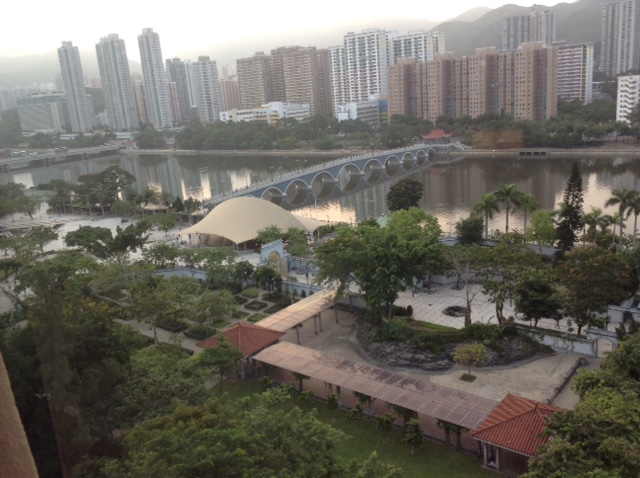
The view from my window in Hong Kong.

So much for being “retired” and having more time to blog. One post in seven months? Pathetic. I can only plead the press of work and New York life. But now I’m back where this blog started five and a half years ago – China – and it looks as if I’ll have plenty of time and material.

For fall semester, starting this week, I’m teaching at Jinan University in Guangzhou (which you may recognize by its old name, Canton), in South China, just up the Pearl River from Hong Kong. When I’ve said “Jinan University” to Chinese, this has been the reaction: “You’re going to teach at Jinan University?” It seems to have a reputation as a very good, and very tough, school. When my best student from Hunan five years ago stayed with me recently after a year teaching Chinese in Pennsylvania, not so far from where I grew up, she confessed that she had been afraid to apply to Jinan. (And this from a young woman who would, as we say in New York, make it anywhere.) Why? “They say it’s hard to get into and easy to get out of” – meaning to flunk out.

I hadn’t meant to come back to China. As anyone who followed this blog in its early days knows, my time in Hunan was challenging, to say the least – as I described it later, “an amazing experience that I’m in no hurry to repeat.” (To refresh your memory, go to the monthly archive on the righthand side of this page and scroll to February through July 2010.) But almost two years ago now, Judy Watson, then associate dean of the CUNY Graduate School of Journalism, circulated e-mail from a professor at Jinan. She was seeking visiting lecturers for a new international journalism program, a joint project of Jinan’s International School and its journalism department, to be taught in English. “Anyone interested?” Judy asked. No! I thought – and then, to my surprise, yes. I realized this was exactly this kind of thing I should be doing as I advance my plot to achieve world domination of English for the media.

So here I am, ensconced in the Foreign Experts Residence on Jinan’s campus (which on first impression makes me feel I’ve landed at an Asian twin of Columbia. More on that another time.) Last Tuesday I flew from Newark to Hong Kong, 16 hours nonstop (but in first class). There I checked into a fine hotel with lavish breakfast buffets and an indoor-outdoor pool to sleep off the jet lag and see a bit of Hong Kong, where I had not set foot since 1985. (The jet lag persists; I’m writing at 5 a.m., having been awake since 1:30 after falling asleep before 7 last night – and that after an afternoon nap.) On Saturday I took the train to Guangzhou, where I was whisked to my new apartment.

If you saw photos of my Hunan apartment, fear not. This one is far more livable, much like the apartment hotel I favor in Shanghai. I’ve spent the weekend settling in; I’ve been shown the bank, the grocery store, the restaurant next door (which seems shy about serving foreigners). I’ve been told there’s a mall across from the campus gate but failed to find it in a monsoon. I did find McDonald’s. Outside my window are two swimming pools. Never mind the medical exam or the residence permit; what I need is a pool card (which I can’t get until I pass the medical exam).

And the Internet. I’m just back online after my first experience with the Great Firewall, so please be patient. A VPN seems to have solved the problem but even so I may able to communicate only spasmodically, as we used to say at The Boston Globe. Gmail seems to be working now, but you might also try my CUNY address, diane.nottle@journalism.cuny.edu.

Four hours to my first class.