Sister Diane Ignatius Explains It All for You

                Sometimes I feel as if I’m starring in my own production of a Christopher Durang play. My theater-obsessed  circle will, of course, recognize that title as a slight variation on “Sister Mary Ignatius . . .,” his 1979 play about a didactic nun who explains the basics of Catholicism to the audience, only to be confronted by former students, now grown, who were  traumatized by her teachings. In “Cultural Backgrounds of English-Speaking Nations,” the course I’m giving this month in Wroclaw,  I often find myself standing in front of the whiteboard, feeling as if I’m interpreting the entire  English-speaking world to my class in the time frame of a one-act play. (Like the protagonist of “The Actor’s Nightmare,”  another short Durang play that is often paired with “Sister Mary Ignatius,” I occasionally go up on my lines.)

                This is essentially the course I was assigned to teach in Xiangtan to a class of 30 or so undergraduates, none of them English majors; they paid a fair amount extra to take it, for the extra line on their transcripts, but seemed little disposed to work for it or actually learn anything.  “A good idea for a course,” I thought, “but the wrong audience.” I then proposed it to my university in Poland, and they jumped. Enrollment, originally to be capped at 15 students, officially reached 28, though two or three on the roster have never appeared in class.

                Those who do come are an interesting, articulate and highly intelligent mix. The kids in Xiangtan were just that – kids—who knew next to nothing about the world outside China, and sometimes their home provinces. The students in Wroclaw are adult Europeans, and well educated; many if not most are working toward a master’s degree or Ph.D. Five – four Romanians and one German — are in the Erasmus program, which draws students from all over Europe, adding  a bit of diversity at a school where my students up to now have all been Polish. They need little help with their English, and when I launch into my favorite question – “Do you know this word?” – more often than not they already do. They fill page after page in their notebooks, whereas the kids in China barely carried notebooks at all. Only the Erasmus students who opt to take the course for credit need  to do the take-home exams, but when I handed them out last week, several others asked for copies to test themselves, just for fun.

                At this writing, 6 of the 10 classes are now history. It’s time to asses the work I was actually brought here to do, between nights at the opera and trips to Warsaw for book interviews and return visits to my favorite restaurants.

                I’ve had to repackage the course in part because of a different time frame – 10 classes of two and a half hours each, as opposed to 17 of 90 minutes in Xiangtan. Once you deduct the first, introductory  class and the final wrap-up session, that leaves only eight to tell the students everything they need to know about  the United Kingdom, the U.S., Canada and Australia. And that’s really just seven, since the next-to-last class is to be devoted to language, the variations in accents and usage in the countries we cover. I’ve also reordered the course. In China I started with the United States, given that my students’ main frame of reference was American pop culture. But here, partly for historical chronology and partly because my students are Europeans, I start with the U.K. and proceed west.  (One important difference is that in Wroclaw there is technology in the classroom, and it mostly works; when a glitch occurs, it’s usually my laptop at fault. Another is that everything in the school is clean.)

                Experience suggests that this course should be retitled “Selected Topics in English-Speaking Cultures.”  There is no possible way to cover everything in the time available, so I’ve devoted classes, or parts of classes, to themes.  The second class was a whirlwind tour of the British monarchy, with an  emphasis on the human stories that shaped history, and why any of it still matters today. For me, it was a glorious evening: I got to talk about one of my favorite subjects for two hours (minus time for some film clips from “The Queen”), and nobody left the room or fell over dead! Ula remarked at the end that she didn’t know history could actually be made interesting – which I took as high praise – and on Monday she confessed that she had spent part of her weekend watching “The Tudors.”

                  Last night’s class, on the U.S. government, politics and civil rights, was a harder sell. It was originally scheduled for Friday night but seemed like hard slogging for that time slot, so I put it up to a class vote: which would they rather have on Friday, the aforementioned, or a reading and discussion titled “Why Do Americans Act That Way?” followed by an arts centered DVD? The vote was unanimous: the fun stuff on Friday. Attendance that night quite good – 15 – but, for the government class that followed on Monday, only six, with two lost at the break. To be fair, the five Erasmus students were on a field trip. They will take their medicine – I mean, have a catch-up session – on Friday afternoon. Anyone else who missed Monday will be invited to join us, but I have a feeling they’ll have previous commitments (their jobs, for example).

                And who can blame them? The topic was scary (not to mention potentially boring), the execution exhausting, for them if not for me.  The first half started with an amendment-by-amendment analysis of how the values expressed in the Bill of Rights play into the collective American psyche we had discussed on Friday. Next came a bare-bones explanation of the three branches of government with their checks and balances – child’s play for anyone with a basic mastery of junior-high civics, let alone a political science degree like the one sitting in my armoire at home.  I followed with a quick rundown on the coming midterm elections, on the grounds that they may make the news here, and the nasty state of current political discourse, driven by the extreme, and extremely vocal, right wing. For listening practice, I played a Times Book Review podcast featuring Kate Zernicke, author of a recent book on the Tea Party movement, that let them experience a New Yorker talking like an authentic New Yorker —  fast, loud, covering about  a million ideas in eight New York minutes – instead of one using her “teacher voice.” After the break, I covered race, the northern migration and the civil rights era in 40 minutes flat. 

                “Are your brains fried?” I asked at the end.

                “The first half was awful,” Ula said.

                It was indeed a lot to take in – and how much better would most Americans do if subjected to two and a half hours of Polish political history and government? No doubt the jazz musician in class would prefer to hear about the current state of his art form in America, and others would prefer to talk about pop culture — which is, after all, what rules the world. Yet, given the impact of U.S. government policies on the lives of people all over the world, this material is so important. In an ideal world, I would not have to make such tough choices about what topics to present in class; the class would go on meeting into infinity, until we had covered everything everyone wanted to talk about.  But this is a three-week, 10-session course.

                I can only hope my choices and performance are not driving people away. I’ve spent enough time in the classroom, as both student and teacher, to know there is always attrition when you’re teaching adults who choose to take a course, rather than undergraduates who have to. People may sign up expecting one thing from their own interpretations of the course description, then find the reality to be something entirely different. Or life gets in the way. When I taught the advanced English class here last summer, paranoia set in as attendance dropped, mostly without explanation, from 14 the first day to 8 by then end of the second week, then to 6 and finally 4 on the last day. I expressed concern to Agnieszka, our administrator, that the students were dissatisfied, but she said the course evaluations looked fine. It was the end of summer vacation season, she told me, and people wanted to get away while they could. Given how enthusiastically I was welcomed back this fall, I have to believe she was sincere. Beside, these students have jobs, from which they arrive in class after a full day’s work; families, from whom they take time out to come; and probably other commitments I know nothing about. Being adults, and paying customers, they have a right to pick and choose when the topics interest them and when they can put their time to better use.

                “Where’ve you been?” I greeted Rafal, a repeat student and one of my all-time favorites, when he appeared in class last week after missing two in a row.

                He sighed. “Work.”

                “It’s OK. I know you want to be here.” (Last year Rafal, a doctoral candidate, called the office in March to ask if I’d be teaching that August, only to have to drop out at the last minute because of time pressures.)  “Come when you can.”

                I extend the same invitation to everyone in the class, as well as any past student who’d like to sit in. Come when you can, and when you want to learn the things I can teach you. When you do, I’ll be there, to explain it all for you.
Balkon 2, rzad 1, miejsce 6

                I broke the news to Agnieszka, the administrator of our English program, as we were leaving the Opera House the other night: “I’m afraid won’t be able to come in the summertime anymore.”

                “Oh . . .” She looked disappointed. “No?”

                “From now on, I’m coming only in opera season.”

                This fourth trip to Wroclaw is my first not in summer, and it’s a little like stepping  into an alternative universe. The teachers who have come here for the New School practicum know the city as mostly sunny, often quite hot and fairly deserted. It’s especially quiet in the evenings, when there’s rarely much to do (not that most of us have the energy after a three-hour class five days a week) but sit at a café and have dinner, which is hardly cause for complaint. In the fall, the air is crisp and cools down  several weeks before New York; students cluster in our hallways and on the streets; and theater is back in season. None could possibly offer a better mix of Old World charm and up-to-the-minute staging than the Wroclaw Opera.

                My October visit happens to coincide with a two-week Festival of Contemporary Opera. It’s been an opera-heavy trip: before arriving in Wroclaw, I had already seen a dark “Pelleas et Melisande” at the Deutsche Oper in Berlin and the Stuttgart Opera’s ultracontemporary “Luisa Miller.” And that doesn’t even count the day I curled up in bed with a cold to watch a 1966 production, in black-and-white, of “The Bartered Bride” from the National Theater in Prague on ZDF Theaterkanal, Germany’ all-theater TV channel. (Stop for a moment and think about that: a dedicated theater channel. Nice to be in a country with its priorities in order. Had I been able to stay in again the next afternoon, you’d be reading  a blog item contrasting the Stuttgart Ballet’s very traditional and romantic “Romeo and Juliet” with a production of the play on the theater channel, populated by authentically annoying teenagers with braces on their teeth and pigtails in their hair. But I was due at “Luisa Miller.”) When I arrived in Erfurt for a couple of days’ sightseeing, I thought I might have to run straight out again when I saw my probable favorite, “Eugene Onegin,” advertised for that very night – until the hotel clerk pointed out that it was in Weimar, a train ride away.

                Thanks to Ula, who works in the English program’s office and also takes my course, I arrived in Wroclaw booked for five nights at the Opera House. Its Neoclassical exterior, built in 1841, houses a small jewel box of a theater, dripping with meticulously restored ornamentation. It seats only 500 or so on a shallow parterre and four horseshoe balconies just two or three rows deep. Sightlines are not always the best; the aisle seat on the second-balcony curve that I’ll have three times cuts off a large swath of the stage. But it’s a great place to be seen.

                The first of my tickets was for “Paradise Lost,” Krzysztof Penderecki’s treatment of Milton via the libretto by Christopher Fry. Since it was sung in German with Polish surtitles, I couldn’t follow it word for word despite the synopsis in the extensive program book, which includes several essays in both Polish and English. But anyone who has a nodding acquaintance with Christianity would have no trouble with the plot.  The production had two commanding presences in Satan (Piotr Nowacki) and Milton (Maciej Tomaszewski);  an ethereal gray-robed choir split between the loges; and a troupe of dancers — good ones — to portray the nonsinging Adam and Eve (there is a singing couple as well) and Satan’s minions. The  production design was spare of props but did wonders with projections, and the theater apparently has enough fly space and hydraulics – stage level rise and fall like the three levels at Radio City – to induce  envy in at least one friend of mine who directs.

                Saturday’s offering was to be Karol Szymanowksi’s “King Roger,” but  soon after I arrived it became clear that something was up. Theatergoers were pausing at the door to read an 8-by-10 notice, and when I went to buy a program, I was given one for Giacomo Orefice’s “Chopin,” for which I had a ticket the next day. “Jutro?” I asked – “Tomorrow?”  The program-seller made a sign with one hand, to indicate “switched.” An announcement from the stage was no help – the one word I caught was “witamy,” or welcome – but after the show I found an English-speaking representative of the company. He explained that there had been a problem with one of the artists, so “King Roger” had to be postponed, and I could exchange my ticket the next day. As it turned out, “King Roger” is not scheduled until December, when I will be back in Met territory, but I managed to trade for an even more obscure Polish opera, and one far more evocative of Poland: Stanislaw Moniuszko’s “Haunted Manor,” on Oct. 26. (Roger is King of Sicily.)

                Back in New York, when I announced my plans for opera season in Poland, the actor Miller Lide — an aficionado of both opera and Chopin — told me “Chopin” the opera was such a rarity that I must see it, whatever it took. The opera, which dramatizes four scenes from Chopin’s life as he lies near death, struck me as more a curiosity than an opera per se; Orefice did not so much compose it as construct it from Chopin’s own music. Since his instrument was the piano, it was at least interesting to hear the familiar melodies  (many of which I carry around on my iTunes) orchestrated and sung, in Italian. “Chopin” is apparently not such a rarity over here: part of the composer’s bicentennial festival, it had four performances last season in Wroclaw, plus the two last weekend and several more to come. The dying Chopin was not Chopin as we know him, at least from the Delacroix portrait; the tenor Iwan Kit looked far too robust to be dying of consumption, not to mention his close-cropped graying hair. The young man identified as the Pianist, playing sometimes onstage, sometimes from the pit, was more like it. The George Sand figure , short-haired and timelessly dressed in a black tailcoat, tight black pants and strings of pearls, in a sea of ladies in pastel period  gowns, was both a credible seductress and a vocal powerhouse.  (It was not entirely clear who all the singers were, since this program listed two or three possibilities for most roles, and mine did not have the evening’s class list.)

                “The Fall of the House of Usher,” based on Poe’s story, is classic Philip Glass, which means its underlying orchestration of repeated short phrases will, after 90 minutes, leave your pulse racing as if it were “The Tell-Tale Heart” instead. This co-production with the National Opera in Warsaw is set sometimes after the 1950s; Roderick Usher is a creepy photographer, his sister Madeline his subject, and giant blow-ups of his photos play a large part in the production design, as do articles of clothing. The house does not, alas, collapse at the end.  But the opera was beautifully sung in English, though by whom is anyone’s guess, since there was no program at all that evening, nor any cast list posted.

                Despite the occasional glitches, what impresses me about opera in Wroclaw is how professionally it’s done on what must surely be a modest budget, no matter the subsidies it may receive.  I cannot think of an American city its size (700,000) that could support a full season of opera, even if it did have an opera house (and it might not even have a functioning theater).  But Europeans still take classical music seriously, and it shows in the sound of these musicians and the past week’s respectable-to-full houses.

                It’s curious that, whatever the language of the opera, my eyes are automatically drawn to the surtitles, even though I know they’ll do me no good at all. (Annie Dorfman, a Wroclaw colleague last year, joined me for “Pelleas” in Berlin. We both went in cold—she deliberately to test her comprehension,  I because I had forgotten to study. We shouldn’t have.) The titles do, however, dredge up a word of Polish here and there from my memory. It was unclear in “Usher” how a word that started with kwiat- was related to kwiat, or flower; from context, I’d think it had more to do with quiet. But then, my Polish is still a work in progess.

                I still have Strauss’s “Frau ohne Schatten” and “The Haunted Manor” to come, and maybe “Elektra” this weekend in Warsaw.  As I write, I’m listening to a Brahms string quartet streamed on WQXR.org. It occurred to me last week that in theory I could have listened to QXR’s Saturday afternoon  opera broadcast. But by the time it began, I was already in a seat on the parterre, waiting for the curtain to rise on “Chopin. “

La vie boheme, w Polsce

                At last I have achieved my artistic dream: I am a writer living in a garret.

                Most such fantasies involve garrets in Paris – think “La Boheme” — but I’d probably settle for  anywhere in Europe. This month I’m back in Wroclaw, Poland (Breslau, Germany, before World War II), to teach at the University of Lower Silesia (officially Dolnoslaska Szkola Wyzsza Edukacji, or D.S.W.) for the fourth time. Past accommodations have been a room at “the pope’s hotel,” as I irreverently call  the Jana Pawla II in the charming old-European cathedral neighborhood, Ostrow Tumski; a spare single in a suite of three shared with other teachers at the Academy of Fine Arts; and a similar suite at the Evangelical School in the park setting of Wyspa Piasek, or Sand Island, in the Odra River, which had the advantages of in-room Internet access, laundry and cats.  This fall, I’m back at the art academy, but in a far better space.

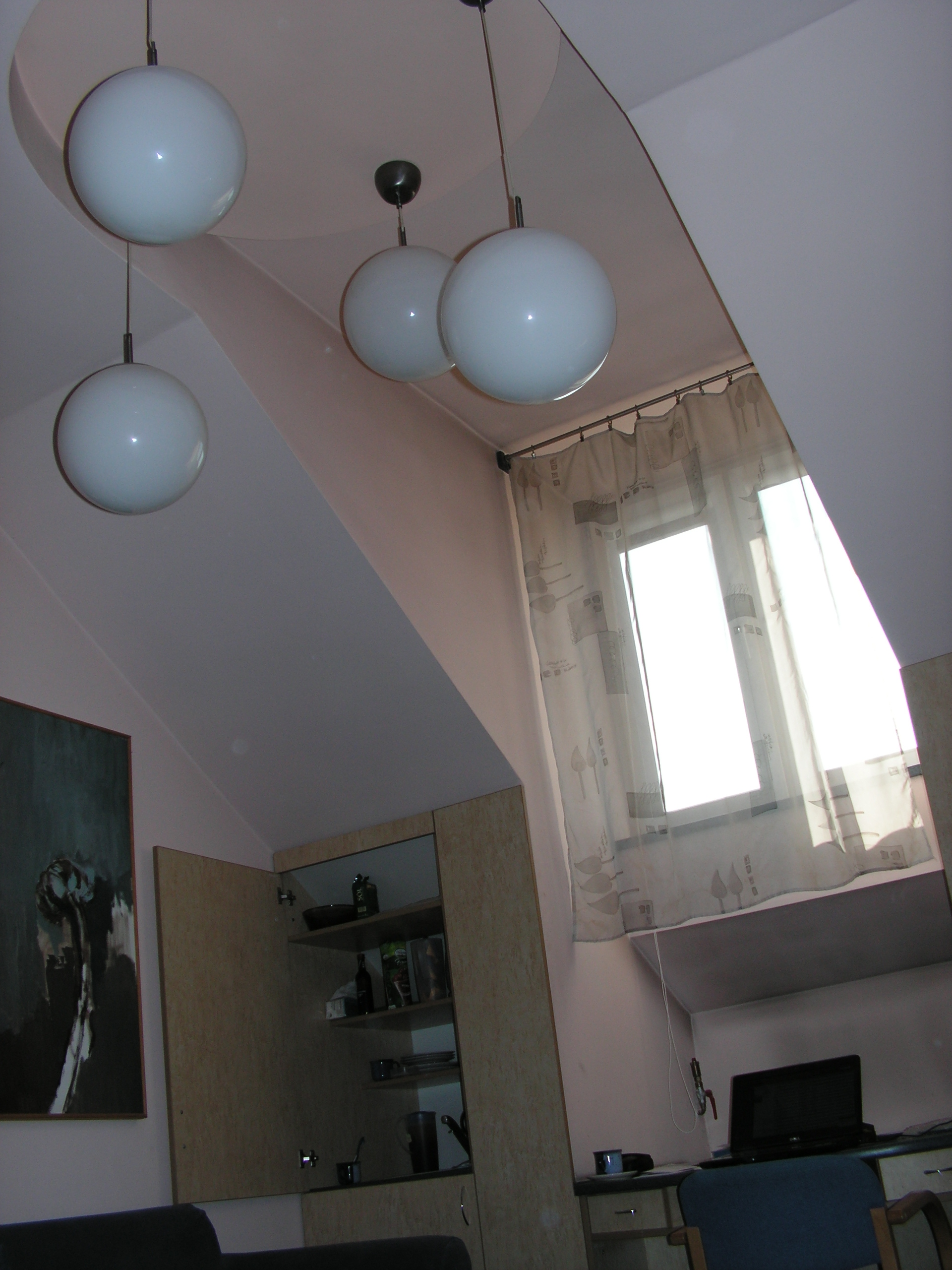
 As garrets go, this one is practical yet charming. My third-floor (fourth to Americans) room under the eaves is reached by a glass elevator from a courtyard filled with sculpture and shared by the adjacent Radisson Hotel. (I can go there for the lavish breakfast buffet and call it brunch, or have dinner after class in the cozy bar, if I want to stick close to home.) The garret has a sloping ceiling; a dormer window so high I have to stand on the desk to open and close it; and a closet door that conceals a sink, a kettle and shelves of dishes but, as last time here, no refrigerator or heating element – which gives me license to indulge in one of my favorite European pastimes, café-sitting. Under the dormer is a  spacious built-in desk, big enough for my laptop, folders, papers and the various electrical accoutrements 21st-century travel demands.  The apparently shared bathroom  has a door connecting from my room, with a key for privacy; I have not yet met anyone there, though I did see signs of a shower the first night. I haven’t yet figured out how to turn on the heat, or if I have any control over it at all, but this is Europe, so the bedding is soft and very warm. In short, my garret is nicer than three of the five hotels rooms I’ve had in the last couple of weeks.  

                What the art academy lacks in amenities like Internet, laundry and cats, it makes up in atmosphere. This is a working  art school, with all the idiosyncrasies and mess that go into making art. Those who saw my Wroclaw photos from two summers ago may remember images of dusty hallways lined with life-size sculptures (except for the mini-rhinoceros) wrapped in plastic, Christo-style,  and many are still there. Outside the elevator stand a dozen or so easels, and directly across from my room is a painting studio, with skylights facing north. This year a menagerie of life-size African animals, made of sheet metal, has been added to the sculpture garden; my favorite is the zebra, whose white stripes consist of empty space. A large abstract oil hangs above my sofa.

                Sofa! I can’t help comparing Wroclaw with Xiangtan. There I had a full one-bedroom apartment, but here I actually have a comfortable place to sit, namely the sofa, while I read or watch TV. Actually, the TV here doesn’t work much better than the one in China – just three snowy channels, in Polish – so once again I watch DVD’s on my laptop on nights when I’m not in class or at the Wroclaw Opera. (I have tickets for five — so far.)   I’m working my way through four seasons of “Dexter,” acquired at the DVD store in Changsha.

                The course that brings me here is one I taught in China, “Cultural Backgrounds of English-Speaking Nations.” It will cover much of the same ground, but differently. For one thing, the audience is different: instead of Chinese undergraduates, European adults, many of them working on their master’s degrees or doctorates, and quite fluent in English. This time I’m starting with the United Kingdom and working my way west, to the United States, Canada and Australia. It will be interesting to see how the course evolves in a country that has its own perspectives on the English-speaking world, not to mention its own experience with Communism.

                Since I teach only three days a week,  I have high hopes of spending the rest of my time working on the ballet book that, so far on this trip, has taken me to London and Stuttgart for interviews – and maybe even the remaining chapters of my long-delayed travel memoir. Sitting in my garret will be a good test of whether I can once again focus on writing after a year dominated by travel. At least, it will if I can make myself sit in my garret and write, between trips to the pool, to the opera, to the luxurious  facial salon (even nicer than Panco in Xiangtan). As any writer knows, there’s nothing we’d rather do than put off writing.  

                I’ve just realized that I don’t seem to have packed the beloved much-folded, multi-circled map I’ve used to navigate Wroclaw for the last three years. Except for the ever-shifting tram routes, I wonder after three days in town if I’ll even need it.

                But now, off to that café.

West End, South Bank

                “What are you going to do in London?” asked the driver of the classic big black London cab who delivered me from Paddington Station to my B&B in Notting Hill.

                “Go to the theater,” I told her – yes, her. “Ah!” she answered with a knowing nod, as if to say that was nothing out of the ordinary in this city. I already had tickets to three shows and hopes of squeezing in a fourth.  For the record:

                Opening night of Stephen Sondheim’s “Passion” at the Donmar Warehouse was less of an Event than it might have been in New York, even though the Donmar would qualify as Off Broadway rather than On; there was no hooplah, no celebrities in evidence, and if the critics were there that night, they were dressed down like electron-stained wretches everywhere. Giorgio (David Thaxton) was clearly the center of this production, though he had not yet nailed his climactic moment; Elena Roger sang Fosca with a thin, light voice that soudned slightly at odds with the extreme passion at the character’s core. 

                Alan Bennett’s “Habit of Art” at the National – in which a fictional meeting between Benjamin Britten and W.H. Auden serves as the play within a play that uses its own theatricality to make broader points about artists and art – made a fine afternoon’s entertainment, especially from a second-row seat that cost 10 pounds under the sponsorship of Travelex. I am sorry, though, to have missed the first cast, which included Richard Griffiths as Auden and Frances de le Tour as the stage manager.

                I made my maiden voyage to the Menier Chocolate Factory in Southwark to see its chamber setting of “Aspects of Love,” the Andrew Lloyd Webber musical that has been my secret vice for some years now, possibly because it felt so true to life at the time of its deservedly ill-fated Broadway run in 1990.  (I do wish I’d paid more attention to the line “A love affair is not a lifetime,”  but I was too busy licking my wounds from one of my own at the time.) Overall, the show is better than it was; moving the original opening number to the first-act curtain spot is a huge  improvement, but it’s still essentially a story about bed-hopping by mostly tiresome characters. At least, having seen the Menier’s home space, I now understand its staging of “A Little Night Music” that is now playing on Broadway.

                 And yes, I did make it back from an interview in Ipswich in time for one more opening night: Michael Gambon’s in “Krapp’s Last Tape” – the best thing I saw in London, as I suspected all along it might be. It was striking how little the script calls for this master of his craft to speak onstage rather than on “tape,” but the opportunity to watch him work with his face and body is priceless.

                In my spare time, I went undercover and took the backstage tour of the Royal Opera House at Covent Garden. While in the Royal Ballet studios, I heard a page for Tamara Rojo, a dancer I probably should have arranged to interview, had I been thinking faster, for the book project that took me to London in the first place. The next week, the Stuttgart Ballet’s artistic director, Reid Anderson, told me he, too, had been in the Royal Ballet studios that very day, coaching the dancers in John Cranko’s “Onegin”; by the night it opened, I was already on my way to Stuttgart to interview him.  Small world, isn’t it?

London through the lens of time

                More and more, London is turning into a city of memory.

                That concept first took root in my mind when I played volunteer auxiliary tour guide to 10 Japanese women in Boston circa 1998.  Ten years had already passed since the nine I lived there.  Wherever I took those women, wherever I looked – every attraction, every restaurant, seemingly every street corner — I could mentally replay a significant scene from my life. A few years ago, I realized the same was becoming true of New York, where I’ve now been a native for 22 years. Last week, London joined the list.

                Except for the occasional day trip to New York in my teens and college years, London predates both those cities in my life. I made my first two forays down from Manchester in the spring of 1975 – an incredible 35 years ago – and that doesn’t even count the many times I had already encountered London  through literature. Then I was a 20-year-old college student on her study-abroad, with, she presumed, a brilliant career in journalism ahead. I return now as woman well into middle age, that career behind her and not quite so brilliant as her younger self expected.  

                It’s already been six years since my last time in London, which was the first time I felt the city had finally shaken off its postwar mentality of stoically making do and jumped into the contemporary world of gleaming glass towers by Norman Foster and breakfasts where yogurt with granola and fruit  have replaced the baked beans. (I missed the Swinging ‘60s and thus can’t speak for the zeitgeist back then.) Some things about the new London are easily recognizable, some barely at all – in the city and in me. 

                For one thing, I’m no longer willing to tackle the stairs and escalators of the Underground system with Big Blue. so I let myself be whisked to Paddintgon Station in 15 minutes on the Heathrow Express ($50 round trip, and worth every penny). I also seem to have abandoned my traditional walk: I would start at Westminster, stop to pay tribute at the statue of the suffragist Emmeline Pankhurst where she used to chain herself to the fence, stroll through the Parliament Gardens, cross Lambeth Bridge and finally head east along the South Bank directly across the Thames from the Houses of Parliament. Now that my baggage includes a mild but chronic disc problem and possibly a bone spur in one foot, it seems advisable to save my strength for a long day ahead, in this case a theatrical double-header. So I alight from the Tube at Westminster as usual but go straight over that bridge, walking east along the entertainment center that is the “new” South Bank, past the old London County Hall that now houses the aquarium, past — or to — the London Eye, the National Theater, the OXO Tower, the Tate Modern, perhaps as far as Shakespeare’s Globe Theater.  

                I still navigate using Geographia’s “Pocket Guide to London,” the tiny book I bought 35 years ago. It carves central London into a grid of small maps, each numbered and marked with the numbers of  those for adjacent areas; it requires no folding or unfolding, and therefore does the double service of being easy to handle and making me look somewhat less like a tourist.  It has accompanied me on every trip to London and even made the trip a few times without me, with people – once my brother, once an unusually reliable friend – who swore a blood oath that they would bring it back safely, and did. Notations may date back to anytime since 1975. “Strand station closed for construction” on the Underground map in the back is from either that year or 1978, I forget which, and refers to a station that, to the best of my knowledge, no longer exists, having been subsumed by Charing Cross and Embankment. There is no Jubilee Line. (A small folding Tube map dated 2004 fits neatly into the book.) The National Theater does not exist, though the nearby Royal Festival Hall does; nor does the Globe, which was reconstructed only in 1997. The Tate Modern is there, but identified merely as “power station,” which it was before it was converted into a showcase for art. The London Eye, the giant Ferris wheel visible from Trafalgar Square, was not even thought of. Never mind; I know where everything is.  

                Kings Road in Chelsea is circled, from the time I was to meet a colleague in the London bureau for lunch; was he was there for The Boston Globe in 1984, or The New York Times in 1996? I can just as easily locate hotels where I’ve stayed over the years: the Royal National near Russell Square, from my student and young-adult (read: poor) days; the very traditional No. 16 Cadogan Gardens near Sloane Square  and my poshest London lodging to date, the Pelham in South Kensington, from my employed days;  the Vicarage Gate from 2004;  and now a B&B on Pembridge Square in Notting Hill. 

                As I made my progress through the city, I could see signs of my past everywhere, even –  perhaps especially – where they no longer existed. Off Leicester Square, I passed Wyndham’s Theater, where I saw Paul Scofield’s Prospero in 1975 from a 50-pence balcony seat. Chez Solange, which made the world’s best chicken in cream sauce, has long since disappeared from Cranbourn Street; so has Cadbury’s Old Jamaica from the newsstand where I used to stock up on 10 large bars at a time. (And so has my Wedgwood shop in Piccadilly.)  At Seven Dials near the Donmar stands the theater where I saw “Jerry Springer — The Opera” six years ago, when it seemed destined for Broadway that fall and I, being the conscientious worker bee I was back then, thought I should see it to have some story ideas ready. Heading back to the Tube after the show, I looked across Charing Cross Road to see the Prince Edward Theater, where I was probably one of the first Americans to see “Evita” in 1978 and  took in a matinee of the original production of “Chess” on Thanksgiving Day 1986. 

                Dining at the Ivy that evening on my favorite menu item, a kedgeree of smoked haddock and salmon in curry sauce, I had already thought back to lunch there that same Thanksgiving Day. Then it was the old Ivy of dark wood paneling and businessmen in suits, being served roast beef and Yorkshire from a silver tray on a rolling cart, rather than the new Ivy, updated into an light-toned, airy hangout for the media set. Outside, I tried to find the exact spot where I stood to snap a picture that is in my living room today, the golden twilight photo of the Ivy and the Ambassador Theatre across the street, its marquee dominated by a giant V for “Vita and Virginia,” when my friend Lois and I were in town around 1993.  Then I headed for Monmouth Street and Dress Circle, the theatrical music-and-souvenir shop  where I’ve make a point of looking in ever since it was in Covent Garden — back in 1984, I think. That stretch between Covent Garden and Seven Dials, once a warren of vacant storefronts, is now one café and boutique after another – one of them purveying fashion in women’s, i.e. larger, sizes with prices to match — as the shopping mall  born of the old market buildings spreads to the streets beyond.  

                I can’t say I love everything about shiny new London; being American, I still want my England to look old and quaint. But I can comfortably contemplate the passage of time from the terrace at a seafood restaurant along the Thames on a sunny (yes, sunny!) late September afternoon. As I enjoyed a fine plate of fish and chips, the traditional mushy peas served neatly in a small ramekin instead of a green blob, 20 or so  teenagers – clearly a school group, the latest of many seen along  the South Bank that day — walked by, backpacks in tow. They probably think this is the real London. Well, I suppose it’s their turn.

Readers and writers

Brina’s not really gone. She’s just sneaking in a little more reading time.

That was the issue in my favorite Brina-and-David argument of all time. “We had the biggest fight,” she all but whispered into the phone, for fear he would overhear. At dinnertime the night before, they were about to go out for Thai. Brina went into the bathroom for a few minutes; she emerged to find David exploding with accusation: “You were sneaking in a little more reading time!”

Though stunned by his anger, she reacted in her usual calm manner. “David,” she reasoned, “I own the book. I don’t need to sneak in more reading time.”

I almost rolled off the sofa laughing. This was funnier than the time she called to announce, “I’m definitely divorcing David” – that time it was something about the washing machine. I’ve been using the line ever since, most recently in Germany while visiting the family of my friend Steffen Muench, who died unexpectedly in August, at 48 (Personal History, Aug. 27). Steffen’s sister-in-law was translating his eulogy for me, since I had missed the funeral, having been, naturally, on a trip elsewhere at the time. While I waited for the translation, I disappeared upstairs to, yes, sneak in a little more reading time. Later, I sneaked up once again, to read the eulogy and then to check my e-mail, where I found messages from David and their son, Joshua, that Brina had died.

In 2007 the British writer Alan Bennett published a comic novella, “The Uncommon Reader,” that posited what might happen if Queen Elizabeth II suddenly discovered books and became a voracious reader. Over the years, Brina and I had speculated many times about what Her Majesty carried in the purse that was always slung over her forearm – “even on her own boat!” I couldn’t wait to send Brina a copy of the Bennett book, especially after I read the passage in which the Queen, riding in her ceremonial horse-drawn carriage, pulled a small book out of her purse and began reading. I notated the margin: “sneaking in a little more reading time.”

And why not? Brina envisioned a Nation of Readers, so why shouldn’t the Queen of England want to be a citizen? She didn’t care so much about national boundaries. But, much as Kurt Vonnegut once wrote a novel about families defined not by DNA but by the happenstance of shared middle names, Brina thought we should recognize an international nation of people who read books, and valued them above most other things in life.

I met Brina in 1984 in a writer’s block workshop at the Cambridge Center for Adult Education. She had recently turned 50, and ever after, whenever we spoke on the phone, the picture I saw in my mind was Brina at just that age, with soft cheeks and a head of short black curls just starting to gray. She was trying to write personal essays as part of figuring out what came next in her life; I, at 29, had so little confidence in my ability to write that I was too paralyzed to finish a simple travel story. Neither of us owned a computer. We wouldn’t have seemed the likeliest candidates to develop a friendship that would continue after the group ran its course a couple of years later, but from time to time Brina would call me on the phone. Eventually something clicked.

It took me two years to figure out how her mind worked. Mine is linear in the extreme, while hers operated in a spiral pattern. A conversation would start at Point A, then wind around to points, B, C and beyond, yet it would end up back at Point A every time. Once I understood that I needed to bookmark my brain at Point A, we could have wide-ranging  conversations about anything.

Over time, we discovered we had much more in common than we might have thought. We had both been compelled to work in family businesses at an early age by domineering fathers who didn’t necessarily have our interests in mind. We were both a little ashamed of our educations – she for not having finished Barnard, I for having had to settle for less than a brand-name university. We had both wasted a lot of time and energy on disappointing boyfriends before meetings the loves of our lives. “Never marry a man whose face doesn’t light up when he sees you,” she said. I saw David’s face light up many times.

By the end of the writer’s block workshop, that story I couldn’t finish had been the lead of The Boston Globe’s Travel section, the first of many; it is the first chapter of the travel memoir on which I’ve been working these last two years. Later, Brina began to teach writing at the Cambridge Center. I took one of her courses; she took one of mine.

She published relatively little herself, but her guidance and encouragement helped dozens of writers find their own voices – most notably Dorothy J. Irving, who published her delightful memoir of her family’s life in the U.S. Foreign Service, and Thomas Anthony Donahoe, who read an essay in Brina’s class about meeting the children he fathered as a sperm donor that swiftly became a Modern Love column in The New York Times.  Perhaps Brina’s greatest contribution to American journalism was her observation that when you’re writing for a morning newspaper, “you’re writing for people who may not have had their second cup of coffee yet.” I used that line many, many times in my 20 years at The Times, and I like to think it’s still floating around the newsroom.  

She listened through the inevitable ups and downs of my newspaper career. I listened to her daily analyses of the O.J. Simpson trial and explained to her that the American Dream had less to do with freedom from fear of, say, pogroms than it did with owning real estate. “We have sort of a mother-daughter relationship,” she once told David.

“Who’s the mother and who’s the daughter?”

“Depends what day it is.”

Brina really didn’t need another daughter; she already had three of her own. She often said of Sho: “As long as she’s alive, I ain’t dead.” A few years ago I headed out to Fire Island to see Sho, who had told me how to spot her on the pier: “I look a little more like my mother every year.” She was right. Walking down a street in New York with Josh and Ian some years ago, I was struck by how Josh walked exactly like Brina, leaning slightly back, arms behind him with fingers spread out just the way she walked, and I realized he couldn’t possibly be anyone else’s son. I haven’t seen Sarah or Miriam for quite a few years now, but I suspect they, and Becky and Grace too, have a good deal of Brina in them.

She never divorced David, of course. She did call one Sunday afternoon, circa 1994, to tell me very matter-of-factly, “David almost died last night” – the softshell crab incident – and she was clearly shaken by even the idea of ever losing him. After that, she was watchful whenever he dipped into the popcorn shrimp at Border Café.

Brina was at heart a storyteller, a far better one than I will ever be. It’s her stories I’ll remember most: the ones she typed into a seemingly endless series of Macs; the ones she spoke into one tape recorder after another; the ones I heard over the phone for 26 years. Now, though, words flow from my fingers almost as easily as the stories flowing from her lips. I started writing this on a train somewhere between Berlin and Stuttgart, but not until after I had sneaked in enough time to finish the novel I was reading. Brina would understand. I just wish she had managed to sneak in a little more writing time.

Diane’s further adventures: the sequel

It seems like only yesterday that I touched down at Newark after the Great China Adventure of 2010. Actually, it was almost yesterday — well, two months ago, which feels like no time at all after nearly five months in China. On Saturday I take off again, this time for Europe and, I hope, Turkey. In the meantime, I’ve barely been home for two weeks at a stretch, having made short trips to Boston, the Berkshires, North Carolina and Washington.

For those of you who like to keep track:

Saturday: I take off for five days in London to do an interview for the ballet book I’m writing with Bonnie Robson and, of course, to pack in as much theater as possible — three shows booked so far, one slot as yet unfilled.

Sept. 24-27: Berlin and environs for the opera and the Muench family.

Sept. 27-Oct. 3: Stuttgart, to shadow the artistic director of the Stuttgart Ballet for a few days, on which I expect to base the first chapter of the book. If I have a slow day, I may run down to Strasbourg, just over an hour away on the TGV.

Oct. 3-5 (tentative): Erfurt, for a couple of days of sightseeing on Steffen’s recommendation (Aug. 2 e-mail: “Erfurt you must see! It’s a wonderful middle age city …”).

Oct. 5-28: Wroclaw, Poland, for the fourth time. This year I’ll be breaking new ground, teaching outside the New School’s summer practicum there for the first time and  introducing a new course, “Cultural Backgrounds of English-Speaking Nations,” for advanced levels. If that sounds suspiciously familiar, you’re right: it was my Friday night class in China, which I’m reshaping for a European audience. It will be my first visit to Wroclaw not in the summertime, and my first during opera season.  I’m already booked for four and in heavy negotiations for a fifth.

Oct. 28-Nov. 10: Good question. I’m still on the waiting list to join my friend Lois for a two-week tour of Turkey. If that comes to pass, I should be home Nov. 10; if not, I may still be home Nov. 10. Since I’ve thrown caution to the winds and booked my return flight from Istanbul by way of Warsaw, I’m toying with the idea of flying down there anyway and either following the tour or making up my own. Or I may do a bit more traveling in Poland or just come home early, Continental and LOT willing.

By my recent standards, this is just a very quick trip. You know where to find me.

Personal history

                On Nov. 9, 1989, I must have been watching, along with the rest of the world, as the Berlin Wall came tumbling down. “Isn’t that nice?” I probably thought, or something like that. Then I went back to my own life, which had nothing to do with the forces of history in play at that moment.

                Or so I thought. But then, how could I have known what was waiting for me on the other side of that wall? Enter die Muenchs.

                “How do you know all these people from all over the world?” I’m often asked when I mention that I’ve just come from a wedding in Serbia or a beach house in Australia. The answer is usually, “I travel.” In this case, I met Steffen Muench in early 1995 when we were both Visiting Media Fellows at the De Witt Wallace Center for Communications and Journalism at Duke University. I was visiting from The New York Times for a month, he from the NDR radio station in Neubrandenburg, north of Berlin, for six.  Sometime during my stay,  Steffen gave a party in his apartment (palatial compared to Xiangtan) at Campus Arms, where Duke housed the fellows. The occasion was a visit from his  wife, Andrea, and their son Paul, then 7 or 8. “We have another one at home,” Andrea said that night, in her careful, precise English, “but he is too little to come.” (Years later, she would tell me how leaving Johann with his grandmother saved her at Immigration, where she was questioned at length about her intentions of returning home.) On the stove was a big pot of German potato soup – the first of many.

                At Duke, Steffen tended to hang out with Piotr Wolski from Warsaw, also recently liberated from the Soviet bloc, and together, with their twin rental cars, they ventured into the American landscape and culture. They both came to my 40th birthday party, and Steffen and I explored Duke’s primate research facility, populated by lemurs from Madagascar.   After I left, they make a brief trip north, during which I invited myself along on their private tour of the United Nations. I took them to Virgil’s barbecue restaurant, where, against my advice, they both ordered the Pig-Out Platter; their Eastern European eyes popped at the variety and amount of meats on the platters, and I took home the leftovers.

                A couple of years later, I received e-mail from Steffen saying that he and Andrea wanted to come to New York; did I know of an inexpensive place to stay? “You would be most welcome to stay in my flat,” I remember writing back, and a tradition was born. Since then, they have come over nearly every year, and I’ve been a regular visitor to their home since just after 9/11. I attended Paul’s wedding two years ago and recently booked my flight to Steffen and Andrea’s 25th-anniversary party next month  at the 751-year-old castle overlooking their village in Mecklenburg-West Pomerania.

Newark Airport, 2008

                Late one night last week, I found a rather cryptic message on my voicemail: “Hallo, this is Paul, from Germany. Can you please call?” The next morning, he sounded mature and calm as he told me,  “Steffen has died.” In my shock at this entirely unexpected news, I fixated on his use of the gentler-sounding present perfect  tense – “Steffen has died,” instead of simply “died” or “is dead” — and marveled at the emotional perfection of his no doubt unconscious choice.  (Technically, present perfect refers to an action still in progress, not to one that, like death, that happens once and is over and done with, thus calling for simple past.) “I don’t know the word,” Paul apologized several times as he told me the details, and I went into English teacher mode to fill in his blanks with words like “autopsy” and “funeral.” Andrea would like to talk to me, he thought, but English might be too much for her right now.

                The thing about Steffen was, you could never be friends with just Steffen. With him came the whole mishpokhe, as another recently departed friend would say: Andrea, Paul and Johann. And his mother, Oma Else (who knows I don’t understand German but keeps speaking it to me anyway, and the scary part is, I’m starting to understand her). And Andrea’s parents, who took me to dinner when they came to New York. And Paul’s wife, Peggy. And the family’s many friends: Joerg and Marina (who bravely came to stay among the boxes in my new apartment nine days after I moved in), Ulli and Ulrike, Birgit and her son Benny, and any number of Germans who’ve never been to New York but have shared a table with me, in their homes or the Muenchs’.  In the last few days as I’ve reflected, not for the first time, on the fragility of life, I realized how much all these people from behind the Wall have enriched my life. They have lost a husband, a father, a son, a friend. I have lost a translator, a travel consultant, a tour guide, a friend. We have all lost a fine cook and a bit of a ringmaster.

                In the years since the lemur excursion, we have done an astonishing number of things together, for people who live on opposite sides of an ocean. One year I was with them to celebrate the anniversary of German reunification with a home-cooked dinner – was it the venison and dumplings that time? — and a concert.  I’ve traveled with them to places as far-flung as Berlin (where we watched the Wall come down again, this time a pile of foam blocks on the stage of the Friedrichstadtpalast, the Radio City of Berlin), Weimar and the nearby Buchenwald concentration camp, Usedom Island  (where they escorted me across the border for my first time in Poland), Boston on Fourth of July and, last year, the Florida Keys. Alaska was once discussed, Sweden was a near-miss, and not long ago I was told we would need a week for Erfurt sometime. Two years ago, they put me on a train to Berlin on the first leg of my railpass tour of Eastern Europe and were waiting on the platform three months later for my victory lap. Above all, we shared New York, where we saw Broadway shows, braved the Top of the Rock’s outdoor deck on frigid January days, ventured to the Isamu Noguchi Museum in deepest, darkest Queens and celebrated two real American Thanksgivings together, last year with all five of the under-50 Muenchs.

                It was odd that, on the day I heard that Steffen was gone, I was flying to North Carolina, where we had first met, and odder still to be staying there with my niece, knowing that the last time I was in her house, I was waiting for a vanload of Germans to pick me up for a week on the Outer Banks. In fact, this was the first time I had been in North Carolina with no member of the Muench family present. 

                I’m still going to visit next month. As usual, I have a book for Ulli; I’m not sure what to do with the DVD’s I was saving for Steffen. My fantasy is that Andrea will say the German equivalent of “What the heck — we’ve already booked the castle. Let’s have the party!” But I think not. Failing that, I’d like to walk up the cobblestone street to the castle late that afternoon and, under trees turning color in clear,  crisp  autumn air, silently give thanks for what Steffen, in his Teutonic construction, would call “the Wall-falling-down.”

                I did hear from Andrea this week, via e-mail, and explained about not being able to make it to the funeral. “When you say goodbye to Steffen for me,” I wrote, “tell him I’m sorry I can’t be there, but I have theater tickets that night — for a musical.” She answered that going to the theater and seeing a musical was “the best thing you can do to think of Steffen.”  On my way home from North Carolina, I was stopping in Washington to see Signature Theater’s new production of “Chess,” Bjorn Ulvaeus and Benny Andersson’s rock musical about a high-stakes match in the late 1980’s (“It’s the U.S. versus U.S.S.R.  . . .”). When the arrogant American player needled a reporter, “You’ve been in a Communist country for two days and you’ve lost your sense of humor?” I couldn’t  decide if Steffen would have reacted with a knowing chuckle or an outright roar, but I do know how much he’d have appreciated the line. And the defecting Soviet champion’s first-act curtain number, ”Anthem,” surely spoke for all of us:

                Let man’s petty nations tear themselves apart

                My land’s only borders lie around my heart.  

End of the chapter

     I’ve slept on the Great Wall of China. I’ve cruised the Yangtze River, all the way from Chongqing to Shanghai. And about nine hours from now, at Pudong International Airport, I come to the end of the Great China Adventure of 2010.

     For two weeks I’ve been on vacation. In Beijing my friend Heidi from New York joined me for a brief China adventure of her own – once in a lifetime for her, not necessarily for me. Under a rare blue sky and blazing sun, we walked the Forbidden City from Tiananmen to the north gate and, being who we are, went to the theater two nights in a row. The first night was a classic rip-roaring opera of the revolution, presented at the National Performing Arts Center unveiled during the 2008 Olympics, known to Westerners as the Egg, just down Changan Avenue from the Great Hall of the People. Since no program or synopsis was available in English, all I know is what I saw onstage: a cheerful heroine in khaki uniform soldiers on through the many hardships of the Long March to find happiness with the People and, not incidentally, Comrade Right. The second night brought a classic of another kind: traditional Peking opera complete with masks and costumes and, to Western ears, bizarre-sounding music dominated by percussion and vocals wails. The first piece on the program concerned a general and his devoted wife, who, after performing an extended dance for him, commits suicide to avoid being any trouble to him in the coming battle; an all-dance piece followed, in which the Monkey King defeats 18 different attackers in highly stylized movement. Coming as it did after a private tour of the Peking Opera Art Museum and National Theater’s studios and costume gallery, it was great fun, and made me feel I was re-entering my orbit.

      As for sleeping on the Great Wall: no, I’m not kidding. The China Culture Center, the expat haven in eastern Beijing that organized the Sichuan tour Pam and I took in April (Weekend in Sichuan, April 7) runs occasional overnights to the Wall at Jinshanling in Hebei province, far from the day-trippers and the T-shirt strip mall at the more accessible Badeling site. A two-hour bus ride took about a dozen of us out of the suburbs and into the mountains, where a thin gray-brown line could eventually be seen running atop the unbroken green, dotted with blocky towers. In one of those towers we would spend the night, nothing but pads and sleeping bags separating us and the hard stone of the Wall. The accommodations may not have been luxurious – the bathroom was either a bucket or a bush – but the quiet and solitude, the fact of having the Wall practically to ourselves as it snaked over the mountains into infinity, certainly was. In the morning, Heidi did the four-hour hike up and down the steep and sometimes very narrow stairways, and proudly finished well ahead of the others. I sat reading a book, and when Mr. Wong, the local man whose family had provided our dinner under the stars, walked by to check that I was all right, I flashed him the “happy” sign.

     I won’t go into detail about the Yangtze cruise here, since I have hopes of marketing that  story elsewhere. Suffice it to say that it was six days of exquisite scenery, good enough food and so much relaxation that I was too lazy to take out the laptop. It’s the rainy season, which meant that the ship carried only 67 passengers, about two-thirds of capacity, and was thus a great bargain. Most of the time the rain consisted of mist, the kind that has lent Chinese landscape painting so much atmosphere for centuries. As Heidi pointed out last night, “the sun came out on the only day it mattered,” the day we toured the Lesser Gorges of the Daning River by small and then even smaller boat. Later we explored museums in Wuhan, Chizhou and Nanjing, drooling over the jade and the porcelain in the galleries, and inevitably adding a few pieces to our own collections from their well-stocked shops.

      Here in Shanghai, the rainy season is in full force this morning. Yesterday it washed out our plans for dinner on an art museum’s rooftop terrace overlooking People’s Park, and complicated our walk through the 400-year-old Yu Garden and the maze of shops surrounding it. The Yu Garden was the first stop on my half-day wake-up tour back in February, and yesterday I was delighted to find myself seeing so many things, from details of wall carvings to entire courtyards, that I had missed the first time, through either the guide’s schedule or my jet-lagged stupor. And it seemed fitting that last night, in a lighter drizzle – Heidi carrying my Expo 2010 umbrella, I in the biker poncho that replaced my raincoat lost in Xiangtan — we strolled the Bund, where this blog began nearly five months ago. On the newly raised promenade, we walked seemingly suspended between past and future — between the golden facades of the stately 19th-century European buildings along the Bund and the flashing neon colors of the Pudong skyscrapers across the river, where there was nothing but farmland when I first stood there 25 years ago.

     We were not alone. Thousands of Chinese walked there with us, the flashes of their cameras far outnumbering the ones from Heidi’s. In the last five months, I have taught hundreds of them, had my picture taken with countless more, and begun lasting friendships with a few. And I don’t even know their real names, only the English ones they have chosen for classes and the occasional encounter with people like me.

     What I do know is what individuals they are. Those robotic-looking people, all wearing Mao suits and caps, all the women with the haircut of Honey in “Doonesbury”? They’re history, if in fact they ever even existed as Westerners perceived them. So many times this semester, I looked at my students and wondered what they’d have been like 20 years ago, or 40, in their parents’ or grandparents’ time. But had they lived then, of course, they would have been different people. 

     One night on the cruise, the in-room movie on our flat-screen TV was Zhang Yimou’s “To Live,” the chronicle of one Chinese family from the 1940’s through the Cultural Revolution and beyond. The final scene shows the protagonists – once wealthy, long impoverished and scarred by time, but alive — playing with their grandson in the late 1970’s. “He’ll travel on trains and planes,” the grandfather says as the closing credits begin rolling across the screen. “Trains and planes . . . trains and planes . . .” It’s that child’s children I’ve been teaching here, and Great-Grandpa was right. They are traveling into their future on trains and planes, on cruise ships and subways, on their own motorbikes and, when they can afford them, probably in their own cars, just like us. In a few hours, I’ll be seeing them at the airport. This time tomorrow, and for a long time to come, I’ll be seeing them in my pictures — and in my mind.

Divesting

                And just like that, it’s over.

                The four months that seemed to stretch out into infinity have passed — in fact, gone flying by ever since the midterm break. A few weeks ago, groups of students wearing  black gowns with bright yellow stripes over their jeans and sneakers were lined up on risers in front of the Eighth Teaching Building. “That’s funny,” I thought, “it’s only the 15th week. Why is graduation so early?” Then I understood about the risers: it wasn’t  commencement, but the photo shoot. Right on cue, the soon-to-be graduates tossed their mortarboards into the air and shouted as the shutter snapped. Then they descended, making room for the next class.

                “That was graduation,” Pam explained. There’s a ceremony, but “their parents don’t come” – and the picture is all those parents will see of four years of work, until the education pays off and  the kids start supporting them. Even so, they must be incredibly proud; most of these graduates are probably the first in their families, some the first to get any education to speak of. But to me it seemed rather sad. If any occasion would bring parents to campus from far-flung provinces, I thought, surely it would be graduation. OK, so my parents didn’t attend my college graduation, but then, neither did I: it was off-season, and I was already working several states away. In any case, I had none of the class identification the Chinese do.

                Soon they’ll start packing to leave campus. I did mine a few days ago. (As I write, I’m in Beijing, the Forbidden City just about a mile behind me and visible from my window when the smog lifts.) After four months, packing meant divesting. Big Blue and Little Red are as overstuffed as ever – I guess I bought more than I thought —  and I cringe to think what I’ll pay in overweight fees for three flights in the next two weeks.

                I arrived with clothes for two seasons, and many of those are not going home – not two good pairs of walking shoes, now worn and mud-encrusted beyond repair, nor a pair of rain boots I don’t like; not the heavy tights I wore under leggings during those cold, rainy early weeks; not my beloved Icelandic  wool jacket, frayed beyond redemption. (I must go back to Iceland for another one.) I’ve used up six of the seven boxes of bedtime tea I brought with me, and most of the vitamins, and the big bottles of Flex shampoo and conditioner I didn’t know I could buy here. I’ve left Pam one textbook I suspect I wouldn’t use again, and the deck chair in which I spent so much time perched above the magnolia trees, reading and occasionally napping. The little sweeper is  coming home with me and, with luck, will work there with the electrical converter my German friends leave at my place. My everyday umbrella went to Mimi;  I later bought two that make better souvenirs.

                More problematic were the little New York gifts I brought with me. I  gave out a number of New York Times lapel pins to various students, but I still have a dozen or so. Perhaps most pressing were the remaining decks of cards decorated with fireworks over the Manhattan skyline, which are relatively heavy. I had given out a few during the semester – to Emma, who arranged my Expo tickets, and to the three girls who saw me safely home from Shaoshan —  leaving me with eight or nine to dispose of. 

                One, with a postcard showing  United Nations headquarters, went to Christy, who has cleaned my apartment weekly; she recently confessed that she dreams of living in New York someday, which would explain why, of all the discarded magazines I’ve offered her, she mostly chose The New Yorker. A deck of cards seems like far too little to thank Stevie Nicks and Kenny, who have helped me so much this semester, but they seemed thrilled. “For me? Really?” said Stevie Nicks. “I love it,” Kenny responded with his shy smile. Mimi got one, too, though again, it doesn’t seem like enough. One went to Annie, who let me sit in on her “Pride and Prejudice” class —  the only Chinese teacher this semester who’s expressed any interest in getting to know the foreign teachers – and invited Pam and me to a fabulous lunch with her family on my last day in town.

                I gave one to the couple at the fruit stand when I stopped to make my last purchase, and they seemed genuinely touched. The kid at the Chinese burrito stand also got one, and lit up as he usually does when he waves as I pass.  I tried to give one to the water man, who has carried two giant jugs at a time up the four flights to my apartment many times this semester, but he declined; maybe he looked at the shape of the package and thought it was cigarettes. I meant to give one to Stephen, my Friday night date, but he drifted away, so I left it with Pam. I’d give one to the fried rice master, but he’s too intimidating (although I did get a little half-smile and nod the other day when I walked down Restaurant Row). Maybe I should have had a student take me there and tell him, “You’re the best cook in Xiangtan.”

                I missed my chance to say goodbye to other people I’ve met along the way: Maisie, the waitress at Will Long, a former English major who wants to be a tour guide, who was once too shy to speak to me but offered me discounts once she discovered I wouldn’t bite; and the lady at the backstreet fried rice place where a student first introduced me, who shouts an order for beef fried rice to the kitchen as soon as she sees me and lets me linger at lunchtime to watch Chinese soaps or sitcoms.  Even the old lady downstairs became friendlier with time, greeting me with a ni hao. When she would see me heading out with luggage, she’d ask something that I instinctively knew meant “Where are you going?” “ Shanghai,” I said at spring break. “Ah! Shanghai!” she replied brightly, and I knew I had answered correctly. Later it was Guangzhou, which she followed with what I interpreted to be “Have a good trip.”  I did not see her on the morning I left for good; if I had, I probably wouldn’t have answered “Beijing” or “Yangtze cruise,” but “Home.” In any case, it’s the end of the semester; she knows.

                The truth is, by my last day in Xiangtan I was almost as nervous about leaving there as I was about coming in the first place. Weeks ago, I was listening to William Finn’s “Elegies,” a song cycle about death and dying. As usual, Betty Buckley brought tears to my eyes with “Only One,” a song about a prickly English teacher who has been told she is dying and plans to do so without sentimentality or regrets:

If just one student learns the beauty of aesthetics,
Then that’s fine. I need only one.
Or if one student learns the wonders of poetics,
Then he’s mine, And my work here will be done.
And if one student values structure,
Learns that words can be valuable and fun.
Show me twenty students who despise the poems they have to memorize
All right, I need only one.

                My work here is done. In China I haven’t attempted anything like aesthetics or poetics – barely even lyrics from a Broadway musical. I’ve had more than 200 students, some of whom whiled away their class time talking and texting in the back of the room. But “only one”? In just one semester I’ve had far more than one: Stevie Nicks, whose confidence in speaking English grew exponentially in our time together; Mimi, who already has prospects for continuing to learn French;  Andrea, who I suspect has all the right instincts to become a journalist, if that’s what she decides she wants; Kang, who loyally came to my classes in a course he had already passed, just to keep up his English; and on and on. And in Poland I already have Ania and Rafal and Ula and who knows how many more in the future, even though I won’t be there this summer.

                In my past, there’s a long line of fine, dedicated teachers who, I think, would be astonished but pleased to see me standing at the head of a class of 30 or 40 out in Hunan, and making some headway. But today it’s time to put my feet up for a bit. They could use a rest, for I’ve spent  much of my first two days in Beijing being shown the town by Longjun and his friends. Two summers ago, Longjun was the best student in my first paid ESL teaching gig  at Columbia University, and this week he is graduating from Beijing Forestry University with a business degree. His parents won’t be coming from Anhui province, but by sheer chance his English teacher from Columbia is in town. So yesterday I was up at the crack of dawn to go to his graduation photo shoot, where I stood on the margins with the few proud parents and grandparents who could make it, snapping pictures — of the hundreds of graduates lined up in a broad arc on the risers, and of our own particular kids. Not for the first time, I was the only foreigner anywhere in sight. And probably not for the last time, I heard those words:  “Ex-cuse me! Can I take a photo with you?” “Of course,” I replied. The photographer counted down: “Yi! Er! San!” I smiled into the camera and, with my fingers, made that V sign that is ubiquitous in Chinese photos:  happy.